
“Why are you always trying to impress everyone?”
“I’m not! I’m completely different from other people.”
Whether you’re on the internet or in real life, you’ve probably seen someone use “pick-me” in a TikTok comment, dating discussion, meme, or group chat. You might have wondered what it means.
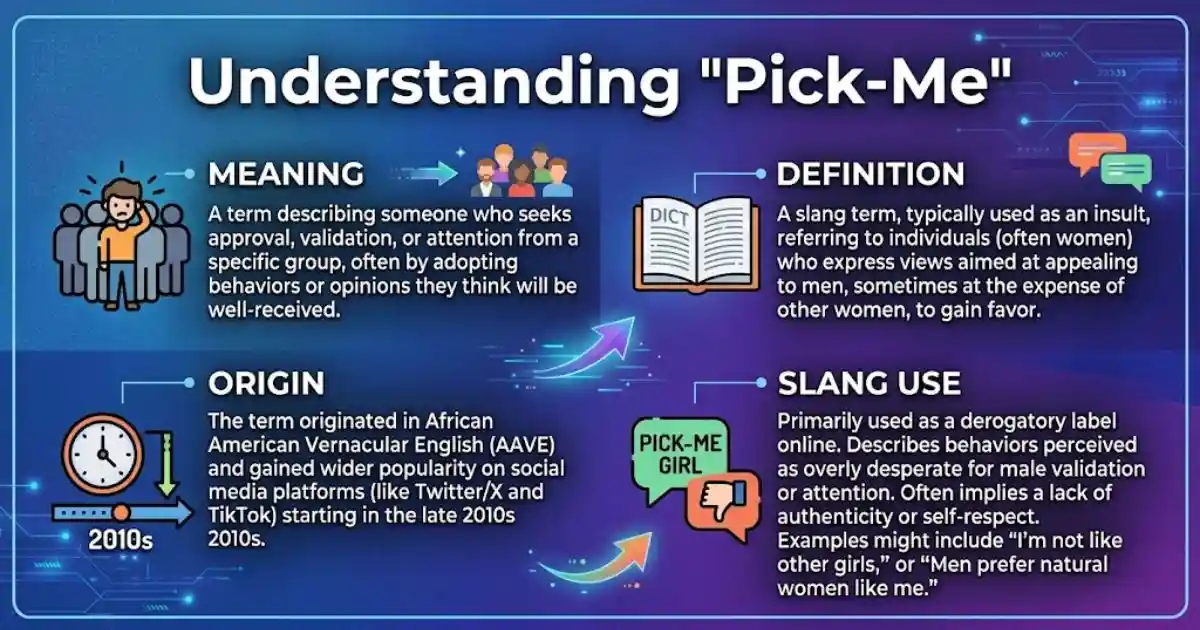
In modern colloquial language, pick-me describes someone who seems to seek attention, approval, validation, or acceptance, often by trying to appear different, special, or more desirable than others.
The term has become especially common in dating, social media, pop culture, and online conversations, where people often discuss attention-seeking behavior, relationships, gender dynamics, and social validation. But here’s the interesting part: being confident, unique, or having different preferences doesn’t automatically make you a pick-me. So, how can you tell the difference between genuine individuality and actual pick-me behavior?
In this guide, you’ll discover the pick-me meaning, examples, slang usage, cultural interpretations, similar terms, dating context, online trends, and when to use or avoid, the word.
Read Also : Salty Meaning, What It Means in Slang and Social Media!
Meaning & Definition
“Pick-me” is modern slang for someone who appears to seek attention, approval, or validation by trying to stand out as more desirable, different, or “better” than others often by putting down people in their own social group. The term is especially common on TikTok, Instagram, X, Reddit, Discord, and other social platforms.
For example, if someone says, “I’m not like other girls. I only hang out with guys because girls are too dramatic.” Another person might call that behavior pick-me.
However, being unique, confident, having different interests, or wanting attention does not automatically make someone a pick-me. The label usually refers to a repeated pattern of performative behavior or approval-seeking, particularly when someone changes how they act to gain acceptance from a desired audience.
Old and New Slang Meaning with Comparison
| Aspect | Older/Traditional Use | Modern Slang Meaning |
| Basic idea | “Pick me” could literally mean asking someone to choose you. | A person seeking attention, approval, or validation. |
| Typical context | Games, teams, classrooms, or everyday choices. | Social media, dating, friendships, and online culture. |
| Main focus | Being selected for something. | Being perceived as desirable or special. |
| Behavior | Directly asking to be chosen. | Performing certain traits to gain approval. |
| Example | “Pick me for your team.” | “She acts like she’s different from every other girl just to impress guys.” |
| Tone | Neutral. | Usually teasing, critical, or negative. |
Today, pick-me is overwhelmingly understood as an internet slang term rather than simply a request to be selected.
Pronunciation of Pick-Me
“Pick-me” is pronounced:
PICK-me
/ˈpɪk miː/
Say it like the ordinary phrase “pick me.” The slang meaning comes from the idea of wanting someone to choose or approve of you.
Breakdown
The expression contains two simple words:
- Pick = choose or select.
- Me = the speaker or person seeking attention.
Together, “pick me” suggests the idea of “choose me instead of everyone else.”
In slang, the phrase developed into a description of someone who seems to communicate, directly or indirectly, “Choose me because I’m different.”
A pick-me person may:
- Seek social validation.
- Try to appear unusually different or desirable.
- Seek approval from a particular audience.
- Compare themselves favorably with others.
- Put down peers to make themselves look better.
- Emphasize traits they believe will earn attention.
The important distinction is intent and pattern. Having unconventional interests or expressing personal preferences is not enough by itself to make someone a pick-me.
Other Meanings and Descriptions
The phrase can have different shades of meaning depending on context.
1. Attention-seeker: Someone who frequently tries to attract attention.
2. Approval-seeker: Someone who strongly wants acceptance or validation from others.
3. “Not like other people” behavior: Someone who emphasizes how different they are from a particular group.
4. Performative behavior: Someone who appears to exaggerate or display certain traits mainly to impress an audience.
5. Dating-related slang: Someone who tries to appear especially desirable to a potential romantic partner.
A common misunderstanding is that “pick-me” simply means confident, attractive, feminine, masculine, or unconventional. That’s too broad. The slang is generally about approval-seeking behavior and social comparison, not someone’s personality or appearance alone.
Read More: RN Meaning, Definition, Origin, Slang & Examples!
Meanings Across Platforms
The meaning of pick-me stays relatively consistent across social media, but the way people use it changes by platform.
| Platform | Common Meaning | Typical Example |
| TikTok | Calling out attention-seeking or performative behavior. | “That whole video feels so pick-me.” |
| Commenting on posts, captions, or behavior that appears designed to gain approval. | “This caption is giving pick-me.” | |
| X | Used in debates, jokes, criticism, and viral posts. | “Why are you trying so hard to impress them? Pick-me behavior.” |
| Often used in discussions about dating, relationships, gender, and social behavior. | “That sounds more like validation-seeking than confidence.” | |
| Discord | Casual teasing within friend groups or communities. | “Bro is being a pick-me again.” |
| Dating apps | Describes someone who appears to perform certain traits to attract matches. | “Her bio feels a little pick-me.” |
| Gaming communities | Can describe someone seeking special attention or approval from teammates or a group. | “Stop trying to be the favorite you’re acting pick-me.” |
Because internet slang spreads quickly, people sometimes use pick-me too loosely. A person having an unusual hobby, disagreeing with popular opinions, or getting along with another gender doesn’t automatically make them a pick-me.
Psychological / Emotional Meaning
From a psychological and emotional perspective, pick-me behavior is often associated in everyday conversation with validation-seeking, social comparison, insecurity, belonging, and the desire for acceptance.
That does not mean everyone called a pick-me has low self-esteem or a psychological problem. Pick-me is an informal slang label, not a clinical diagnosis.
Positive
In a positive or relatively harmless interpretation, someone may simply want to be noticed, appreciated, accepted, or included.
For example:
“Pick me for the team I know I can help.”
Here, wanting to be selected is perfectly normal.
Even in modern slang, some behavior labeled “pick-me” can come from ordinary human needs such as:
- Wanting social acceptance
- Wanting to feel valued
- Wanting romantic attention
- Wanting to belong
- Wanting recognition
- Wanting to make a good impression
The key difference is whether the person is simply expressing themselves or repeatedly performing behavior to obtain approval.
Neutral
A neutral interpretation focuses on social behavior rather than judging someone’s personality.
Someone may consciously or unconsciously emphasize certain characteristics because they believe those traits will make them more appealing to a particular audience.
For example:
“I don’t really care about parties. I’d rather stay home and play games.”
That statement alone is not pick-me behavior.
But if someone repeatedly says:
“Unlike all those boring people, I’m the only one who actually understands gaming.”
The comparison may make the behavior feel more pick-me.
Negative
The negative use of pick-me usually describes behavior that appears performative, approval-driven, competitive, or dismissive of others.
Common examples include:
- Putting down peers to gain approval.
- Constantly saying, “I’m not like everyone else.”
- Changing opinions to impress a desired audience.
- Seeking praise by criticizing others.
- Performing exaggerated helplessness or superiority for attention.
- Trying to become the “favorite” person in a group.
For example:
“I don’t need makeup like all those other girls. I’m naturally better.”
The problem isn’t simply having a preference for natural looks. The comparison and put-down of others are what can make the statement sound pick-me.
It’s also important to avoid turning pick-me into a weapon for dismissing anyone who expresses confidence or individuality. Context, repetition, and intent all matter.
Read More: Lit Meaning Definition, Origin, Slang & Examples!
Grammar and Linguistic Notes
“Pick-me” is generally used as an informal noun or adjective-like slang term.
Common forms
- a pick-me noun
“He’s acting like a pick-me.” - pick-me behavior attributive modifier
“That comment sounds like pick-me behavior.” - pick-me girl common gendered expression
“People online called her a pick-me girl.” - pick-me guy used similarly for men
“He’s being a pick-me guy in the comments.” - pick-me energy informal expression describing a perceived vibe
“That post has strong pick-me energy.” - giving pick-me social-media phrasing
“That caption is giving pick-me.”
The hyphenated spelling “pick-me” is common when the phrase functions as a slang label or modifier. In the literal phrase “pick me,” however, no hyphen is needed:
“Please pick me for your team.”
The slang also appears in expressions such as “pick-me behavior,” “pick-me attitude,” “pick-me vibes,” and “pick-me energy.”
Similar Terms & Alternatives
Several slang terms overlap with pick-me, but they are not exact synonyms.
| Term | Meaning | Difference from Pick-Me |
| Attention-seeker | Someone who wants attention. | Broader and less specific. |
| People-pleaser | Someone who prioritizes pleasing others. | Focuses on pleasing people rather than appearing desirable. |
| Try-hard | Someone perceived as trying excessively hard to succeed or impress. | More general. |
| Clout chaser | Someone seeking popularity, influence, or online attention. | Usually connected to status or internet fame. |
| Validation-seeker | Someone who strongly seeks approval or reassurance. | Focuses on emotional validation. |
| Wannabe | Someone trying to appear like something they are not. | Can involve imitation rather than approval-seeking. |
| Attention whore | Vulgar slang for someone perceived as constantly seeking attention. | Much harsher and more offensive. |
| Not like other girls/guys | Someone emphasizing their difference from their gender group. | A common form of behavior associated with “pick-me.” |
If you’re choosing the right word, ask yourself what the person is actually doing. Pick-me is most appropriate when the behavior centers on gaining approval or being chosen, especially by contrasting oneself with others.
Origin and History of Pick-Me
The modern slang term “pick-me” grew from the broader idea of wanting someone to “pick me” or choose me. It became increasingly associated with online conversations about dating, gender roles, attraction, and social validation.
The term became particularly visible in internet culture during the 2010s and early 2020s, eventually becoming widespread on social media platforms.
Timeline
| Period | Development |
| Before modern slang | “Pick me” was primarily a literal phrase meaning “choose me.” |
| 2010s | The phrase increasingly appeared in online conversations describing people seeking romantic or social approval. |
| Late 2010s | “Pick-me” became more strongly associated with gendered behavior and dating discussions. |
| Early 2020s | TikTok and other social platforms dramatically increased the term’s visibility. |
| 2020s | Pick-me, pick-me energy, and pick-me behavior became common internet expressions. |
| Today | The term is used broadly for perceived attention-seeking or approval-seeking behavior, sometimes seriously and sometimes humorously. |
The slang evolved because internet communities often create short labels for recognizable social patterns. As social media made personal behavior more visible and discussable, “pick-me” became a convenient way to describe a particular type of approval-seeking presentation.
Read More: Cheugy Meaning: Definition, Origin, Slang & Examples
Usage in Different Contexts
The safest way to understand pick-me is to look at what the person is trying to accomplish and who they are trying to impress.
Casual Chats
In everyday conversation, pick-me is usually informal and often teasing.
Examples:
- “You’re being such a pick-me right now.”
- “That was definitely pick-me behavior.”
- “Stop trying to be everyone’s favorite.”
- “She’s giving major pick-me vibes.”
Friends may use the word jokingly, so you shouldn’t automatically interpret it as a serious insult.
If someone says:
“Pick me for your team!”
That’s usually the literal meaning, not slang.
If someone says:
“He keeps agreeing with everyone just so they’ll like him. He’s such a pick-me.”
That’s the modern slang meaning.
Social Media
Social media is where pick-me appears most frequently.
You’ll often see expressions such as:
- Pick-me girl
- Pick-me guy
- Pick-me energy
- Pick-me behavior
- Giving a pick-me
- So pick-me
- Not-like-other-girls behavior
People may use the term in captions, comments, memes, reaction videos, and discussions about dating or social dynamics.
Example:
“Posting that just to get guys in the comments to compliment you is giving pick-me energy.”
However, social media labels can be exaggerated. A viral comment may call someone a pick-me based on one short clip without knowing the person’s actual personality or intentions. It’s better to treat the label as an opinion about behavior, not an objective diagnosis.
Professional Use
You should generally avoid using “pick-me” in professional communication.
The expression is informal, subjective, and potentially insulting. Calling a coworker a pick-me can create unnecessary conflict and may sound disrespectful.
Instead, describe the specific behavior:
- attention-seeking
- approval-seeking
- overly competitive
- performative
- trying to impress others
- seeking recognition
For example, instead of saying:
“She’s such a pick-me.”
A professional description would be:
“She frequently seeks approval from senior team members.”
That communicates the observation without using internet slang or making a personal judgment.
Gaming & Group Chats
In gaming communities and group chats, pick-me can be playful or insulting depending on the relationship.
Examples:
“Bro is trying so hard to become the admin’s favorite. Pick-me behavior.”
“Pick me for the squad I know the map.”
The first example uses pick-me as slang because the person is seeking special approval.
The second uses “pick me” literally, meaning “choose me.”
This distinction is especially useful in fast-moving group chats where slang and ordinary language can look identical.
Quick rule: If someone is asking to be selected for a game, team, task, or role, “pick me” is probably literal. If they’re trying to gain special approval by changing or performing their behavior, “pick-me” is probably slang.
Ultimately, “pick-me” is best understood as a social media slang term for perceived approval-seeking or attention-seeking behavior, particularly when someone tries to stand out by contrasting themselves with others. Understanding the context helps you distinguish genuine individuality from behavior that others may interpret as performative or validation-driven.
Read More : Pog Meaning: Definition, Origin, Slang & Examples!
Advantages and Disadvantages of “Pick-Me”
“Pick-me” is usually a negative slang term for someone who appears to seek attention, approval, or acceptance by trying especially hard to stand out or gain favor often by putting down people in their own social group. However, the behavior itself can sometimes come from a genuine desire to connect, so context matters.
| Advantages | Disadvantages |
| Can show confidence or individuality when genuine | May come across as attention-seeking |
| Can help someone express their personality | Can involve putting others down for validation |
| May help someone stand out socially. | Can create an impression of insecurity |
| Can encourage self-expression | Often attracts criticism online |
| May help someone connect with a particular group | Can reinforce unnecessary competition for attention |
The important distinction is authentic self-expression vs. approval-seeking behavior. Saying, “I love gaming because I genuinely enjoy it” is not automatically pick-me behavior. Saying, “I’m not like other girls; girls hate gaming, but I’m better because I play games” may be labeled pick-me because it seeks validation through comparison.
Real-Life Examples & Memes
You will often see pick-me behavior in social media posts, dating conversations, friend groups, and memes. The joke usually focuses on someone desperately trying to appear “different” or “better” to gain someone’s attention.
Example 1: Dating
“I don’t need flowers. I’m not like other girls. Just give me a burger and I’ll be happy.”
This could be completely genuine. It becomes pick-me behavior when the statement is mainly used to make other women look demanding or inferior.
Example 2: Social Media
“I don’t wear makeup because I actually like looking natural. Unlike other girls who can’t leave the house without makeup.”
The first sentence is simply a preference. The second creates a comparison, which can make the statement sound attention-seeking.
Example 3: Friend Group
“I’m the only girl here who actually understands football.”
If the person genuinely enjoys football, there is nothing wrong with saying it. The pick-me label becomes more fitting when the statement repeatedly implies that other girls are less interesting because they don’t share the same interest.
Common Pick-Me Meme Themes
Online memes often portray a fictional character who:
- Says they’re “not like other girls.”
- Pretends to dislike popular things to appear unique.
- Changes their personality around someone they want to impress.
- Constantly seeks compliments or reassurance.
- Puts down their own gender or social group.
- Says, “I’m one of the guys.”
- Emphasizes how “low-maintenance” or “different” they are.
Remember that memes exaggerate behavior for humor. Not every unconventional person is a pick-me.
Cultural or Regional Interpretations
The meaning of pick-me is broadly recognizable in English-speaking internet culture, but the behavior can look different depending on local dating norms, social expectations, and online communities.
| Region | Common Interpretation | Typical Context |
| United States & UK | Attention-seeking or approval-seeking behavior | Dating, TikTok, friendships, social media |
| India, Pakistan & Philippines | Trying to appear different or more appealing to gain approval | Dating, gender discussions, family/social circles |
| Australia | Often used casually or humorously for someone seeking validation | Friend groups, dating, social media |
United States & UK
In the US and UK, “pick-me” became strongly associated with online conversations about dating, gender, social approval, and “not like other girls” behavior.
You may see it on platforms such as TikTok, Instagram, Reddit, X, and other social communities. It can describe women seeking male approval, but the broader idea is seeking validation by presenting yourself as unusually desirable or different.
The term can also be used more loosely for anyone who appears desperate for approval.
Australia
In Australia, “pick-me” can appear in casual online conversations, especially among younger social media users. The term is often used humorously to describe someone who appears to be trying too hard to gain attention or approval.
Australian slang culture often favors playful teasing, so the word may sometimes be used less seriously than it would be in a heated online argument.
Common Mistakes & Misconceptions
One of the biggest misconceptions is that being different automatically makes someone a pick-me. It doesn’t.
Mistake 1: Thinking Every Unique Person Is a Pick-Me
Liking unusual hobbies, avoiding makeup, enjoying sports, or having mostly male friends does not automatically make you pick-me.
Mistake 2: Confusing Confidence With Pick-Me Behavior
Confidence sounds like:
“I like my style, and I’m comfortable with it.”
Pick-me behavior sounds more like:
“I’m better than everyone else because I don’t dress like them.”
The difference is often comparison and validation.
Mistake 3: Assuming “Pick-Me” Only Applies to Women
Although the term is especially common in discussions about women seeking male approval, pick-me can be used more broadly.
A person of any gender can display approval-seeking behavior.
Mistake 4: Calling Someone Pick-Me After One Comment
One unusual statement doesn’t establish a personality pattern. Look at the context, intention, repetition, and behavior before using the label.
The Vibe Behind “Pick-Me”
The vibe behind pick-me is usually attention-seeking, approval-seeking, performative, or validation-driven.
Depending on context, it can carry different emotional tones:
| Vibe | Meaning |
| Positive/Playful | Light teasing between friends |
| Neutral | Describing someone who appears to seek approval |
| Negative | Calling someone desperate, performative, or overly attention-seeking |
The word often suggests:
“Please notice me. Choose me. See me as different or better.”
That doesn’t necessarily mean the person is intentionally manipulative. Sometimes insecurity, social pressure, or a desire for acceptance can influence the behavior.
Is “Pick-Me” Offensive or Friendly?
“Pick-me” can be offensive, especially when you use it as a direct insult.
Among close friends, it can be playful:
“Girl, that was such a pick-me moment 😂.”
But in an argument, calling someone a pick-me can feel judgmental or dismissive.
When It Is Usually Fine
- Casual jokes between friends
- Discussing a social media trend
- Analyzing a fictional character
- Describing a recognizable behavior
When to Be Careful
- Professional conversations
- Serious relationship discussions
- Arguments
- Conversations with strangers
- Labeling someone’s personality without context
How to Respond to “Pick-Me”
If someone calls you pick-me, don’t automatically assume they’re right. Consider what they actually mean.
Calm Response
“What makes you say that?”
This encourages them to explain the behavior instead of turning the conversation into an argument.
Confident Response
“I just like what I like. I don’t need everyone to agree with me.”
Humorous Response
“Apparently I’m auditioning for the internet today 😂.”
If Someone Is Clearly Insulting You
“You can disagree with me without labeling me.”
The best response usually depends on tone and context. If the comment is playful, humor can work. If it is genuinely insulting, setting a boundary is better.
Differences From Similar Words
“Pick-me” overlaps with several slang terms, but each one has a slightly different focus.
| Term | Meaning | Main Focus |
| Pick-Me | Someone seeking approval by emphasizing how different or desirable they are | Validation |
| Attention-Seeker | Someone who strongly wants attention | Attention |
| Try-Hard | Someone putting excessive effort into impressing others or succeeding | Effort |
| People-Pleaser | Someone who prioritizes keeping others happy | Approval |
| Clout Chaser | Someone seeking fame, influence, or social status | Online status |
| Wannabe | Someone trying to imitate or become like someone else | Imitation |
| Not Like Other Girls | A phrase describing someone who emphasizes being different from other women | Uniqueness |
| Thirsty | Someone appearing overly eager for attention, attraction, or validation | Desire/attention |
Relevance in Dating & Online Culture
Pick-me is especially common in dating conversations and online culture because social media makes approval highly visible.
On platforms such as TikTok, Instagram, Reddit, X, and dating apps, users may compete indirectly for likes, comments, followers, romantic attention, or social validation.
In dating, pick-me behavior can include:
- Trying excessively to impress a crush.
- Pretending to enjoy everything a romantic interest likes.
- Saying you’re “better than other people” to stand out.
- Putting down potential romantic competitors.
- Acting unusually agreeable to gain someone’s approval.
- Constantly emphasizing how low-maintenance you are.
However, being accommodating or having similar interests to someone you like isn’t automatically pick-me behavior.
The key question is:
Are you expressing your genuine personality or performing a personality mainly to get chosen?
That distinction makes the slang much easier to understand.
Common Examples of “Pick-Me”
Here are some common examples you might encounter online or in everyday conversations:
- “I’m not like other girls.”
- “I only hang out with guys because girls are too much drama.”
- “I don’t need gifts. I’m way easier to please than other women.”
- “I’m the only girl here who actually understands sports.”
- “I don’t wear makeup because I don’t need attention.”
- “Other girls want fancy dates, but I’m happy sitting in the garage with you.”
- “I’m different from everyone else.”
- “I don’t care what other girls think. Guys are much easier to talk to.”
Again, these statements aren’t automatically pick-me behavior. The surrounding context and intention matter.
Popularity & Trends
The word “pick-me” became especially popular through social media discussions about dating, gender dynamics, validation, and online identity.
The phrase gained wider visibility through short-form content, memes, reaction videos, and discussions about “not like other girls” culture.
Its popularity also reflects a broader internet trend: people increasingly use short labels to describe recognizable social behaviors.
Today, you may encounter pick-me in:
- TikTok comments
- Instagram posts
- Reddit discussions
- X conversations
- Dating content
- Relationship advice
- Memes
- Pop-culture commentary
- Influencer discussions
Because slang evolves quickly, the term can sometimes be used too broadly. Its strongest meaning remains connected to seeking approval or being chosen by presenting yourself as unusually desirable, different, or superior.
When Not to Use “Pick-Me”
Avoid using “pick-me” simply because someone has different preferences from you.
Don’t use it when:
- Someone has an unconventional hobby.
- Someone prefers spending time with a particular friend group.
- Someone genuinely dislikes makeup or fashion.
- Someone has mostly friends of another gender.
- Someone expresses a different dating preference.
- Someone receives attention without asking for it.
- Someone simply disagrees with you.
You should also avoid using the term in professional settings, where clearer language such as “attention-seeking,” “approval-seeking,” “performative,” or “trying to impress others” may communicate your point more accurately.
Most importantly, don’t use pick-me as a shortcut for dismissing someone you simply dislike.
FAQs About Pick-Me Meaning
1. What does “pick-me” mean in slang?
Pick-me describes someone who appears to seek attention, approval, or acceptance by trying to seem especially desirable, different, or impressive.
2. Is “pick-me” an insult?
Usually, yes. It often carries a negative or mocking tone, although friends may use it playfully.
3. What is a pick-me girl?
A pick-me girl is a common internet phrase for a woman who appears to seek male approval by emphasizing how different or better she is compared with other women.
4. Can a man be a pick-me?
Yes. Although “pick-me girl” is more common, pick-me behavior isn’t limited to one gender.
5. Is being different from other people pick-me?
No. Individuality is not the same as pick-me behavior. The term usually involves seeking validation or making comparisons to gain approval.
6. What is a “pick-me” personality?
It generally refers to a pattern of approval-seeking, attention-seeking, performative, or validation-driven behavior.
7. Is “not like other girls” a pick-me?
It can be, especially when someone uses the phrase to gain approval by putting other girls down. The context matters.
8. What is the opposite of a pick-me?
There is no exact opposite slang term, but self-confidence, authenticity, independence, and self-acceptance describe qualities that don’t depend heavily on external validation.
9. How do you know if someone is a pick-me?
Look for repeated patterns such as seeking approval, performing a certain personality, competing for attention, or putting others down to appear more desirable.
10. Can “pick-me” be used jokingly?
Yes. Friends often use it jokingly, especially when someone is obviously trying to impress a crush. However, the term can still feel insulting depending on the relationship and tone.
Final Thoughts
“Pick-me” is modern internet slang for behavior that appears focused on getting attention, approval, validation, or being chosen often by emphasizing how different or desirable you are compared with others.
While the term is common in dating, TikTok, memes, social media, and online conversations, you should use it carefully because genuine individuality is not the same as attention-seeking.
When you understand the difference between authentic self-expression and approval-driven behavior, you’ll know when “pick-me” actually fits and when it’s simply being used as an unfair label.

Hi, I am Isabel, the Author of Skypunz.com, where I share witty puns, jokes, and fun content to brighten your day.