
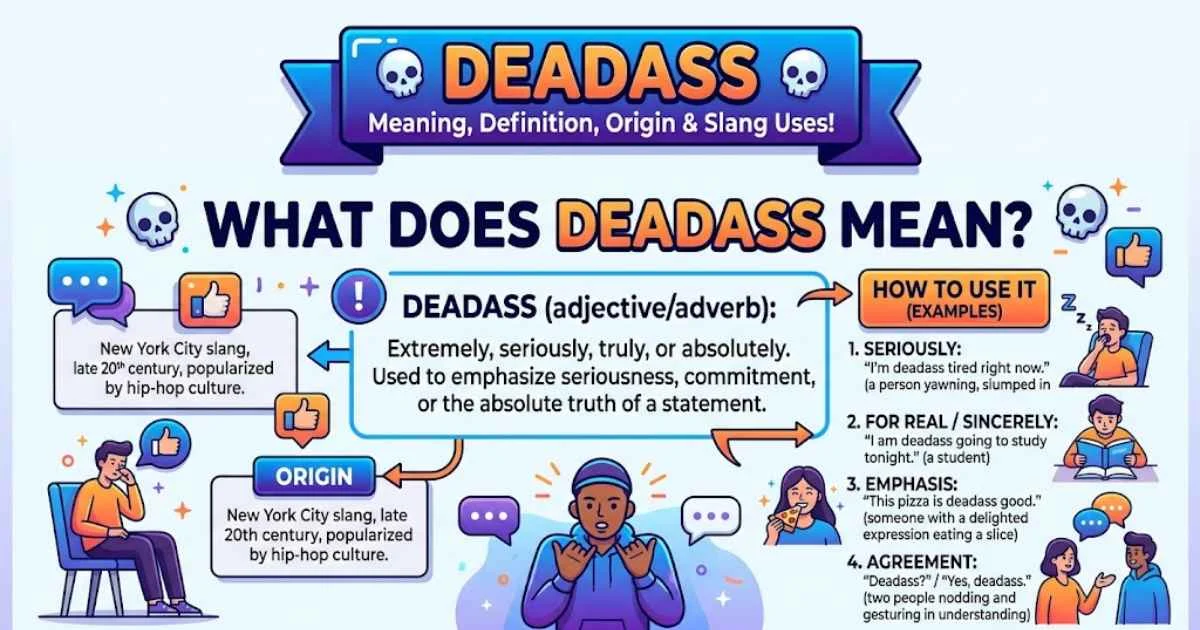
Do you really not know what “deadass” is? If you’ve seen this word in the world of internet slang, in a text, meme, TikTok comment, or group chat, you have to understand that “deadass” is a modern slang term that usually means “seriously,” “genuinely,” “honestly,” or “truly.”
You can use it to strongly express your truth, strongly agree with someone, or express surprise at what they say. From casual conversations with friends to social media, gaming chats, dating, and online communities, the word has become a recognizable part of internet language. But why does “deadass” sometimes sound funny, intense, or even confrontational depending on the situation? And when should you use it, or avoid it?
In this guide, you’ll learn what deadass means, where it comes from, how people use it, and how to understand its tone in different conversations.
Read Also : Lit Meaning Definition, Origin, Slang & Examples!
Meaning & Definition
Deadass is modern slang that means “seriously,” “for real,” “I’m not joking,” or “I’m being completely honest.” When someone says, “I’m deadass,” they want you to know that they are serious and telling the truth.
You’ll commonly see “deadass” in texting, social media posts, memes, gaming chats, and casual conversations. It can also emphasize a statement, as in:
- “Deadass, that was the best movie I’ve seen.”
- “Are you deadass right now?”
- “I’m deadass telling you the truth.”
- “Deadass? You actually won?”
The word can express seriousness, disbelief, agreement, honesty, or emphasis, depending on the context and tone.
Old and New Slang Meaning with Comparison
| Aspect | Older/Traditional Use | Modern Slang Use |
| Basic meaning | Serious or sincere | Seriously / for real |
| Common expression | “I’m serious.” | “I’m deadass.” |
| Tone | Direct and straightforward | Casual, emphatic, sometimes humorous |
| Typical setting | Spoken conversation | Texting, TikTok, X, memes, gaming, chats |
| Example | “I’m serious about this.” | “I’m deadass about this.” |
| Main purpose | Show sincerity. | Emphasize truth or seriousness. |
Today, “deadass” is primarily understood as an informal slang expression rather than a literal phrase.
Pronunciation of “Deadass”
“Deadass” is generally pronounced:
DED-ass
/ˈdɛd.æs/
It sounds like “dead” + “ass.” In casual speech, the two parts usually blend together naturally.
If you hear someone say “deadass?” with a rising tone, they may be asking, “Seriously?” or “Are you for real?”
Breakdown
The slang expression comes from the combination of “dead” and “ass.” Here, dead contributes to the idea of being completely or absolutely serious, while ass works as an intensifier.
So, in modern slang:
Deadass = completely serious + no joke + for real
For example:
“I’m deadass tired.”
This means:
“I’m seriously tired.”
Similarly:
“You deadass did that?”
means:
“Did you seriously do that?”
The phrase isn’t usually intended literally. You should interpret it as an emphasis marker based on the surrounding conversation.
Other Meanings and Descriptions
Depending on context, “deadass” can communicate several related ideas:
- Seriously—”Deadass, you need to try this.”
- For real—”Deadass, I saw him there.”
- Honestly—”Deadass, I wasn’t expecting that.”
- No joke—”That was deadass the funniest thing ever.”
- Are you serious? — “Deadass? You paid that much?”
- Strong agreement—”Deadass. That’s exactly what I was thinking.”
- Strong emphasis—”I’m deadass exhausted.”
The safest way to understand it is to look at who is speaking, what they are discussing, and the tone of the message.
Meanings Across Platforms
Deadass generally keeps the same core meaning across platforms, but the tone can change.
| Platform | Common Meaning | Example |
| TikTok | Seriously / for real | “Deadass, this trend is everywhere.” |
| Honest emphasis | “Deadass, this photo came out perfect.” | |
| X (Twitter) | Strong opinion or agreement | “Deadass, people need to relax.” |
| Seriousness or blunt agreement | “Deadass, that strategy works.” | |
| Discord | Serious statement or reaction | “Deadass? You won that round?” |
| Gaming chats | Surprise, agreement, or emphasis | “Deadass, that boss was impossible.” |
| Text messages | “For real” / “Seriously” | “You’re deadass moving tomorrow?” |
| Memes | Humor and exaggeration | “Deadass me after one hour of sleep.” |
On social platforms, “deadass” often appears alongside other informal expressions such as “fr,” “no cap,” “for real,” “literally,” and “I’m serious.”
The important point is that the platform rarely changes the basic definition. Instead, it influences the tone and emotional intensity.
Read More: Cheugy Meaning: Definition, Origin, Slang & Examples
Psychological / Emotional Meaning
Deadass often signals that the speaker wants to remove doubt from what they are saying. It can function as a conversational signal that says, “Pay attention, I genuinely mean this.”
Positive
In a positive situation, a deadass can communicate:
- Excitement
- Strong agreement
- Admiration
- Confidence
- Sincerity
- Enthusiasm
Example:
“Deadass, you did an amazing job.”
Here, the speaker is emphasizing that the compliment is genuine.
Neutral
In a neutral context, “deadass” simply reinforces a factual or personal statement.
Example:
“I’m deadass going home after work.”
The speaker is simply making it clear that they are serious about their plan.
It can also be used to confirm information:
“Deadass? The store closes at 8?”
Here, the speaker is asking for confirmation.
Negative
In a negative or confrontational context, “deadass” can express:
- Frustration
- Disbelief
- Annoyance
- Anger
- Challenge or confrontation
Example:
“You’re deadass blaming me for that?”
The phrase can make the question sound more intense.
This is why deadass is highly dependent on tone. The same word can sound friendly among friends but confrontational in another situation.
Grammar and Linguistic Notes
Deadass functions mainly as an informal slang intensifier or adverbial expression.
It can appear in several positions within a sentence:
At the beginning:
“Deadass, I forgot my keys.”
In the middle:
“I deadass forgot my keys.”
As a standalone response:
“Deadass?”
As an agreement:
“Deadass. Exactly.”
It is usually written as one word: “deadass.”
Because it is strongly associated with informal speech and internet culture, you generally shouldn’t use it in formal essays, academic writing, business reports, professional emails, or formal presentations.
Common misunderstanding
Some readers may interpret “deadass” literally because of the word “dead.” In slang, however, it normally has nothing to do with death.
For example:
“I’m deadass serious.”
does not mean anything related to being dead. It means:
“I’m extremely serious.”
Understanding the sentence as a whole helps you avoid this common mistake.
Similar Terms & Alternatives
If you want to express the same idea without using “deadass,” you have plenty of alternatives.
| Slang / Phrase | Meaning | Tone |
| For real | Seriously / genuinely | Casual |
| FR | For real | Very casual |
| No cap | I’m not lying | Slang |
| Seriously | Without joking | Neutral |
| Honestly | Truthfully | Casual/neutral |
| I’m serious. | I genuinely mean it | Neutral |
| No joke. | Completely serious | Casual |
| Legit | Genuine / true | Casual |
| Facts | Strong agreement | Internet slang |
| Real talk | Serious conversation | Casual |
| Absolutely | Strong confirmation | Neutral/formal |
| Genuinely | Sincerely / truly | Neutral |
Deadass is closest in meaning to “seriously,” “for real,” “no joke,” and “I’m being honest.”
Read More: Pog Meaning: Definition, Origin, Slang & Examples!
Origin and History of Deadass
Deadass is strongly associated with New York City slang and African American English (AAVE) and has been used in informal speech for decades. It later spread through hip-hop culture, comedy, online communities, memes, and social media.
The expression became especially recognizable to a broader internet audience as social media and texting made regional slang easier to share.
Rather than appearing suddenly as a purely internet-created term, deadass has roots in spoken urban slang that eventually became widespread online.
Timeline
| Period | Development |
| 20th century | Deadass appears in informal American slang, particularly associated with New York speech. |
| 1980s–1990s | The expression continues circulating through New York communities and popular culture. |
| 2000s | Internet forums, texting, music, and youth culture help spread the expression. |
| 2010s | Social media platforms make deadass increasingly recognizable outside its original regional context. |
| 2020s | The term has become common in TikTok, X, Instagram, Reddit, Discord, memes, and gaming culture. |
| Today | “Deadass” remains a widely recognized informal expression meaning “seriously,” “genuinely,” or “for real.” |
Its history is a good example of how regional slang can become mainstream internet language through digital communication.
Usage in Different Contexts
Casual Chats
In everyday conversations, “deadass” is usually used to emphasize that you’re being honest or serious.
Examples:
- “Deadass, I need a vacation.”
- “I’m deadass hungry.”
- “Deadass, that was hilarious.”
- “Are you deadass leaving already?”
- “Deadass, I thought you were joking.”
Among close friends, it can sound completely natural and conversational.
However, you should pay attention to your audience. Someone unfamiliar with modern slang may not immediately understand it.
Social Media
On TikTok, Instagram, X, Reddit, and meme pages, deadass is often used to make statements sound more emphatic, relatable, humorous, or authentic.
Examples:
“Deadass, Monday needs to be canceled.”
“Deadass me when someone says ‘just wake up earlier.’”
“This is deadass the best thing I’ve seen all week.”
Social media users also combine it with other slang:
“Deadass, no cap.”
This essentially doubles down on the idea of “I’m seriously telling the truth.”
Professional Use
You should generally avoid “deadass” in formal or professional communication.
Instead of:
“I’m deadass serious about the deadline.”
Use:
“I’m serious about the deadline.”
Or:
“I want to emphasize that the deadline is important.”
In casual workplace chats with friends or teammates, you might see slang occasionally. However, professional emails, reports, resumes, presentations, client communications, and academic work usually require more standard language.
Gaming & Group Chats
Gamers and online communities often use deadass to express surprise, frustration, agreement, or disbelief.
Examples:
- “Deadass, that player is cracked.”
- “You deadass missed that shot?”
- “Deadass, we almost won.”
- “I’m deadass carrying this team.”
- “Deadass? That was your final move?”
In group chats, the expression can also work as a short reaction:
Friend: “I just won $100.”
You: “Deadass?!”
Here, “deadass” means something like “Seriously?!” or “For real?!”
The meaning becomes clear from the surrounding messages, punctuation, emojis, and conversational tone.
Advantages and Disadvantages of “Deadass”
Deadass is useful when you want to emphasize that you are completely serious, honest, or not joking. Like most slang, though, its effectiveness depends on who you are talking to and the situation.
| Advantages | Disadvantages |
| Adds strong emphasis to your statement | Can sound too casual in professional settings |
| Clearly shows you’re serious | Some people may not understand the slang |
| Works naturally in texting and social media | Can sound blunt or aggressive in certain contexts |
| Makes conversations feel more casual and authentic | Overusing it can make your messages repetitive |
| Can express strong agreement or disbelief | Tone can be misunderstood without facial expressions or voice |
Example: “Deadass, that was the funniest thing I’ve ever seen.”
In casual conversations, deadass can make your message feel more direct and expressive. That leads to another question: what does it actually look like in everyday communication?
Real-Life Examples & Memes
You will commonly see deadass in texts, comments, TikTok captions, memes, gaming chats, and casual conversations. Its meaning usually becomes clear from the surrounding sentence.
Everyday Examples
- “Deadass, I forgot my keys again.”
→ I’m seriously telling you that I forgot them. - “You deadass paid $100 for that?”
→ Are you seriously saying you paid $100? - “Deadass, this is the best pizza I’ve had.”
→ I genuinely mean it. - “I’m deadass tired.”
→ I’m extremely serious about being tired. - “Deadass?”
→ Seriously? / Are you really telling the truth?
Meme-Style Example
Friend: “I can finish this entire assignment in 20 minutes.”
You: “Deadass? 💀”
Here, deadass can communicate surprise, disbelief, or a request for confirmation. The skull emoji often adds a humorous internet tone.
Because slang depends heavily on culture and audience, its meaning can also vary by region.
Cultural or Regional Interpretations
“Deadass” is strongly associated with American internet and urban slang, but its meaning is increasingly recognizable worldwide because of social media.
| Region | Common Interpretation | Typical Context |
| United States & UK | Seriously, genuinely, honestly | Texting, memes, social media |
| India, Pakistan & Philippines | Seriously, for real, genuinely | Online chats, gaming, TikTok |
| Australia | Seriously, honestly, no joke. | Casual conversations and online slang |
United States & UK
In the United States, especially in casual speech and online culture, deadass commonly means “seriously,” “for real,” or “I’m not joking.
Example:
“Deadass, you need to watch that movie.”
In the UK, people may understand the term through American social media and internet culture, although alternatives such as “seriously,” “for real,” or “no joke” may feel more natural in everyday British speech.
Asia (India, Pakistan, Philippines)
In India, Pakistan, and the Philippines, younger internet users may encounter deadass through TikTok, Instagram, YouTube, gaming communities, memes, and English-language social media.
Example:
“Deadass, that exam was impossible.”
Here, the speaker simply means:
“Seriously, that exam was really difficult.”
The slang may be understood easily online even when it is not commonly used in local everyday speech.
Australia
Australian users may understand deadass through global internet culture. However, everyday Australian slang often has its own expressions, so “deadass” may sound more like internet slang than traditional Australian vocabulary.
The important takeaway is simple: context matters more than geography when you’re interpreting deadass online.
Common Mistakes & Misconceptions
One common mistake is assuming “deadass” literally refers to being dead. In modern slang, it usually has nothing to do with death.
Common misconceptions include:
- “Deadass” means “dead.”
Not usually. In slang, it generally means “seriously” or “genuinely.” - “Deadass” always means anger.
Not necessarily. You can use it while joking, agreeing, expressing surprise, or making a serious statement. - “Deadass and dead serious are completely different.” They are very similar in many contexts.
- “You can use deadass anywhere.”
It’s informal slang, so professional emails, academic writing, and formal presentations are usually not appropriate places for it. - “Deadass always sounds rude.” The tone depends on the sentence and the relationship between the speakers.
When you see “deadass,” look at the sentence around it before deciding whether it expresses seriousness, disbelief, emphasis, or agreement.
The Vibe Behind “Deadass”
The vibe of deadass is usually direct, casual, emphatic, and confident. It tells the other person, “I really mean what I’m saying.”
Positive vibe
- “Deadass, you did an amazing job.”
- “Deadass, that’s such a good idea.”
Here, it strengthens praise or agreement.
Neutral vibe
- “Deadass, I forgot about the meeting.”
It simply emphasizes that the speaker is being honest.
Negative or intense vibe
- “You deadass did that?”
Depending on tone, this can communicate shock, frustration, disbelief, or criticism.
So, “deadass” isn’t automatically positive or negative. The surrounding words and conversational tone determine the vibe.
Is “Deadass” Offensive or Friendly?
Deadass is generally not considered inherently offensive. It is informal slang used to emphasize seriousness, honesty, or disbelief.
However, it can sound inappropriate or disrespectful if you use it in a formal environment or toward someone who dislikes slang.
Usually friendly
“Deadass, you’re hilarious.”
Potentially confrontational
“You deadass think that was okay?”
The second example may sound challenging because of the sentence structure and context—not because “deadass” itself is offensive.
For casual conversations, friends, memes, and social media, it is usually fine. For formal communication, choose a more standard phrase such as “seriously,” “genuinely,” or “honestly.”
How to Respond to “Deadass”
Your response depends on what the speaker means.
| If they say… | You can respond… |
| “Deadass, that movie was amazing.” | “For real!” |
| “You deadass did that?” | “Yeah, I actually did.” |
| “Deadass?” | “Deadass.” / “Seriously.” |
| “I’m deadass tired.” | “Same 😭” |
| “Deadass, I forgot.” | “No worries.” |
| “You’re deadass funny.” | “Haha, thanks!” |
If someone says “Deadass?” they may be asking you to confirm whether you’re serious.
A natural response is simply
“Deadass.”
That means “Yes, seriously.”
Differences From Similar Words
Several slang expressions overlap with “deadass,” but each can carry a slightly different tone.
| Term | Meaning | Tone | Example |
| Deadass | Seriously; genuinely | Strong, casual | “Deadass, I’m telling you.” |
| For real | Seriously; genuinely | Casual | “For real, that was .” |
| FR | For real | Very casual/texting | “FR, that was wild.” |
| No cap | No lie; I’m being truthful. | Casual/internet slang | “No cap, that was amazing.” |
| Seriously | In a serious or genuine way | Neutral | “Seriously, you should go.” |
| Honestly | Truthfully | Neutral/casual | “Honestly, I agree.” |
| Legit | Genuine; real; valid | Casual | “That place is legit.” |
| Actually | In fact, really | Neutral | “I actually liked it.” |
The closest alternatives are usually seriously, for real, no cap, and FR, but the exact tone can change.
Relevance in Dating & Online Culture
Deadass is common in modern dating and online conversations because it quickly communicates sincerity. When texting someone you’re interested in, it can emphasize that you’re being genuine.
Dating examples
“Deadass, I had a great time with you.”
This signals genuine interest.
“You deadass want to go on a date with me?”
This expresses surprise or asks for confirmation.
“Deadass, you look amazing.”
This adds emphasis to a compliment.
On platforms such as TikTok, Instagram, Reddit, Discord, and X, users often use deadass in captions, comments, memes, reactions, and casual discussions.
Because online communication lacks vocal tone and facial expressions, slang such as deadass can help communicate emotional emphasis, but it can still be misinterpreted.
Common Examples of “Deadass”
Here are some of the most common ways you may see deadass used:
- To show seriousness:
“Deadass, I’m not joking.” - To emphasize honesty:
“Deadass, that’s what happened.” - To express disbelief:
“You deadass said that?” - To agree strongly:
“Deadass. I completely agree.” - To emphasize an opinion:
“Deadass, this is the best game.” - As a standalone response:
“Deadass.”
→ Seriously / For real. - In online humor:
“Bro deadass thought nobody noticed 💀.” - In gaming chats:
“Deadass, that player carried the whole team.”
Once you recognize these patterns, the slang becomes much easier to understand.
Popularity & Trends
Deadass became widely recognizable through American slang, hip-hop culture, social media, memes, and internet communities. It has particularly strong associations with New York City speech and African American English, while social media has helped spread it to a much broader global audience.
Today, you may encounter deadass on platforms such as TikTok, Instagram, Reddit, Discord, X, YouTube, and gaming communities.
Its popularity comes partly from its versatility. A single word can communicate seriousness, honesty, emphasis, disbelief, agreement, or surprise, depending on context.
Internet users also combine it with other slang:
- “Deadass no cap.”
- “Deadass, bro.”
- “You deadass?”
- “I’m deadass serious.”
- “Deadass 💀.”
The expression continues to appear in informal digital communication because it is short, expressive, and easy to adapt.
When Not to Use “Deadass”
Although deadass works well in casual communication, you should avoid it when professionalism or formality matters.
Avoid it in:
- Job applications
- Professional emails
- Academic essays
- Business reports
- Formal presentations
- Legal documents
- Customer-service communication
- Formal interviews
For example, instead of:
“Deadass, I believe this strategy will work.”
Use:
“I genuinely believe this strategy will work.”
You should also avoid slang when speaking to someone who may not understand modern internet expressions. In those situations, seriously, honestly, genuinely, or for real, you may communicate your meaning more clearly.
FAQs About Deadass Meaning
1. What does “deadass” mean?
“Deadass” usually means seriously, genuinely, or honestly, or for real.
2. Is deadass slang?
Yes. Deadass is informal slang, especially associated with American English and internet culture.
3. Is “deadass” a bad word?
Not necessarily. It is generally informal rather than inherently offensive, but it may sound inappropriate in formal situations.
4. What is “deadass?” mean?
“Deadass?” usually means “Seriously?”, “For real?”, or “Are you being serious?”
5. What does “I’m deadass” mean?
It usually means “I’m completely serious” or “I’m not joking.”
6. Is “deadass” the same as “no cap”?
They can overlap. Both can emphasize truthfulness, but “deadass” more directly emphasizes seriousness or sincerity.
7. Can you say “deadass” in a text?
Yes. It is very common in text messages, DMs, group chats, and social media comments.
8. Is “deadass” used in the UK?
Yes, some UK users understand and use it, particularly through online culture, although it is more strongly associated with American slang.
9. What is another word for deadass?
Common alternatives include seriously, honestly, genuinely, for real, no cap, legit, and FR.
10. Is Deadass friendly?
It can be. The expression itself is usually neutral, while the sentence, relationship, and tone determine whether it sounds friendly, humorous, or confrontational.
Final Thoughts
“Deadass” is a modern slang expression that usually means seriously, genuinely, honestly, or for real. You’ll most often see it in texting, social media, memes, gaming chats, and casual conversations, where people use it to add emphasis or show that they are not joking.
Although it has roots in American slang and is strongly associated with New York and African American English, online culture has helped spread it globally.
The key is context: use deadass with friends and in informal spaces, but choose more professional words like seriously or genuinely when the situation calls for formal language.

Hi, I am James Whitman, the author of Skypunz.com. I create funny puns and jokes to make your day brighter and bring a smile to every reader.