
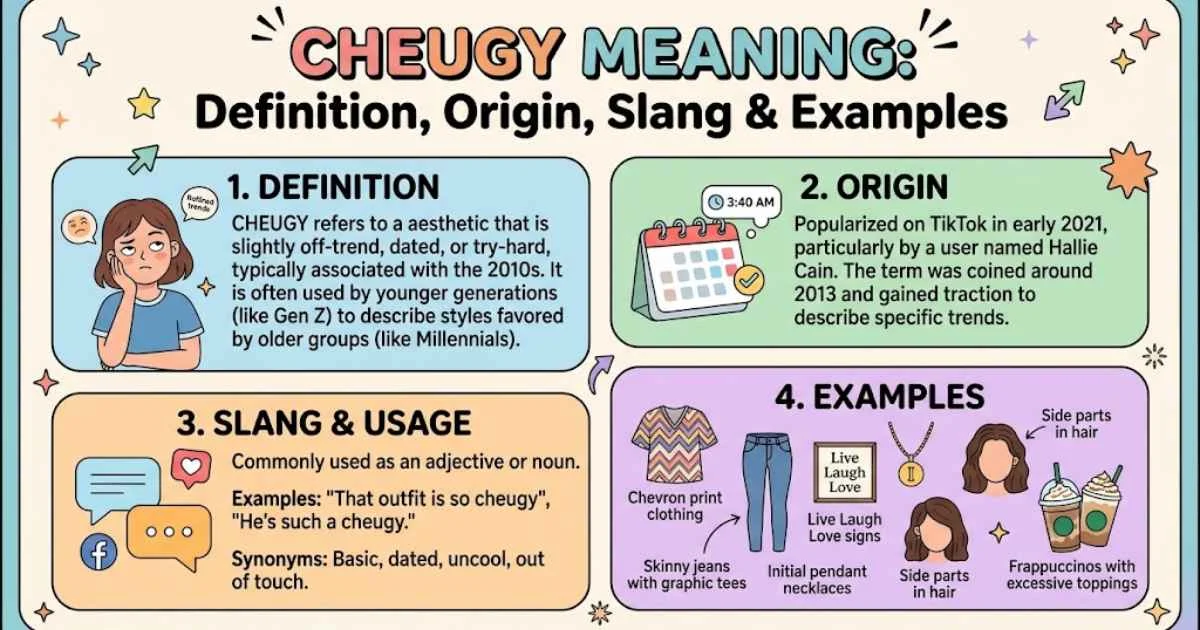
You may often wonder why people use it. “Cheugy” is an internet slang term for something that is strongly associated with ancient customs, fashion, décor, language, and lifestyle trends that are still in place today. The word doesn’t necessarily mean something is ugly or bad, it often has a playful, ironic, or nostalgic vibe.
You may have noticed that “cheugy” has been used on social media platforms such as TikTok, Instagram, Reddit, X, and other social platforms to describe everything from inspirational wall decals and infinity scarves to old social media captions and 2010s aesthetics. As internet culture continues to revive trends from the past, the term remains relevant in conversations about fashion, nostalgia, generational identity, and online aesthetics.
But where did cheugy come from, why did it become so popular, and what makes something truly cheugy instead of just retro, outdated, basic, or cringe?
In this guide, you’ll learn the meaning of “cheugy,” its origins, real-life examples, cultural interpretations, online usage, vibe, similar terms, dating relevance, current trends, and when you should and shouldn’t use this popular internet slang.
Read Also : Pog Meaning: Definition, Origin, Slang & Examples!
Meaning & Definition
Cheugy describes a style, trend, phrase, or aesthetic that was once considered fashionable but now feels dated, overly mainstream, or out of touch with current trends. You might use it for clothing, home décor, social media posts, captions, or habits that were especially popular in the 2010s but are now seen as unfashionable or nostalgic.
For example, someone might call a T-shirt with an inspirational quote, a rustic farmhouse sign saying “Live, Laugh, Love,” or an overly decorated personalized tumbler cheugy.
Importantly, “cheugy” does not always mean “bad.” The word can be playful, humorous, or affectionate. Someone may proudly embrace a cheugy style because they enjoy it.
Old and New Slang Meaning with Comparison
| Aspect | Older/Original Meaning | Modern/New Slang Meaning |
| Definition | A style associated with outdated millennial trends | Something perceived as unfashionable, basic, or behind current trends |
| Typical use | Described specific fashion or lifestyle choices | Used broadly for aesthetics, behavior, captions, décor, and internet culture |
| Tone | Mostly humorous or teasing | Playful, ironic, nostalgic, or mildly critical |
| Example | “That sweater feels cheugy.” | “Posting a motivational quote with a sunset photo is so cheugy.” |
| Cultural association | Often linked to millennial-era trends | Connected to generational style debates and changing internet aesthetics |
Pronunciation of Cheugy
Cheugy is commonly pronounced approximately as “CHOO-gee.”
The pronunciation can vary slightly depending on the speaker, but “CHOO-gee” is the most widely recognized pronunciation.
Breakdown
The word “cheugy” is internet slang rather than a traditional dictionary term with a straightforward literal translation.
Its meaning generally centers around the idea of something being:
- Outdated
- Unfashionable
- Overly mainstream
- Past its trend cycle
- Associated with older internet or fashion culture
- Trying too hard to look trendy
The term is particularly associated with aesthetics that were popular during the 2010s, including certain graphic tees, decorative signs, excessive personalization, inspirational sayings, and heavily curated social media styles.
However, calling something cheugy depends heavily on context and personal taste. A trend can become “cheugy” without actually becoming objectively bad.
Other Meanings and Descriptions
There is no completely separate everyday definition of cheugy, but people use it in several related ways.
You may see it describing:
- Fashion: Side parts, graphic tees, certain boot styles, or heavily coordinated outfits.
- Home décor: Farmhouse signs, excessive rustic decoration, or inspirational wall art.
- Social media: Filter-heavy photos, cliché captions, or highly curated posts.
- Language: Overused motivational phrases or dated internet expressions.
- Lifestyle: Habits associated with a previous generation’s idea of being trendy.
- Nostalgia: Something intentionally embraced because it reminds you of a particular era.
Meanings Across Platforms
The meaning of cheugy stays relatively consistent across social platforms, but the examples change depending on the community.
On TikTok, the word often appears in videos identifying supposedly outdated fashion, décor, hairstyles, or millennial habits. Creators may use it humorously to compare millennial aesthetics with Gen Z trends.
Instagram, cheugy can describe older photo styles, inspirational captions, excessive filters, or certain fashion choices.
X, the term may appear in jokes, cultural commentary, and discussions about changing generational preferences.
Reddit, users may discuss whether a particular trend is genuinely outdated or simply being labeled cheugy because online aesthetics have changed.
In group chats, you might see something as simple as:
“That quote on your wall is so cheugy 😂”
The statement is often teasing rather than genuinely insulting.
How to identify the meaning
Look at what is being discussed:
- Fashion + old trend → likely means outdated style.
- Décor + inspirational signs → probably refers to millennial-era aesthetics.
- Social media + captions → usually means cliché or dated online behavior.
- Friends joking around → often playful teasing.
- Serious cultural discussion → may refer to generational differences in taste.
So, when you encounter cheugy online, focus on the surrounding conversation rather than interpreting it as a simple synonym for “ugly.”
Psychological / Emotional Meaning
Calling something cheugy can communicate more than an opinion about appearance. It can reveal how people emotionally respond to changing trends, nostalgia, identity, and generational culture.
Positive
In a positive context, “cheugy” can represent nostalgia, confidence, humor, and self-acceptance.
Someone might knowingly embrace a trend because they genuinely like it.
For example:
“Yes, my farmhouse décor is cheugy, and I love it.”
Here, the speaker isn’t embarrassed. They are using the label humorously while showing confidence in their personal taste.
Neutral
A neutral use simply identifies something as belonging to an older trend cycle.
For example:
“That style is considered cheugy now.”
The speaker isn’t necessarily criticizing it. They’re simply pointing out that cultural preferences have changed.
Negative
In a negative context, “cheugy” can imply that someone appears out of touch, overly basic, or stuck in an earlier trend era.
For example:
“That caption feels a little cheugy.”
This can suggest that the caption seems cliché or outdated.
Because the word can carry judgment, you should consider your relationship with the person before using it directly about them.
Grammar and Linguistic Notes
Cheugy functions primarily as an adjective.
Common patterns
- That outfit is cheugy.
- This décor looks cheugy.
- Those captions are so cheugy.
- She has a slightly cheugy aesthetic.
You can also use related informal forms such as cheuginess when discussing the quality or characteristic of being cheugy.
Grammar tips
Because cheugy is slang, there is no need to capitalize it in ordinary sentences.
Correct:
“That style looks cheugy.”
Less natural:
“That style looks Cheugy.”
You can use “very,” “so,” “extremely,” or “a little” before it:
- Very cheugy
- So cheugy
- Extremely cheugy
- A little cheugy
The word is generally informal and works best in casual conversation, social media, entertainment, and cultural commentary rather than formal business writing.
Similar Terms & Alternatives
Several words overlap with “cheugy,” but they are not perfect substitutes.
| Term | Meaning | Difference From Cheugy |
| Outdated | No longer modern or current | Broader and more neutral |
| Dated | Associated with an earlier period | Often similar but less internet-specific |
| Basic | Common, predictable, or mainstream | Can describe personality or taste, not just old trends |
| Cringe | Embarrassing or uncomfortable | Focuses more on emotional reaction |
| Unfashionable | Not currently stylish | More formal and direct |
| Old-school | Associated with an earlier era | Can be positive and nostalgic |
| Nostalgic | Evokes memories of the past | Usually positive rather than critical |
| Out of touch | Not aware of current attitudes or trends | Can describe a person rather than an aesthetic |
The closest everyday alternatives are dated, outdated, basic, and sometimes cringe, depending on the context.
Origin and History of Cheugy
Cheugy originated as internet slang among younger users and became widely known in the early 2020s. The term is strongly associated with discussions about millennial culture, especially styles and habits that were popular during the 2010s.
The word gained major attention after social media users began using it to categorize millennial fashion, home décor, social media behavior, and lifestyle aesthetics that Gen Z viewed as outdated.
One important point is that “cheugy” did not suddenly mean “anything millennials like.” Its use developed around specific aesthetics and trend patterns. Over time, people began applying it more broadly and often ironically.
Timeline
| Period | Development |
| Early 2010s | Certain millennial fashion, décor, and social media aesthetics become mainstream. |
| Mid-2010s | Inspirational quotes, personalized items, farmhouse décor, graphic tops, and curated social posts become highly recognizable trends. |
| Late 2010s | Younger internet users begin moving toward different aesthetics and style preferences. |
| Early 2020s | Cheugy has become widely discussed on TikTok and other social platforms. |
| 2021 onward | The term enters mainstream internet vocabulary and becomes part of conversations about Gen Z vs. millennial culture. |
| Today | People use “cheugy” both critically and affectionately to describe dated, nostalgic, or intentionally retro trends. |
The history of the term helps explain why its meaning is closely connected to generational identity and internet culture.
Usage in Different Contexts
Casual Chats
In everyday conversations, Cheugy is usually playful.
You might say:
“Your ‘Live, Laugh, Love’ sign is officially cheugy.”
Or:
“I know this outfit is cheugy, but I still love it.”
Among friends, the term often functions as a humorous way to point out an outdated trend without making a serious criticism.
Social Media
Social media is where Cheugy became especially recognizable.
You may see it used in:
- TikTok trend videos
- Instagram captions
- Fashion discussions
- Meme pages
- Pinterest-style décor discussions
- Gen Z and millennial culture debates
- Before-and-after style comparisons
A creator might post:
“Things we thought were stylish in 2015 but are cheugy now.”
The humor usually comes from recognizing how quickly internet aesthetics and fashion trends change.
Professional Use
You should use “cheugy” carefully in professional settings.
It can work in:
- Marketing discussions
- Fashion writing
- Social media strategy
- Cultural commentary
- Trend reports
- Advertising aimed at younger audiences
For example:
“The brand’s visual identity may feel cheugy to younger consumers.”
However, avoid using it casually to insult a coworker’s appearance, presentation, or personal style. In a workplace, terms such as “dated,” “traditional,” or “less aligned with current trends” may communicate the idea more professionally.
Gaming & Group Chats
Cheugy isn’t primarily gaming slang, but gamers may use it in Discord servers, group chats, or gaming communities when discussing someone’s style, profile, memes, or references.
Examples:
“That gamer tag is kinda cheugy.”
“Bro is using a 2016 meme. That’s cheugy 😂”
“This Discord emoji pack feels so cheugy.”
In these environments, the word is usually informal, humorous, and context-dependent.
The safest interpretation is simple: if someone calls something cheugy, they usually mean it feels dated, overly mainstream, or associated with an older trend—but often in a playful or nostalgic way.
Advantages and Disadvantages
“Cheugy” is an internet slang term used to describe something that feels dated, overly trendy, or associated with a particular millennial aesthetic. It can be funny and self-aware, but it can also sound judgmental when you use it to criticize someone’s personal style.
| Advantages | Disadvantages |
| Helps describe a specific millennial aesthetic quickly | Can sound mocking or dismissive |
| Often used humorously online | The meaning can be subjective |
| Creates relatable internet culture jokes | Trends change, so something labeled cheugy today may return later |
| Makes it easier to discuss outdated trends | Can reinforce age-based stereotypes |
| Encourages self-aware humor | Some people may take the label personally |
| Commonly understood on social media | Not appropriate for every professional or serious conversation |
The biggest advantage is that “cheugy” gives you a short, recognizable way to describe nostalgic trends. The downside is that the word can easily shift from playful humor to unnecessary criticism. That distinction becomes clearer when you look at real-life examples and memes.
Real-Life Examples & Memes
You will usually see cheugy used online to describe fashion, home décor, social media captions, accessories, or phrases associated with 2010s millennial culture.
Common examples include:
- A “Live, Laugh, Love” wall sign
- Chevron-patterned clothing or home décor
- Personalized wine glasses
- Graphic T-shirts with inspirational quotes
- Heavy use of “girlboss” language
- Monogrammed accessories
- Infinity scarves
- Rustic farmhouse décor
- Elaborate wedding hashtags
- Tumblr-style inspirational quotes
- Certain overly staged Instagram photos
- Old-school Facebook-style captions
For example:
“My mom has three Live, Laugh, Love signs, a chevron blanket, and matching wine glasses. The living room is officially cheugy.”
Memes often exaggerate these characteristics for comedic effect. A typical cheugy meme might show a highly decorated farmhouse kitchen alongside a caption such as, “If your kitchen has a sign telling people to gather, you’re probably cheugy.”
The humor usually comes from recognition and nostalgia, rather than from a serious attempt to insult someone. In fact, many people proudly call their own style cheugy because they enjoy the nostalgia.
That playful self-awareness is a major part of the word’s appeal.
Cultural or Regional Interpretations
Although cheugy originated in US internet culture, people in other English-speaking communities may use it differently depending on local trends and familiarity with American social media.
| Region | Typical Interpretation | Common Context |
| United States & UK | Dated or overly millennial | Fashion, décor, Instagram, lifestyle |
| India, Pakistan & Philippines | Often understood as an outdated or overly trendy aesthetic | TikTok, Instagram, fashion, memes |
| Australia | Similar meaning, often applied humorously to dated trends | Fashion, home décor, social media |
United States & UK
In the United States and UK, cheugy is most closely connected with millennial-era fashion, décor, and lifestyle trends. You might hear it when someone jokes about old Instagram aesthetics, inspirational signs, or clothing that was especially popular in the 2010s.
For example:
“Those giant quote signs are so cheugy.”
The term is usually informal and works best in casual conversations, social media posts, and memes.
Australia
In Australia, cheugy can be used similarly to its American meaning: something that feels outdated, overly trendy, or stuck in a previous era of internet culture.
However, Australian users may apply the term to their own local fashion, décor, or social-media trends rather than copying the exact American examples.
Common Mistakes & Misconceptions
One common mistake is assuming that “cheugy” simply means “ugly.” It does not.
Cheugy is more about something feeling dated, overly associated with a past trend, or stereotypically millennial than being objectively unattractive.
Common misconceptions include:
1. “Cheugy” means old.
Not necessarily. Something can be relatively new but still feel cheugy because of its aesthetic or association with an outdated trend.
2. Cheugy only describes clothing.
No. You can use it for fashion, home décor, captions, accessories, phrases, social media behavior, and lifestyle aesthetics.
3. All millennials are cheugy.
Definitely not. The term describes certain trends, not an entire generation.
4. Cheugy is always an insult.
Not necessarily. Many people use it ironically or affectionately to laugh at trends they once enjoyed.
5. Cheugy has one exact definition.
Internet slang changes quickly. Its meaning depends heavily on context, platform, and speaker.
Understanding these differences helps you recognize whether someone is making a harmless joke or genuinely criticizing a person’s style.
The Vibe Behind
The vibe behind Cheugy is usually playful, nostalgic, ironic, and slightly teasing.
It often carries a feeling of:
- “That was so 2015.”
- “I can’t believe we used to love this.”
- “This trend has definitely aged.”
- “It’s outdated, but I secretly still like it.”
Positive vibe
Someone might proudly call themselves cheugy because they enjoy nostalgic fashion or décor.
“I know my pumpkin-spice obsession is cheugy, but I don’t care.”
Neutral vibe
Sometimes cheugy simply describes an aesthetic without strong judgment.
“That room has a very cheugy farmhouse style.”
Negative vibe
It can become negative when someone uses the word to mock another person’s appearance, age, lifestyle, or taste.
“Everything she wears is cheugy.”
The meaning therefore depends not only on the word itself but also on tone, context, and intention.
Is It Offensive or Friendly?
Cheugy is generally informal and playful, but it can become offensive depending on how you use it.
Among friends, calling something cheugy can be a harmless joke:
“Our matching friendship bracelets are extremely cheugy.”
Online, people often use the word with self-deprecating humor. Someone may proudly describe their own style as cheugy.
However, calling a stranger’s appearance, age, body, or lifestyle cheugy can feel insulting. The word is particularly risky when it becomes a way of stereotyping millennials or older social media users.
A good rule
Use “cheugy” when you’re talking about a trend or aesthetic, rather than using it to attack a person.
Better:
“That décor style is pretty cheugy.”
More judgmental:
“You’re so cheugy.”
The first comments on a trend; the second can feel personal.
How to Respond
Your response to cheugy depends on whether the person is joking, complimenting, or criticizing.
If someone jokes that your style is cheugy:
“Honestly, I’m owning it.”
“Cheugy and proud.”
“At least I’m nostalgic.”
If you agree:
“Yeah, that trend definitely aged.”
“We really thought that was peak fashion.”
If you disagree:
“Maybe, but I still like it.”
“Call it cheugy—I think it looks good.”
If someone uses it negatively:
“You can call it cheugy, but I like my style.”
A confident response can turn the label into a joke rather than an argument. That self-aware attitude is very much in line with how the term is used online.
Differences From Similar Words
Although “cheugy” overlaps with words such as “dated,” “basic,” “cringe,” “retro,” and “outdated,” each term has a slightly different meaning.
| Word | Meaning | Difference From Cheugy |
| Cheugy | Dated or overly millennial aesthetic | Specifically linked to certain internet-era trends |
| Dated | No longer fashionable or current | Much broader and more neutral |
| Outdated | No longer modern or relevant | Can apply to ideas, technology, styles, and information |
| Cringe | Embarrassing, awkward, or uncomfortable | Focuses more on emotional reaction than age or trend |
| Basic | Conventional or mainstream | Does not necessarily mean outdated |
| Retro | Inspired by an earlier period | Usually intentional and can be fashionable |
| Old-fashioned | Traditional or associated with the past | Broader than internet slang |
| Tacky | Considered cheap, excessive, or lacking taste | More strongly judgmental than cheugy |
| Nostalgic | Evoking positive feelings about the past | Usually emotional and not necessarily negative |
For example, a vintage jacket can be retro without being cheugy. A 2014-style Instagram quote graphic might be cheugy without necessarily being ugly.
Knowing these distinctions helps you choose the right word instead of treating every old trend as cheugy.
Relevance in Dating & Online Culture
Cheugy has become especially useful in online culture because dating and social-media profiles often communicate personality through aesthetics.
On dating apps, someone might jokingly describe their profile as cheugy if it contains:
- Overly posed travel photos
- Inspirational captions
- Wine-and-sunset pictures
- Excessive use of certain millennial phrases
- Matching vacation outfits
- Highly curated lifestyle photos
For example:
“My dating profile is probably a little cheugy, but the beach photos are staying.”
In dating conversations, the word is often playful rather than serious. Someone may use it to show that they recognize their own outdated habits and can laugh at themselves.
On TikTok, Instagram, Reddit, X, and other social platforms, cheugy also functions as a way to discuss internet nostalgia. Users can look back at trends from the 2010s and compare them with today’s aesthetics.
This makes cheugy more than a fashion label—it has become part of the broader conversation about generational identity, nostalgia, social media trends, and changing aesthetics.
Common Examples of Cheugy
You can recognize cheugy more easily by looking at the types of things people commonly associate with the term.
Fashion
- Infinity scarves
- Certain graphic tees
- Statement necklaces
- Chevron patterns
- Overly coordinated outfits
- Accessories with inspirational wording
Home Décor
- “Live, Laugh, Love” signs
- Rustic farmhouse signs
- Excessive scripted wall art
- Matching decorative quotes
- Certain heavily themed décor styles
Social Media
- Overly staged Instagram posts
- Inspirational quote graphics
- Excessive hashtags
- Highly curated lifestyle captions
- Old-school Facebook-style posts
Language
- Girlboss
- Adulting
- Certain overly inspirational captions
- Corporate-meets-lifestyle buzzwords used ironically
Lifestyle
- Highly curated brunch photos
- Matching monogrammed accessories
- Trend-heavy wedding aesthetics
- Certain 2010s wellness and lifestyle trends
Remember that these examples aren’t automatically cheugy. Context matters. A farmhouse sign may be intentionally nostalgic, and someone wearing an infinity scarf may simply like it.
Popularity & Trends
Cheugy became widely known as a major internet slang term around 2021, especially after TikTok users began discussing millennial aesthetics and 2010s trends.
The term itself was coined earlier, around the early 2010s, among a group of young women who wanted a word for styles and behaviors that felt dated or overly mainstream. It later exploded into wider online culture through social media.
Its popularity reflects a larger internet trend: people increasingly create labels for recognizable aesthetic identities.
Terms such as “cheugy,” “cottagecore,” “Y2K,” “clean girl,” “coastal grandmother,” and “normcore” show how online communities categorize fashion and lifestyle trends.
Interestingly, calling something cheugy can eventually become part of the trend itself. Once people begin joking about an aesthetic, it can return as nostalgia or ironic fashion.
This creates a cycle:
Trend → Becomes mainstream → Feels outdated → Gets labeled cheugy → Becomes nostalgic → Returns ironically
That is one reason internet slang like cheugy can remain culturally interesting even after its peak popularity.
When Not to Use
You should avoid using “cheugy” when the context is formal, sensitive, or likely to make someone feel personally attacked.
Avoid it when:
- You’re speaking in a professional setting.
- You’re criticizing someone’s body or appearance.
- You’re using it to stereotype someone’s age.
- You don’t know whether the person understands internet slang.
- The conversation is serious rather than playful.
- You’re describing something that is simply old rather than specifically tied to a dated aesthetic.
- You’re using the word to shame someone’s personal choices.
Instead of saying:
“Your outfit is cheugy.”
You can say:
“That style feels very 2010s.”
That alternative is more neutral and less likely to sound insulting.
The best use of “cheugy” is usually playful, contextual, and self-aware—especially when you’re talking about trends rather than judging people.
FAQs About Cheugy Meaning
1. What does “cheugy” mean?
Cheugy describes something that feels dated, overly trendy, or associated with millennial-era aesthetics, especially 2010s fashion, décor, and internet culture.
2. How do you pronounce cheugy?
Cheugy is commonly pronounced “CHOO-gee.”
3. Is “cheugy” an insult?
It can be, but it is often used playfully or ironically. The tone and context determine whether it feels friendly or insulting.
4. Is cheugy the same as cringe?
No. Cringe describes something embarrassing or uncomfortable, while cheugy usually points to a dated aesthetic or trend.
5. What is an example of cheugy?
A classic example is a “Live, Laugh, Love” wall sign, especially when used as an example of 2010s millennial home décor.
6. Is cheugy only about millennials?
No. The term is strongly associated with millennial culture, but it can describe anyone or anything displaying an aesthetic associated with that era.
7. Can something be cheugy and fashionable?
Yes. Trends often return. Something considered cheugy can become retro, nostalgic, or intentionally fashionable later.
8. Is cheugy still used?
Yes, although its peak viral popularity has faded. You can still encounter it in social media, memes, fashion discussions, and internet-culture conversations.
9. Can I call myself cheugy?
Absolutely. Many people use the term self-deprecatingly and proudly to celebrate nostalgic styles they still enjoy.
10. Why did cheugy become popular?
It became popular because social media users found a funny way to describe recognizable 2010s millennial trends, especially as younger users began comparing them with newer aesthetics.
Final Thoughts
Cheugy is more than a label for an outdated trend, it captures the internet’s playful relationship with nostalgia, millennial culture, fashion, décor, memes, and changing aesthetics.
Whether you’re describing a Live, Laugh, Love sign, an old Instagram style, or a trend you secretly still love, the word usually works best when you use it with humor and self-awareness.
And remember: today’s cheugy trend could easily become tomorrow’s retro comeback.

Hi, I am the Admin of Skypunz.com. I handle all the fun, creative, and clever puns to make your day full of laughter and smiles!