
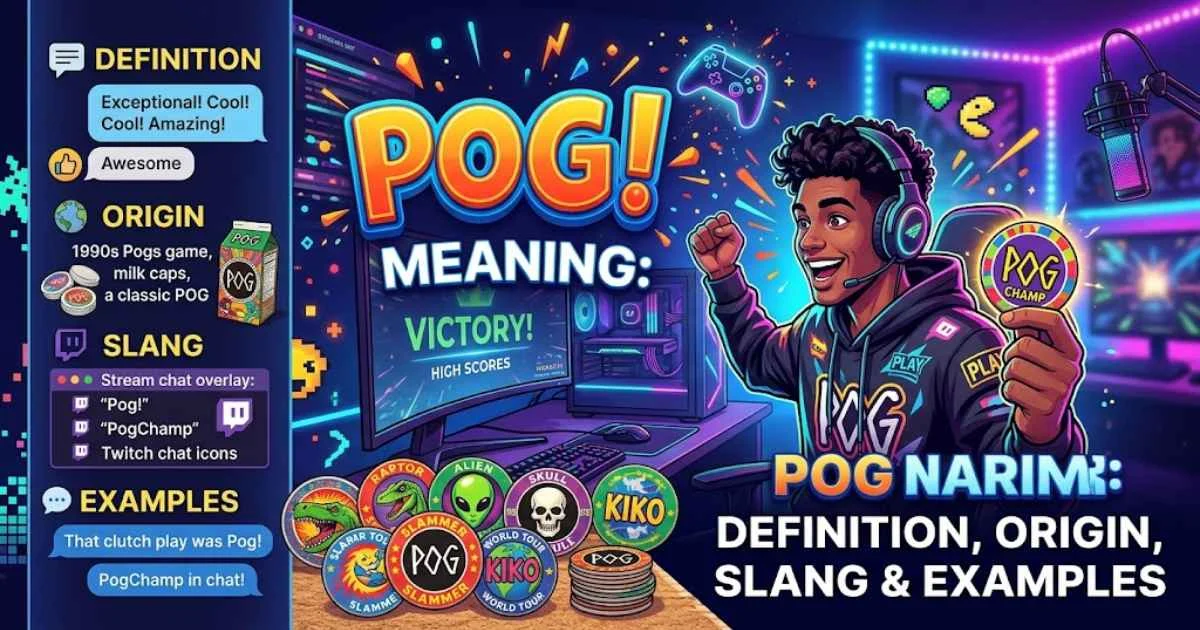
When you spend any time on social media like Twitch, Discord, TikTok, Reddit, YouTube, or gaming chats, you may have seen people writing pog. It is often used when something is interesting, surprising, or impressive. But what does “pog” actually mean? In the world of modern internet slang, “pog” is an immediate reaction that usually expresses excitement, approval, surprise, or celebration.
You might see it after an incredible gaming move, a lucky win, an unexpected success, or some good news in a group chat. The term was especially popularized by Twitch and gaming culture and later spread to social media, livestreams, memes, and online communities.
But where did “pog” come from, how is it different from “PogChamp” or “poggers,” and why do people sometimes use it seriously while others use it ironically?
In this guide, you’ll discover the meaning of pog, its origins, real-life examples, cultural interpretations, common mistakes, similar slang terms, and the best ways to use and respond to it naturally online.
Meaning & Definition
POG is internet slang used to show excitement, approval, surprise, or admiration, especially when something impressive happens. You’ll often see it in gaming chats, Twitch streams, Discord servers, memes, and social media.
For example:
“You won the match with 1 HP? POG!”
Here, POG basically means “That’s awesome!”, “Amazing!”, or “What a play!”
The term is strongly associated with the PogChamp remote and the wider culture of Twitch and online gaming. Over time, people began using “POG” as a standalone reaction rather than relying only on the original remote.
Old and New Slang Meaning with Comparison
| Version | Meaning | Typical Context | Example |
| Older meaning: POG | A collectible game piece used in the 1990s POG game | Toys, childhood games, collectibles | “I used to collect POGs.” |
| Internet slang: POG | Excitement, admiration, or approval | Gaming, Twitch, Discord | “That clutch was POG!” |
| POG as a reaction | “That’s awesome!” or “Amazing!” | Chats and comments | “You actually did it? POG!” |
| PogChamp-related usage | A strong reaction to something surprising or impressive | Streaming and memes | “POGChamp moment!” |
| Modern ironic usage | A playful or exaggerated expression of excitement | Memes and casual online culture | “My pizza arrived early. POG.” |
The biggest potential confusion is that POG has more than one meaning. If you’re talking about a 1990s collectible game, it may refer to physical POG discs. If you see it in Twitch or gaming chat, it almost certainly expresses excitement or approval.
Pronunciation of POG
POG is usually pronounced like “pog,” rhyming with “log,” “dog,” and “frog.”
Pronunciation: /pɒɡ/ or approximately “pahg/pog,” depending on your accent.
You normally say the word rather than spelling out each letter as P-O-G when using it as internet slang.
Breakdown
The modern slang meaning of POG is closely connected to PogChamp, an iconic reaction emote from streaming culture.
The term developed through gaming communities, Twitch chat, esports, memes, and livestream culture. Instead of typing a long reaction such as “That was incredible!”, users could simply write:
- POG
- POGGERS
- POGCHAMP
- That’s POG
- Huge POG moment
In many cases, the exact meaning depends on tone and context. Someone might use POG sincerely after an impressive gaming move, while another person might use it ironically for something completely ordinary.
Other Meanings and Descriptions
Besides internet slang, POG can refer to several things:
- POG game: A 1990s game involving collectible cardboard or plastic discs.
- POG discs: The collectible pieces used in that game.
- PogChamp: A popular internet reaction/emote associated with excitement and surprise.
- POGGERS: A related slang expression meaning something is exciting, impressive, or surprising.
- Play of the Game: In some gaming communities, POG may be interpreted as an abbreviation for Play of the Game, although this is not the original source of the broader internet slang.
- Reaction slang: In modern chats, POG can simply mean “awesome,” “nice,” “let’s go,” or “incredible.”
When you encounter POG online, the surrounding conversation usually tells you which meaning applies.
Meanings Across Platforms
POG can carry slightly different vibes depending on the platform where you see it.
| Platform | Common Meaning | Example |
| Twitch | Excitement or amazement | “POG! That was impelsive!” |
| Discord | Approval or hype | “POG, we finally won.” |
| YouTube | Reaction to an impressive moment | “That ending was POG.” |
| TikTok | Meme-style excitement or irony | “POG, my order came early.” |
| Approval, surprise, or humor | “POG moment right there.” | |
| X | Excitement, sarcasm, or meme reaction | “New update dropped. POG.” |
| Gaming chats | Praise for a great play | “POG clutch!” |
| Esports | Excitement about an exceptional performance | “That was a POG play.” |
On Twitch, the term has one of its strongest associations because of the platform’s long-running emote culture. In gaming communities, it often appears alongside words such as “clutch,” “hype,” “impulsive,” “cracked,” “GG,” “W,” and “let’s go.”
On social media, however, POG can become more ironic or meme-driven. Someone might say “POG” about something mildly interesting simply because the exaggerated reaction is funny.
Psychological / Emotional Meaning
From an emotional perspective, POG communicates a quick burst of positive reaction. Instead of carefully explaining how you feel, you use a short slang expression to signal that something caught your attention.
Positive
The most common emotional meaning is positive excitement.
You might use POG when you feel:
- Excited
- Impressed
- Surprised
- Proud
- Entertained
- Hyped
- Amazed
Example:
“Bro just finished the entire challenge in five minutes. POG!”
Here, the word shows genuine admiration.
Neutral
POG can also be neutral or playful when you simply acknowledge something interesting.
Example:
“The new game update is out.”
“POG.”
The speaker may be excited, but the short response does not necessarily indicate intense emotion.
The tone can depend heavily on the surrounding conversation, punctuation, capitalization, and the relationship between the people chatting.
Negative
POG is generally positive slang, so a negative interpretation is usually unusual. However, people sometimes use it sarcastically.
For example:
“POG, the server crashed again.”
The speaker obviously isn’t celebrating the server failure. The exaggerated reaction creates irony or humor.
This is why you should avoid interpreting POG literally. Online slang frequently depends on context, memes, sarcasm, and community culture.
Grammar and Linguistic Notes
POG functions primarily as an interjection, reaction, adjective-like expression, or informal slang term.
You may see it used in several ways:
- As a reaction: “POG!”
- Before a noun: “That was a POG moment.”
- After a statement: “We actually won. POG.”
- As an adjective-like slang term: “That play was POG.”
- As part of another expression: “POGGERS!” or “POGChamp!”
Because it is an informal internet language, you generally shouldn’t use POG in formal writing, academic assignments, professional reports, or business communication.
Capitalization is flexible. You may see:
- POG
- pog
- Pog
- POGGERS
- PogChamp
The lowercase form “pog” is particularly common in casual online conversations.
A common misunderstanding is assuming that every use of POG is an abbreviation with a fixed word-for-word expansion. In modern internet slang, POG is primarily understood as a reaction associated with excitement or impressive moments, rather than as a universally fixed acronym.
Similar Terms & Alternatives
If you want to express the same general feeling, you have plenty of alternatives.
| Term | Meaning | Tone |
| Poggers | Very exciting or impressive | Playful |
| PogChamp | Strong excitement or surprise | Meme/gaming |
| Hype | Excitement or anticipation | Casual |
| Let’s go! | Excitement or celebration | Energetic |
| W | Win, success, or approval | Modern slang |
| Fire | Excellent or impressive | Casual |
| Based | Approval or agreement | Internet slang |
| impelsive | Extremely impressive or surprising | Casual |
| Sick | Very cool or impressive | Casual |
| GOAT | Extremely great or among the best | Strong praise |
POGGERS is probably the closest direct alternative because both terms developed within the same broad streaming and gaming culture.
However, terms such as “W,” “fire,” “sick,” and “hype” can work in situations where POG might sound too tied to Twitch or older gaming-meme culture.
Origin and History of POG
The history of POG has two important threads: the older POG collectible game and the newer internet slang connected to PogChamp.
The physical POG game became popular in the 1990s, while the internet meaning emerged much later through online video and streaming culture.
The modern slang is strongly associated with PogChamp, which became a recognizable reaction in gaming and livestream communities. The reaction was based on a facial expression from streamer and content creator Ryan Gutierrez, commonly known online as Gootecks.
Over time, the original emote inspired shortened forms such as POG, as well as related expressions such as POGGERS.
Timeline
| Period | Development |
| 1920s | The physical game concept that eventually inspired modern POG play traces back to milk-cap-style games in Hawaii. |
| 1990s | POG became a major collectible game and youth trend, particularly in the United States. |
| Late 2000s–early 2010s | Online gaming and video communities begin developing increasingly recognizable reaction-based meme culture. |
| 2010 | The video associated with the famous PogChamp reaction is recorded and published. |
| Early 2010s | PogChamp became established as an online reaction/remote. |
| 2010s | Twitch and livestreaming help spread POG-style reactions throughout gaming communities. |
| Late 2010s | POG and POGGERS become increasingly common in gaming and streaming chats. |
| 2020s | POG evolves into broader internet slang, including sincere, ironic, and meme-based uses. |
| Today | POG remains recognizable as a shorthand reaction for excitement, approval, and impressive moments. |
One important distinction matters here: the modern slang meaning is not simply a continuation of the 1990s POG toy craze. The two meanings are historically connected through the word itself but developed in very different cultural environments.
Usage in Different Contexts
You can use POG in many informal settings, but the meaning becomes clearest when you consider the situation.
Casual Chats
In casual conversations, POG usually means “awesome,” “nice,” or “that’s exciting.”
Examples:
- “I finally passed my exam. POG!”
- “We got free tickets. POG.”
- “You actually finished the project early? POG!”
- “Pizza is here. POG.”
Friends may also use it ironically for ordinary events.
“I found my missing charger. POG.”
The humor comes from treating a small event as if it were a major achievement.
Social Media
On TikTok, Instagram, Reddit, X, YouTube, and other social platforms, POG is often used as a meme reaction.
You may see it in:
- Comments
- Captions
- Gaming clips
- Reaction posts
- Memes
- Short videos
- Livestream discussions
- Community posts
For example:
“He actually landed that trick. POG!”
or:
“POG, the update finally fixed the bug.”
The term can also be intentionally exaggerated. Internet users often turn short slang expressions into reaction memes, so POG doesn’t always indicate serious excitement.
Professional Use
You should generally avoid POG in formal professional communication unless your workplace specifically uses casual internet slang.
For example, this would be inappropriate in a formal business email:
“POG! We closed the deal!”
A more professional alternative would be:
“Great news! We successfully closed the deal.”
However, POG may appear naturally in workplaces where people communicate through Discord, Slack, gaming communities, streaming teams, or informal digital groups.
The key is to match your language to the audience and communication channel. If your coworkers regularly use internet slang, POG may be understood, but it can still sound overly casual in formal settings.
Gaming & Group Chats
Gaming is where POG feels most natural.
You might see it after:
- A clutch victory
- An unexpected comeback
- A difficult achievement
- A rare item drop
- A powerful play
- A funny gaming moment
- A surprising strategy
- An impressive esports performance
Examples:
“That 1v4 was POG!”
“You got the legendary drop? POG!”
“POG! We came back from 0–2!”
In Discord and group chats, POG can work as a one-word reaction. You don’t need a complete sentence because everyone already understands the emotional message.
The meaning is usually something like “That was amazing!” or “Let’s go!”, or “What an incredible moment!”
Overall, POG is best understood as fast, expressive internet slang for excitement, approval, or admiration. Its meaning changes slightly with the community, but gaming, Twitch, memes, and online reaction culture remain its strongest associations.
Advantages and Disadvantages
Pog is mainly used online to show excitement, surprise, approval, or admiration, especially when something impressive happens. It became strongly associated with Twitch, gaming communities, livestreams, memes, and internet culture.
| Advantages | Disadvantages |
| Quickly expresses excitement | Can confuse people unfamiliar with internet slang |
| Works well in gaming chats and livestreams | May sound outdated in some online communities |
| Adds energy to conversations | Its meaning depends heavily on context |
| Easy to use as a reaction | Not suitable for formal or professional communication |
| Connects with gaming and meme culture | Some people use it ironically rather than sincerely |
For example, if your friend wins a difficult game, you might say “Pog!” to mean “That was awesome!” or “That was impressive!”
The biggest advantage is its simplicity: one short word can communicate a strong reaction. However, understanding where and when to use it matters just as much as knowing what it means.
Real-Life Examples & Memes
You’ll most often see pog when someone reacts to an exciting, unexpected, or impressive moment. It is especially common in gaming streams, Twitch chats, Discord servers, Reddit communities, and meme culture.
Everyday Examples
- Friend: “I finally beat the boss!”
You: “Pog!” - Gamer: “I won with one HP left.”
Viewer: “POG!” - Friend: “I got tickets to the concert.”
You: “Pog, let’s go!” - Streamer: “We just reached 10,000 followers!”
Chat: “POGGG!”
Meme-Style Usage
You may also see variations such as
- Pog
- PogChamp
- Poggers
- POGGERS
- That’s pog
- Huge pog
- Mega pog
- Pog moment
The tone can be completely serious or deliberately exaggerated. Someone might type “POG!!! “because they are genuinely excited,” while another person may use “pog” ironically to make fun of how dramatic internet reactions can become.
That playful flexibility is one reason the term became so recognizable in online communities.
Cultural or Regional Interpretations
The meaning of pog stays fairly consistent across English-speaking internet communities, but the frequency and style of use can vary by region and online culture.
| Region | Common Interpretation | Typical Context |
| United States & UK | Excitement, approval, surprise | Twitch, gaming, memes, Discord |
| India, Pakistan & Philippines | Excitement or admiration | Gaming, social media, livestreams |
| Australia | Positive reaction, often humorous or ironic | Gaming and online communities |
United States & UK
In the United States and the UK, POG is strongly connected to Twitch culture, esports, gaming, livestreams, and memes. You might see it in a fast-moving chat when a streamer makes an impressive play.
For example:
“That clutch was pog!”
Here, “pog” means something like “That was amazing!”
Younger internet users may also use it humorously, especially when reacting to something unexpectedly impressive.
Asia (India, Pakistan, Philippines)
Across online gaming and social media communities in India, Pakistan, and the Philippines, English internet slang often mixes naturally with local languages and expressions.
You may see pog in gaming chats, Discord servers, YouTube comments, Facebook communities, and livestreams.
For example:
“Bro got the rare drop. Pog!”
The intended meaning is usually “That’s awesome!”, “Lucky!”, or “What a great moment!”
The exact tone depends on the community. Some users use it sincerely, while others use it because they recognize it as a popular gaming meme.
Australia
Australian internet users may encounter pog primarily through international gaming and streaming communities. It can express excitement, but it is also commonly used in a casual or ironic way.
For example:
“You actually did it? Pog.”
Because Australian online communication often favors informal language, the term can fit naturally into gaming conversations, although it is not everyday slang for everyone.
Overall, pog remains more strongly tied to internet culture than to any particular country.
Common Mistakes & Misconceptions
One common mistake is assuming pog has one universal meaning in every situation. Online slang changes according to context, platform, and community.
1. Thinking “pog” is always serious
Not necessarily. Someone can use pog sincerely or ironically.
“Pog, we won!”
may express genuine excitement.
But:
“Wow, you remembered your password. Pog.”
could be completely sarcastic.
2. Assuming it is only used on Twitch
Twitch helped popularize pog-related slang, but the word spread into Discord, Reddit, TikTok, YouTube, gaming chats, memes, and other online spaces.
3. Confusing “pog” with “PogChamp”
The two are closely related but are not identical.
- Pog = a short reaction expressing excitement or approval.
- PogChamp = a famous emote/reaction associated with excitement and surprise.
- Poggers = an expanded slang form of pog.
4. Assuming everyone knows it
People outside gaming and internet culture may not understand it immediately. If you’re talking to someone unfamiliar with online slang, simply saying “That’s awesome!” may communicate your meaning more clearly.
5. Treating “POG” as one fixed acronym
In some contexts, POG can appear as an acronym or abbreviation unrelated to internet slang. Always check the surrounding conversation before deciding what it means.
The safest approach is simple: look at the platform and the situation before interpreting the word.
The Vibe Behind
The vibe of pog is usually excited, positive, playful, and energetic.
Positive Vibe
When used sincerely, it communicates:
- Excitement
- Approval
- Admiration
- Surprise
- Celebration
- Enthusiasm
“Pog! You actually won!”
Neutral Vibe
Sometimes pog is simply a quick reaction without strong emotion.
“Pog, nice.”
Here, it can mean “Nice!” or “Cool!”
Negative or Ironic Vibe
Although the word itself is generally positive, internet users can use it sarcastically.
“Pog, another software update.”
The speaker probably isn’t genuinely excited. The humor comes from using an enthusiastic reaction for something annoying or boring.
So, tone and context determine the vibe.
Is It Offensive or Friendly?
Pog is generally friendly and non-offensive. It is normally used to celebrate something exciting or impressive.
You can use it casually with:
- Friends
- Gaming teammates
- Stream viewers
- Online communities
- Discord groups
- Meme communities
However, avoid using it in formal emails, professional reports, academic writing, or serious business conversations unless you’re intentionally discussing internet slang.
Also remember that slang can feel awkward when used outside the community that understands it. If someone doesn’t know what pog means, they may simply find it confusing rather than offensive.
In short, pog is usually playful rather than insulting.
How to Respond
Your response to pog depends on what happened and the tone of the conversation.
If Someone Says “Pog!”
You can respond with:
- “Let’s go!”
- “I know, right?”
- “Huge win!”
- “Pog!”
- “That was impulsive!”
- “GG!”
- “We did it!”
Example
Friend: “I finally beat the final boss!”
You: “Pog! GG!”
If someone uses pog sarcastically, you can match their humor:
Friend: “I have three hours of homework. Pog.”
You: “Absolutely legendary.”
The key is to match the energy and context of the original message.
Differences From Similar Words
| Term | Meaning | Typical Tone | Example |
| Pog | Excitement or approval | Playful | “Pog! We won!” |
| PogChamp | Excited or surprised reaction | Energetic | “PogChamp, what a play!” |
| Poggers | Another form of pog | Playful/meme-like | “That’s poggers!” |
| GG | Good game | Sportsmanlike | “GG, everyone!” |
| W | Win or something positive | Casual | “Huge W!” |
| Based | Approval of an opinion/action | Confident | “That take is based.” |
| Fire | Very good or impressive | Modern/casual | “That song is fire.” |
| Lit | Exciting or excellent | Casual | “The party was lit.” |
| Nice | Approval or praise | Neutral | “Nice play!” |
The main difference is that pog specifically carries an excited internet-reaction vibe, while terms such as GG, W, fire, and nice can fit a wider range of conversations.
Relevance in Dating & Online Culture
“Pog” is not specifically a dating term, but you may encounter it in dating-related online conversations, especially when people use gaming slang or meme language.
For example:
“She actually replied. Pog.”
Here, pog simply expresses excitement about getting a response.
You might also see:
“Got the date planned. Pog!”
In this context, it means “Awesome!”, “Great!”, or “That’s exciting!”
On dating apps and social platforms, slang like “pog,” “W,” “based,” “fire,” and “rizz” can make conversations feel more relaxed and playful.
However, using too much gaming slang can sometimes make your message feel forced. If you’re trying to create a genuine romantic connection, use pog naturally rather than inserting it into every message.
In online culture more broadly, pog represents the playful, reaction-driven communication style that became popular through streaming and gaming communities.
Common Examples of “Pog”
Here are some common ways you may encounter the term:
In Gaming
“That clutch was pog!”
Meaning: That clutch was amazing!
In Twitch Chat
“POG!!!”
Meaning: Something exciting just happened.
In Discord
“You got the legendary item? Pog.”
Meaning: That’s awesome/lucky!
On Social Media
“Pog, my favorite creator posted!”
Meaning: I’m excited about this!
In Memes
“Pog moment.”
Meaning: An unexpectedly exciting or impressive moment.
In Casual Conversation
“You finished it already? Pog.”
Meaning: Nice! / That’s impressive!
The word becomes especially natural when you’re already participating in an online gaming or meme-focused community.
Popularity & Trends
Pog became popular through gaming and livestream culture, particularly through Twitch and the broader rise of reaction-based internet communication.
Its popularity was closely connected to PogChamp, an emote associated with an exaggerated expression of excitement or surprise. From there, shorter forms such as pog and variations such as “poggers” became part of gaming vocabulary.
The term spread beyond Twitch into:
- Discord
- YouTube
- TikTok
- Gaming forums
- Esports communities
- Meme pages
- Livestream chats
Its usage has also shifted over time. While some communities once used pog very frequently, others now use it mainly ironically, nostalgically, or as a recognizable gaming meme.
That doesn’t mean the word has disappeared. Internet slang often moves in cycles: a term can become mainstream, fade from everyday use, and later return as a meme, ironic expression, or nostalgic reference.
When Not to Use “Pog”
Although pog is harmless in most casual situations, you should avoid it when clarity, professionalism, or sensitivity matters more than internet humor.
Avoid It In:
- Job interviews
- Formal business emails
- Academic essays
- Professional reports
- Legal documents
- Official applications
- Serious workplace communication
- Conversations with people who may not understand internet slang
For example, instead of:
“Pog! Your application was approved.”
A professional message would be better as:
“Great news! Your application has been approved.”
You should also avoid using “pog” when discussing serious or sensitive situations. An overly playful reaction can appear insensitive or inappropriate, even if you didn’t intend it that way.
The best rule is simple: use “pog” when the conversation is casual, playful, and internet-focused, not when professionalism or emotional sensitivity is required.
FAQs “Pog” Meaning
1. What does pog mean in slang?
“Pog” is internet slang used to express excitement, surprise, approval, or admiration, especially in gaming and streaming communities.
2. Is pog a bad word?
No. Pog is generally friendly and non-offensive.
3. What does pog mean in gaming?
In gaming, pog usually means something like “awesome,” “amazing,” or “that was impressive.”
4. What does PogChamp mean?
PogChamp is a well-known internet reaction/emote associated with excitement and surprise.
5. Is pog still used?
Yes. Its popularity varies by community, but pog remains recognizable in gaming, streaming, meme, and online communities.
6. What is the difference between “pog” and “poggers”?
Both express excitement or approval. Poggers is simply a longer, more playful variation of pog.
7. Can you use pog in texting?
Yes. You can use pog in casual texts with people who understand internet slang.
8. What does “pog moment” mean?
A “pog moment” is an exciting, impressive, surprising, or memorable moment, usually in an online or gaming context.
9. Is pog appropriate for work?
Usually not. Pog is informal internet slang, so professional alternatives such as “great,” “excellent,” or “impressive” are safer.
10. What does “POG” stand for?
In internet slang, pog does not necessarily function as a conventional acronym. Its modern usage is strongly associated with gaming and streaming culture, while POG can have other meanings in unrelated contexts.
Final Thoughts
Pog is a short, energetic piece of internet slang that usually means “awesome,” “exciting,” or “impressive.” Its roots in gaming, Twitch, livestreams, memes, and online communities helped turn it into a recognizable reaction across platforms.
Whether you say “Pog!” “PogChamp,” or “poggers,” the meaning is usually clear when the context is playful and positive. Just remember that slang works best when you match the platform, audience, and tone.

Hi, I am Isabel, the Author of Skypunz.com, where I share witty puns, jokes, and fun content to brighten your day.