
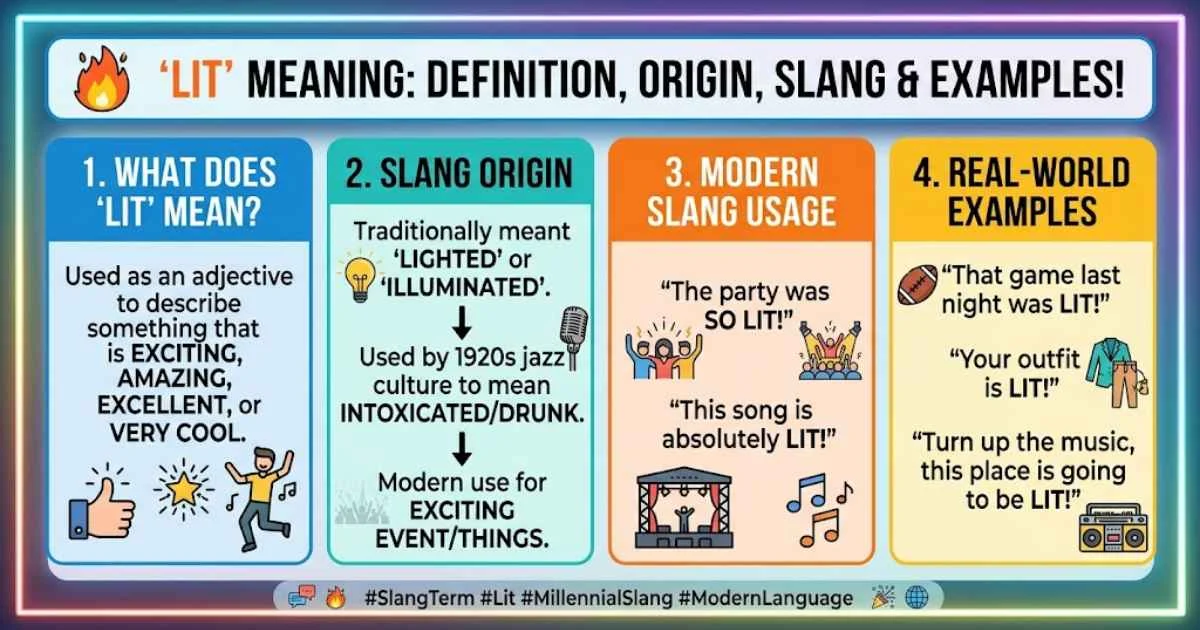
Have you ever been to a party and heard someone say, “It was lit!” or “That song is lit! ”? Then you’ve probably wondered what they really mean. You’re not alone, many people have the same question. In modern slang, “lit” usually means exciting, fun, energetic, inspiring, or extremely enjoyable. The meaning can change slightly depending on the situation, but it’s often used to express strong excitement or approval.
You might hear lit in everyday conversations about parties, concerts, music, sports, gaming, fashion, and social events. It’s also common on TikTok, Instagram, X, Reddit, YouTube, and group chats, where people use it in captions, comments, memes, and reactions.
But where did lit come from, why did this simple word become so popular in internet culture, and how can you tell when someone means “exciting” versus another meaning?
In this guide, you’ll discover the meaning of lit, its slang origins, real-life examples, cultural interpretations, similar words, online usage, dating relevance, and when you should or shouldn’t use it.
Read Also : Cheugy Meaning: Definition, Origin, Slang & Examples
Meaning & Definition
“Lit” is a popular slang term that usually means exciting, fun, energetic, or extremely enjoyable. You’ll often see it in text messages, social media posts, memes, music, parties, gaming chats, and online conversations.
For example, if someone says, “That party was lit!” They mean the party was really fun, lively, and exciting. Depending on the context, “lit” can also mean intoxicated, intense, or literally illuminated.
The key is context. If someone says, “The concert was lit,” they are praising the experience. If they say, “He got lit last night,” they may be referring to drinking or getting intoxicated.
Old and New Slang Meaning with Comparison
| Meaning | Older/Common Meaning | Modern Slang Meaning | Example |
| Lit | Illuminated or set on fire | Exciting, amazing, or fun | “The party was lit!” |
| Lit | Past tense of “light” | Extremely energetic or impressive | “The crowd was lit.” |
| Lit | Literary abbreviation in some contexts | Rarely used as slang | “She studies lit.” |
| Lit | Burning or ignited | Intoxicated in some contexts | “He got lit last night.” |
Modern internet users most often use lit as a positive reaction to something exciting or entertaining.
Pronunciation of “Lit”
Lit is pronounced /lɪt/ and sounds like “lit” in standard American English.
It is a short, one-syllable word that rhymes with words such as sit, hit, fit, and bit.
Breakdown
The slang meaning of lit comes from the idea of something being “lit up” or highly energized.
- Lit = exciting
- Lit = fun
- Lit = energetic
- Lit = impressive
- Lit = happening
- Lit = sometimes intoxicated
When you see lit online, look at the surrounding words to determine whether the person is describing an event, mood, performance, person, or state of intoxication.
Other Meanings and Descriptions
Although slang is now one of the most recognizable uses of lit, the word has several other meanings.
- Illuminated: “The street was lit by bright lamps.”
- Burning: “The candle was lit.”
- Exciting: “The game was lit!”
- Intoxicated: “They were getting lit at the party.”
- Literature: “I have an exam in English lit.”
- Highly energetic: “The crowd was absolutely lit.”
This variety is why context matters when interpreting the word.
Meanings Across Platforms
The meaning of lit stays relatively consistent across online platforms, but the tone can change depending on where you see it.
| Platform/Context | Common Meaning | Example |
| TikTok | Exciting, trendy, entertaining | “This trend is lit!” |
| Fun, attractive, impressive | “Your birthday party looked lit.” | |
| X | Exciting or remarkable | “That performance was lit.” |
| Impressive, entertaining, or intense | “That match was lit.” | |
| Discord | Exciting gaming session or conversation | “Tonight’s server is lit.” |
| YouTube | Great, energetic, entertaining | “This concert was lit!” |
| Gaming | Intense or exciting gameplay | “That final round was lit.” |
| Texting | Fun or exciting | “The weekend is gonna be lit.” |
On social media, lit often works as a quick expression of enthusiasm. You may also see variations such as “so lit,” “super lit,” “lit AF,” or “that was lit.”
However, don’t assume every use is slang. A sentence such as “The room was lit” could simply mean the room had enough light.
Read More: Pog Meaning: Definition, Origin, Slang & Examples!
Psychological / Emotional Meaning
When someone describes something as lit, they are usually communicating a strong emotional reaction. The slang can express excitement, enthusiasm, enjoyment, approval, or high energy.
The emotional meaning depends heavily on the situation.
Positive
In a positive context, lit communicates strong approval.
You might use it when:
- You had an amazing time.
- A performance impressed you.
- The party was energetic.
- The game became exciting.
- The song created a great atmosphere.
- Your friends are having fun.
Examples:
- “That concert was lit!”
- “The whole night was lit.”
- “Your playlist is lit.”
- “That comeback was absolutely lit.”
Here, lit is similar to awesome, amazing, exciting, fire, hype, or epic.
Neutral
Sometimes lit simply describes an energetic atmosphere without expressing a particularly strong emotional judgment.
For example:
“The stadium was lit during the final minutes.”
The speaker is emphasizing the energy and excitement of the crowd.
In another context, lit can also refer to something being physically illuminated:
“The building was lit up at night.”
In this literal use, it has nothing to do with internet slang.
Negative
Lit is usually positive, but its meaning can become negative depending on context.
For example:
“He got way too lit last night.”
Here, lit may mean heavily intoxicated, and the speaker may be describing irresponsible or excessive drinking.
It can also be used sarcastically:
“Yeah, that meeting was really lit.”
If the meeting was boring, the speaker may actually mean the opposite. Tone, punctuation, and surrounding conversation help you recognize this kind of ironic slang.
Grammar and Linguistic Notes
Lit can function as both a traditional English word and an informal slang expression.
As the past tense and past participle of light, it can describe something that was illuminated or ignited:
- “She lit the candle.”
- “The fire was lit before dinner.”
As slang, lit commonly functions as an adjective:
- “The party was lit.”
- “That concert is lit.”
- “The game got lit.”
In informal speech, you may also encounter phrases such as:
- Get lit
- Got lit
- So lit
- Super lit
- Lit AF
- Stay lit
Be careful with professional or academic writing. Although lit is widely understood, its slang meaning is informal and may sound too casual in business communication.
Also, don’t confuse slang lit with literature, even though “lit” is commonly used as an informal abbreviation for literature in educational contexts.
Similar Terms & Alternatives
Several slang words can communicate a similar idea to lit, although each has its own tone.
| Term | Meaning | Example |
| Fire | Extremely good or impressive | “That song is fire.” |
| Hype | Exciting or energetic | “The crowd was hype.” |
| Turnt | Highly energetic or partying | “Everyone got turnt.” |
| Epic | Extremely impressive or memorable | “That ending was epic.” |
| Awesome | Very good or impressive | “That was awesome.” |
| Dope | Excellent or cool | “Those shoes are dope.” |
| Banging | Very enjoyable, especially music/food | “This track is banging.” |
| Lively | Full of energy | “The party was lively.” |
| Poppin’ | Busy, exciting, or happening | “The club was poppin’.” |
Lit is generally associated with high energy and excitement, while terms such as fire often emphasize quality or excellence.
Origin and History of “Lit”
The history of lit is interesting because its slang meaning developed from an older English word.
The traditional word lit is the past tense of light, as in “She lit the candle.” Over time, informal speech began using lit to describe something that felt highly energized or exciting.
The modern slang sense became particularly popular in American youth culture, hip-hop, nightlife, music, and social media. It later spread widely through online communities and became a recognizable part of internet vocabulary.
Timeline
| Period | Development |
| Old English / Early English | Forms related to light developed to describe illumination or fire. |
| Traditional English | Lit became established as the past tense of light. |
| 20th Century | Informal expressions connected lit with excitement and intoxication. |
| 1990s–2000s | Slang usage became increasingly visible in music and youth culture. |
| 2010s | Lit became widely popular through hip-hop, nightlife, memes, and social media. |
| 2020s | The term remains recognizable online, although newer slang terms sometimes replace it in younger internet communities. |
The modern meaning therefore isn’t completely disconnected from the original word. The idea of something being “lit up” naturally developed into a metaphor for something being energized, exciting, or intense.
Usage in Different Contexts
The safest way to understand lit is to look at what the speaker is describing. A party, concert, video game, person, or physical room can all produce different interpretations.
Casual Chats
In everyday conversations, lit usually means fun, exciting, or amazing.
Examples:
- “The party last night was lit.”
- “This weekend is going to be lit.”
- “That movie was lit.”
- “Your birthday setup looks lit.”
You can use it with friends when you want to express enthusiasm without sounding formal.
Common phrases:
- That’s lit!
- So lit!
- It was lit!
- This place is lit!
- Tonight is gonna be lit!
Social Media
On TikTok, Instagram, X, YouTube, and other social platforms, people often use lit as a short reaction to exciting content.
For example:
“This performance is lit 🔥.”
Here, the person is saying the performance is energetic, impressive, or exciting.
It can appear in:
- Captions
- Comments
- Hashtags
- Memes
- Reaction posts
- Short videos
- Event photos
Because social media favors short and expressive language, lit became especially useful as a quick way to show enthusiasm.
Professional Use
You should generally avoid slang lit in formal professional communication unless you are intentionally using an informal or creative brand voice.
For example, avoid:
“The client presentation was lit.”
Instead, use:
“The client presentation was highly engaging.”
Or:
“The event was energetic and successful.”
However, lit can still appear in professional settings when discussing marketing, entertainment, social media, youth culture, or consumer trends.
For example:
“The campaign uses contemporary slang such as ‘lit’ to appeal to younger audiences.”
Here, the word is being discussed rather than casually used.
Gaming & Group Chats
In gaming communities and group chats, lit can describe an intense match, exciting moment, impressive play, or energetic conversation.
Examples:
- “That final round was lit!”
- “The tournament chat is lit tonight.”
- “That clutch was lit.”
- “The server got lit after the update.”
- “This lobby is getting lit.”
In gaming, the word often overlaps with “hype,” “intense,” “chaotic,” “epic,” and “exciting.”
Just remember that “lit” doesn’t always mean something is literally on fire or illuminated. In most online slang conversations, it is an emotional reaction describing something as high-energy, exciting, or enjoyable.
Overall, when you encounter lit, check the surrounding context first. If the topic is a party, song, game, event, or social experience, the slang meaning is probably exciting or fun. If the topic involves a candle, fire, lamp, or room, the traditional meaning of “illuminated” or “ignited” is more likely.
Absolutely—here is a complete, SEO-focused, reader-friendly section set for “Lit,” using your requested H2/H3 structure, natural LSI/NLP keywords, bold key terms, examples, tables, and concise FAQs.
Advantages and Disadvantages of “Lit”
“Lit” is a short, expressive slang term that usually describes something exciting, energetic, fun, or impressive. It works especially well in casual conversations, social media captions, parties, gaming, and online communities. However, because it is informal, it is not appropriate for every situation.
| Advantages | Disadvantages |
| Quickly expresses excitement or enthusiasm | Too informal for most professional situations |
| Easy to use in texts and social media | Meaning can change depending on context |
| Adds an energetic, playful tone | Some people may interpret it as referring to alcohol or being intoxicated |
| Common among younger internet users | Can sound outdated depending on the audience |
| Works well for parties, music, games, and events | Overuse can make your language sound repetitive |
| Helps show strong positive emotion | Older or unfamiliar audiences may not understand it |
Overall, lit is most effective when you know your audience and the conversation is casual. That becomes even clearer when you look at how people use it in real conversations and memes.
Real-Life Examples & Memes
You will often see lit used to describe a party, concert, game, celebration, performance, or even an exciting online moment.
Real-Life Examples
- “That party was lit!” — The party was extremely fun and energetic.
- “The concert was absolutely lit.” — The concert was exciting and lively.
- “This game is getting lit!” — The game is becoming intense or exciting.
- “Your new outfit is lit.” — Your outfit looks impressive or stylish.
- “The comments section is lit today.” — The online discussion is unusually entertaining or active.
- “Tonight is gonna be lit.” — The speaker expects an exciting night.
Lit in Memes
Memes often exaggerate the meaning of lit for comedic effect. A meme might show someone celebrating a tiny achievement with a caption such as “The party is lit!” The humor comes from treating an ordinary moment as if it were an unforgettable event.
On TikTok, Instagram, X, Reddit, and other social platforms, “lit” can also appear in captions, reaction posts, GIFs, and short videos to signal excitement.
The key idea is simple: when someone calls something lit, they usually want you to know that it feels fun, exciting, energetic, or worth celebrating.
Cultural or Regional Interpretations
The slang meaning of lit is widely understood in English-speaking internet culture, but its tone and frequency can vary by region.
| Region | Common Interpretation | Typical Context |
| United States & UK | Exciting, fun, energetic, impressive | Parties, music, social media, gaming |
| India, Pakistan & Philippines | Cool, exciting, happening, impressive | Social media, chats, entertainment, youth culture |
| Australia | Fun, exciting, lively, impressive | Casual conversations, parties, sports, online culture |
United States & UK
In the United States and UK, “lit” commonly describes something exciting, lively, or entertaining.
For example:
“The festival was lit last night.”
You might also hear it in gaming, music, sports, and social media conversations. The exact level of excitement depends on context.
Asia (India, Pakistan, Philippines)
Across India, Pakistan, and the Philippines, younger internet users may use lit in English-language chats, captions, memes, gaming communities, and entertainment discussions.
For example:
“Bro, this wedding is lit!”
Here, “lit” generally means fun, energetic, or happening rather than its older literal meanings.
Because English is commonly mixed with local languages in online communication, you may see lit combined with regional expressions and casual slang.
Australia
In Australia, lit can also mean exciting, lively, or impressive, particularly in informal online conversations.
For example:
“That game was lit!”
However, Australian speakers may choose other local expressions depending on their age, social group, and situation.
So, while the basic meaning remains similar, age, platform, and cultural context can influence how natural “lit” sounds.
Common Mistakes & Misconceptions
One of the biggest mistakes is assuming that lit always means drunk or intoxicated. That was associated with an older slang usage, but modern internet slang frequently uses “lit” to mean exciting or excellent.
Common misunderstandings
1. “Lit” always means drunk.
Not necessarily. In modern slang, “lit” often means exciting, fun, or energetic.
2. “Lit” means literally on fire.
In standard English, lit can be the past tense of light, as in “She lit a candle.” That is completely different from the slang usage.
3. “Lit” is always positive.
Usually, yes, but tone matters. Someone can use it sarcastically or ironically.
4. Everyone understands internet slang.
Not always. Older audiences or people unfamiliar with online culture may not recognize the slang meaning.
5. “Lit” belongs in professional writing.
Generally, avoid it in formal emails, academic papers, business reports, and official communication.
When you understand these differences, it becomes much easier to identify which meaning someone intends.
The Vibe Behind “Lit”
The vibe of lit is usually energetic, enthusiastic, playful, and positive. It gives a sentence more emotional intensity than simply saying something is “good.”
Compare:
- “The party was good.”
- “The party was lit!”
The second sentence communicates much stronger excitement and enthusiasm.
Depending on the context, the vibe can be:
Positive
“That performance was lit!”
Meaning: The performance was exciting, impressive, or amazing.
Neutral
“The place gets pretty lit on weekends.”
Meaning: The place becomes lively or energetic.
Playful or Humorous
“My kitchen is lit—I finally made toast without burning it.”
Here, “lit” is deliberately exaggerated for humor.
Understanding the emotional tone helps you decide whether “lit” sounds natural or forced.
Is “Lit” Offensive or Friendly?
“Lit” is generally friendly and non-offensive when used in its modern slang sense. It is commonly used to express excitement, approval, or enthusiasm.
For example:
“Your new video is lit!”
This is normally a compliment.
However, context still matters. If someone uses lit to refer to alcohol consumption or intoxication, the meaning changes. It can also sound sarcastic depending on tone.
For safe everyday use, use lit in informal conversations with friends, social media posts, gaming chats, and casual discussions.
Avoid relying on it in formal business communication, academic writing, job applications, or professional presentations.
How to Respond to “Lit”
Your response depends on what the person means by lit.
| If someone says… | You can respond… |
| “That party was lit!” | “For real! It was amazing.” |
| “This song is lit!” | “Absolutely! This track goes hard.” |
| “The game is getting lit!” | “Yeah, it’s getting intense!” |
| “Your fit is lit!” | “Thanks! I appreciate it.” |
| “Tonight is gonna be lit.” | “I’m ready!” |
| “That video was lit 😂” | “Glad you liked it!” |
You do not need a complicated response. A simple “For real!”, “Absolutely!”, “Facts!”, or “I know, right?” can work naturally in casual conversation.
Differences From Similar Words
Although lit overlaps with several modern slang terms, each word has its own tone and typical use.
| Word | Main Meaning | Tone | Example |
| Lit | Exciting, fun, energetic | Casual, enthusiastic | “The party was lit.” |
| Fire | Excellent, impressive, amazing | Strongly positive | “That song is fire.” |
| Hype | Excitement or anticipation | Energetic | “Everyone is hyped for the game.” |
| Dope | Cool, excellent | Casual | “Those shoes are dope.” |
| Sick | Extremely cool or impressive | Casual | “That trick was sick.” |
| Awesome | Very good or impressive | Casual/general | “That was awesome.” |
| Turnt | Highly excited, energetic, or partying | Very casual | “Everyone was turnt at the party.” |
| Epic | Extremely impressive or memorable | Casual | “That was an epic night.” |
The easiest distinction is that lit often emphasizes the energy or atmosphere of a situation, while words such as fire and dope can focus more directly on how good something is.
Relevance in Dating & Online Culture
Lit appears frequently in dating conversations and online culture because people use it to describe fun experiences, attractive content, exciting plans, or enjoyable dates.
For example:
- “That date was lit.”
- “Our weekend trip was lit.”
- “Your profile is lit.”
- “The party scene is gonna be lit tonight.”
On dating apps and social media, the word can create a casual, confident, and youthful tone.
However, using too much slang can sometimes make your messages sound unnatural. If you’re messaging someone you barely know, consider matching their communication style instead of forcing slang into the conversation.
In online culture, lit also appears in memes, comments, gaming chats, music discussions, livestreams, and short-form videos. Its flexibility is one reason the term remains recognizable.
Common Examples of “Lit”
Here are some of the most common ways you may encounter lit:
Parties
“This party is lit!”
Meaning: The party is very exciting and energetic.
Music
“This song is lit!”
Meaning: The song is exciting, catchy, or impressive.
Gaming
“That final round was lit!”
Meaning: The round was intense and exciting.
Sports
“The stadium was lit tonight.”
Meaning: The atmosphere was energetic and exciting.
Fashion
“Those sneakers are lit.”
Meaning: The sneakers look extremely cool.
Social Media
“Your vacation photos are lit!”
Meaning: The photos look impressive, exciting, or stylish.
Events
“The festival was lit.”
Meaning: The event was lively and enjoyable.
These examples show why lit can describe both a specific object and an entire atmosphere.
Popularity & Trends
Lit became especially prominent in modern slang and internet culture during the 2010s, spreading through music, hip-hop culture, social media, memes, and youth communities.
Its popularity grew because it is short, expressive, and easy to use in captions and comments. Platforms such as Instagram, Twitter/X, TikTok, YouTube, Reddit, and Snapchat helped slang terms like “lit” travel quickly across communities.
Although slang constantly evolves, lit remains recognizable because it has become part of broader online vocabulary. However, its popularity can vary by age group and platform, and some younger users may prefer newer expressions such as fire, hype, goated, or slaps depending on the context.
This is why slang should always be interpreted according to context, audience, platform, and generation rather than assuming one fixed definition.
When Not to Use “Lit”
You should generally avoid lit when the situation requires formal, precise, or professional language.
Avoid it in:
- Academic essays
- Business reports
- Formal emails
- Job applications
- Professional presentations
- Legal or official documents
- Formal customer communication
Instead of:
“The conference was lit.”
Use:
“The conference was highly engaging and energetic.”
Instead of:
“The presentation was lit.”
Use:
“The presentation was engaging and impressive.”
In casual communication, however, lit can be a natural and expressive choice. The best rule is simple: match your language to your audience and situation.
FAQs About Lit Meaning
1. What does “lit” mean in slang?
Lit usually means exciting, fun, energetic, or impressive.
2. Is “lit” a positive word?
Yes. In modern slang, lit is generally positive and expresses excitement or approval.
3. Does “lit” mean drunk?
It can refer to intoxication in some contexts, but modern slang commonly uses it to mean exciting or fun.
4. Is “lit” still used?
Yes. It remains recognizable and is still used in social media, casual chats, music, gaming, and memes.
5. Is “lit” appropriate for formal writing?
No. Lit is informal slang, so standard words such as “exciting,” “excellent,” or “energetic” are better for formal writing.
6. What is another word for “lit”?
Depending on context, alternatives include fire, awesome, hype, dope, epic, sick, and exciting.
7. What does “that’s lit” mean?
“That’s lit” usually means “That’s exciting,” “That’s awesome,” or “That’s really cool.”
8. Can you use “lit” for a person?
Yes, but the meaning depends on context. It may describe someone who is energetic, excited, or partying, or it may refer to intoxication.
9. Is “lit” offensive?
Generally, no. Modern slang is usually friendly and harmless.
10. What is the difference between “lit” and “fire”?
Both can mean something is excellent, but lit often emphasizes energy or excitement, while “fire” more directly means very impressive or excellent.
Final Thoughts
“Lit” is a flexible piece of modern slang that usually means exciting, fun, energetic, or impressive. You may see it in social media posts, memes, music, gaming, parties, dating conversations, and casual chats.
Although it can have other meanings depending on context, the modern slang sense is generally positive and informal.
The easiest way to use it correctly is to consider the conversation, audience, platform, and tone before dropping it into your sentence.

Hi, I am James Whitman, the author of Skypunz.com. I create funny puns and jokes to make your day brighter and bring a smile to every reader.