
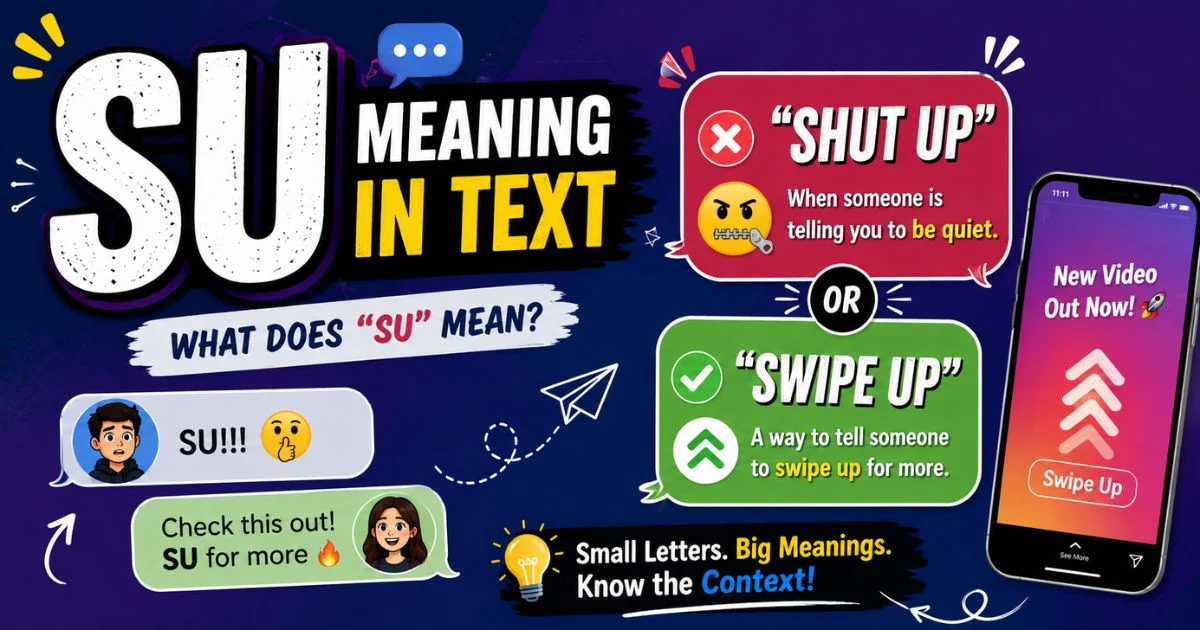
In text messages and social media, SU most commonly means “Shut Up” or “Swipe Up” (a call to action on platforms like Snapchat or Instagram). Its exact meaning depends entirely on the context of the conversation or post.
You’re chatting with someone when they suddenly reply with “SU,” and the short message leaves you wondering what they mean. That confusion is common because SU Meaning in Text can change based on the conversation, context, and tone involved.
In most casual chats, “SU” can mean “shut up,” often used playfully, as a reaction to surprising news, or to tell someone to stop talking. In some contexts, it may have other texting meanings.
Understanding the tone of the message and the context of the conversation helps you read “SU” correctly. A reply like “SU 😂” can sound very different from “SU” during an argument.
Here, you’ll see the common meanings, examples, texting uses, online slang, chat abbreviations, and related internet expressions. Let’s look at how people use “SU” in real conversations.
Read Also : Ps Meaning In Text: What Does PS Actually Mean?
What Does Su Mean In Text?
Quick Answer
SU can mean different things in a text message, depending on the conversation. The most common meanings include “shut up” and “swipe up.” In casual chats, “shut up” may sound rude, but friends often use it playfully to show surprise or disbelief. On social media, especially when discussing a story or post, “swipe up” may be the intended meaning.
TL;DR
If someone sends “SU” in a chat, check the surrounding message before deciding what it means. For example, “SU, no way!” may use SU as a playful reaction, while “SU to see the link” could refer to “swipe up.” The tone, platform, and context usually reveal the intended meaning.
The Basic Definition
In texting and online communication, SU is an abbreviation rather than one fixed phrase. People shorten words and expressions to make messages quicker and easier to type.
When someone uses “SU” by itself, “shut up” is a common interpretation. However, the phrase does not always express anger. Friends may use it to react to surprising news, a funny story, or an unbelievable claim.
For example:
- “SU! You actually met her?” can show surprise.
- “Bro, SU 😂” can sound playful between close friends.
- “Please SU” may sound more direct or annoying.
The same abbreviation can therefore carry different meanings based on the relationship between the people chatting.
Why Context Matters
Context matters because short abbreviations often lack enough information to explain their meaning on their own. The previous message, tone, platform, and situation can all change how “SU” should be understood.
For example, if someone says, “SU, you’re lying!” They may be joking with a friend. If someone writes “SU” during an argument, the message may sound like a direct command to stop talking.
Look at the words around the abbreviation and consider who sent it. This simple check can prevent misunderstandings and helps explain why SU meaning in text does not always have one universal answer.
Common Meanings of SU
The meaning of SU in texting depends heavily on where and how someone uses it. “Shut up” appears often in casual conversations, while “swipe up” can appear in social media contexts.
SU as “Swipe Up”
SU can mean “swipe up,” especially in social media conversations. People may use the abbreviation when talking about a story, link, promotion, or other content that requires an upward swipe or similar action.
For example:
“SU for the full video.”
Here, “SU” tells the reader to swipe up to access the linked content. This meaning depends strongly on the platform and the surrounding message.
Because social media features change over time, the exact action may vary by app. Still, “swipe up” remains a recognizable interpretation when the conversation clearly involves viewing or opening linked content.
SU as “Shut Up”
SU commonly means “shut up” in casual texting. The phrase can be serious, but friends often use it as a playful reaction rather than an actual command.
For example:
“I won the tickets!”
“SU! No way!”
In this exchange, “SU” expresses surprise and disbelief rather than anger. Emojis, punctuation, and the relationship between the speakers can also soften the phrase.
However, readers should not automatically assume that “SU” sounds friendly. In a tense conversation, it can come across as rude, dismissive, or hostile. Context and tone make the difference.
Other Possible Meanings
“SU” can have other meanings outside everyday texting. Its interpretation may depend on the topic, community, workplace, school, game, or online platform where it appears.
Some less common possibilities include:
- See you, in certain informal conversations or personal shorthand.
- Sign up, when discussing registration or joining something.
- Startup, in business or technology discussions.
- Student union, particularly in school or university settings.
- Stand up, when the surrounding conversation involves an instruction or action.
These meanings are less reliable without context. If the message does not make the meaning clear, checking the surrounding conversation is usually more useful than assuming one definition.
Read More : Nmms Mean In A Text: Meaning, Slang & Funny Examples!
Origin and Background of SU
The use of SU as an abbreviation comes from a broader habit of shortening language in fast, informal communication. People have long created brief forms to save time, fit limited space, or communicate more casually.
Early Internet Communication
Early online communities helped make abbreviations a normal part of digital conversation. Chat rooms, forums, instant messaging services, and online games encouraged users to type quickly while keeping messages short.
Common abbreviations such as LOL, BRB, and BTW became familiar across internet communities. Short forms like “SU” fit naturally into this style because users could communicate a phrase with only two letters.
The exact history of “SU” is difficult to tie to one person or single invention. Like many internet abbreviations, its use developed gradually across different forms of online communication.
The Rise of Mobile Texting
Mobile phones made short messages even more common. Early texting often involved character limits and slower typing, so abbreviations helped people communicate more efficiently.
As texting became a normal way to talk with friends, family, and coworkers, users created and adopted many forms of texting slang. Two-letter abbreviations became especially convenient because they required very little typing.
This environment helped expressions such as “SU” spread through SMS, instant messaging, group chats, and social platforms. Its meaning still depends on the conversation rather than the letters alone.
Evolution Over Time
The meaning and popularity of texting abbreviations can change as communication platforms evolve. A phrase that once appeared frequently may become less common, while a new meaning can grow within a particular online community.
“SU” shows why digital slang needs context. On one platform, it may refer to “swipe up,” while in a casual conversation it may mean “shut up.” Other communities may use the same letters differently.
When you see “SU,” focus on the message around it, the platform, and the relationship between the speakers. That approach gives you the most reliable way to understand what the abbreviation means in that specific conversation.
How Social Media Influenced SU
Social media helped abbreviations like SU spread quickly because users communicated with short messages, captions, comments, and direct messages. Its meaning can change depending on the platform and the type of conversation.
Platform-Specific Meanings
The meaning of SU can depend on where you see it. On social media, it may refer to “swipe up” when someone directs viewers toward a link or piece of content. In casual comments or DMs, it may mean “shut up,” often as a reaction to something surprising or funny.
Platform features also influence how people interpret abbreviations. A phrase that makes sense in an Instagram conversation may sound unusual in a private text message.
Influencer Culture
Influencers and content creators helped spread short phrases and abbreviations through captions, stories, comments, and DMs. Their audiences often adopt the same language because it feels quick, informal, and familiar.
For example, a creator might encourage followers to interact with content using short instructions. Over time, repeated exposure can make abbreviations feel natural even to people who did not originally use them.
Why It Became Popular
SU became useful because it is short, easy to type, and flexible. Digital conversations often move quickly, so users naturally shorten common phrases.
The abbreviation also works well in casual communication where people rely on context, emojis, punctuation, and shared online habits. Its popularity does not come from one specific source. Instead, it reflects the broader growth of internet slang and digital shorthand.
SU in American Digital Culture
In American digital culture, SU fits into a larger pattern of informal online language. People often shorten phrases to make conversations faster and more expressive.
Everyday Communication
People may use “SU” in texts, group chats, comments, and private messages. When it means “shut up,” friends can use it to express disbelief, excitement, amusement, or mild annoyance.
For example:
“You got backstage passes?”
“SU! Seriously?”
The speaker may not be telling the other person to stop talking. Instead, “SU” can communicate something like “No way!” or “I can’t believe that!”
Generational Differences
Different age groups may interpret internet abbreviations differently. Younger users who regularly interact with social media may recognize several possible meanings, while someone less familiar with online slang may understand “SU” differently.
Even within the same generation, meaning can vary by friend group, platform, and personal texting habits. That is why context remains more reliable than age alone when interpreting an abbreviation.
Signaling Digital Fluency
Using abbreviations can sometimes show familiarity with online communication styles. People who regularly use social media may understand short forms without needing them explained.
Still, using “SU” does not automatically prove that someone understands internet slang. Digital language changes quickly, and people often use different abbreviations based on their interests and communities.
SU in Different Contexts
The meaning of SU in different contexts becomes clearer when you consider the platform, conversation, and relationship between the people involved. The same two letters can sound playful in one setting and inappropriate in another.
WhatsApp Chats
In a WhatsApp conversation, SU often means “shut up” when friends use it as a reaction. For example, “SU 😂” may express surprise or disbelief rather than anger.
WhatsApp groups can make context especially important because several people may interpret the same abbreviation differently. Look at the messages immediately before and after “SU” to understand the intended tone.
Instagram DMs
On Instagram, “SU” can have different meanings depending on the conversation. In casual DMs, it may mean “shut up,” while discussions involving links or older Instagram features may use it to mean “swipe up.”
For example, “SU for details” points toward an action involving content or a link. On the other hand, “SU, you look amazing!” clearly uses the phrase as a casual reaction.
TikTok Comments
TikTok comments often use short internet slang, making context essential when someone writes “SU.” A commenter may use it as a playful reaction to a surprising video, funny moment, or unexpected story.
TikTok language also changes quickly because trends spread rapidly across large communities. As a result, an abbreviation may gain a temporary meaning within a particular trend or group.
Text Messages
In regular text messages, “SU” commonly appears as an informal shorthand. Friends may use it to express surprise, disbelief, or annoyance.
For example:
“I just bought the car we talked about.”
“SU, you actually did it?”
Here, the meaning is closer to “No way!” than a serious request to stop speaking. The relationship between the people helps establish that tone.
Friends and Relationships
Between close friends, “SU” can sound playful and affectionate when used appropriately. People who know each other well can often understand the intended tone from the conversation, emojis, or previous messages.
However, the phrase can still sound disrespectful if the relationship is tense. If you are unsure how someone will interpret it, a clearer phrase such as “No way!” or “You’re kidding!” may communicate your reaction without confusion.
Work and Professional Settings
Using “SU” in a professional conversation requires more caution. If it means “shut up,” it can easily sound rude or disrespectful, even when you intend it as a joke.
In workplace emails, business chats, and formal messages, it is better to use clear language. If “SU” refers to something like “sign up,” “student union,” or another professional term, write the full phrase when the meaning may not be obvious. This reduces misunderstandings and keeps communication professional.
Read More : YK Meaning in Text: What Does It Really Mean?
Emotional and Psychological Meaning of SU
The meaning of SU can carry more than the literal words behind the abbreviation. In casual conversations, people often use it to show an emotional reaction, create a sense of familiarity, or respond quickly without writing a full sentence.
What It Can Express
When SU means “shut up,” it can express surprise, disbelief, excitement, annoyance, or playful disagreement. The emotional meaning depends on the surrounding words and the relationship between the people.
For example, “SU! You met him?” may show genuine surprise. “SU, that’s so annoying” can sound more direct and may express frustration.
Speed and Convenience
Short abbreviations make digital communication faster. Typing “SU” takes much less effort than writing the full phrase, especially during a fast-moving conversation.
This convenience matters in texting, group chats, social media comments, and instant messages, where people often prefer quick responses. The abbreviation also fits naturally into short replies when the meaning is already clear.
Social Connection
Shared slang can create a feeling of closeness. Friends may use abbreviations such as “SU” because both people understand the informal style without needing an explanation.
This kind of digital shorthand can strengthen a sense of belonging within a friend group or online community. However, the same abbreviation may feel confusing or unfriendly to someone outside that group.
A Relatable Scenario
Imagine a friend texts:
“I just got tickets to the concert!”
You might reply:
“SU! No way 😂”
Here, “SU” does not necessarily mean that you want your friend to stop talking. It works as an emotional reaction that communicates surprise and excitement. The emoji and the situation make the intended tone easier to understand.
Casual vs. Serious Tone
The tone behind SU can change completely depending on the situation. A message between close friends may sound playful, while the same two letters during an argument can feel harsh.
Playful Expressions
Friends often use “SU” jokingly when they hear something surprising, impressive, or unbelievable. In these situations, the phrase can work almost like “You’re kidding!” or “No way!”
For example:
“I finished the whole project in one night.”
“SU 😂”
The laughter emoji helps show that the speaker probably uses the phrase playfully rather than aggressively.
When SU Sounds Rude
“SU” can sound rude when someone uses it to dismiss another person or stop them from speaking. This interpretation becomes more likely during an argument or serious conversation.
For example:
“I’m trying to explain what happened.”
“SU.”
Without a friendly context or softening language, the message can feel disrespectful. That is why using “SU” with people you do not know well can create unnecessary tension.
How Tone Changes Meaning
Several clues can help you understand the intended tone:
- Emojis: 😂 or 😭 can make a reaction feel playful.
- Punctuation: “SU!” may show strong surprise, while “SU.” can feel more serious.
- Relationship: Close friends often use stronger informal language.
- Conversation topic: A joke and an argument create very different meanings.
- Surrounding words: The messages before and after “SU” provide useful context.
Reading these clues together gives you a much better idea of what the sender intended.
Cross-Cultural Interpretations of SU
The meaning of SU can vary across countries, languages, and online communities. Internet slang often travels across borders, but people may interpret the same abbreviation differently.
Global Internet Language
Social media has made many English abbreviations familiar to people who do not speak English as their first language. Terms from texting, gaming, and online communities can spread quickly through international platforms.
As a result, someone in another country may recognize “SU” because they have seen it in videos, comments, games, or social media posts. Their understanding may still differ from that of a native English speaker.
Language Adaptation
People often adapt English internet slang to fit their own language and communication style. They may use an abbreviation because it is popular online even when they would normally express the same idea differently in everyday speech.
This creates a flexible form of digital communication. Meaning can shift as slang moves between languages, platforms, and communities.
Community-Specific Meanings
Online groups can give common abbreviations their own meanings. Gaming communities, schools, fandoms, workplaces, and social media groups may use “SU” in ways that outsiders do not immediately understand.
When a meaning seems unusual, check the community and topic before assuming it is incorrect. A specialized conversation may provide clues that a general slang definition cannot.
Common Misunderstandings About SU
Most confusion around SU meaning in text comes from assuming that the abbreviation has only one definition. In reality, the surrounding conversation often determines what the sender means.
Assuming It Is Always Rude
Not every use of “SU” means someone is angry or trying to insult another person. Friends may use “shut up” as a playful reaction to surprising information.
For example, “SU, you actually won?” can sound friendly when two close friends are joking. The same words from a stranger could feel much harsher.
Confusing Different Meanings
A person may see “SU” and immediately assume it means “shut up.” That can cause confusion when the conversation involves social media, links, registration, or another topic.
For example, “SU for the link” may point toward “swipe up” rather than “shut up.” Looking at the subject of the conversation usually helps identify the correct meaning.
Misreading Tone
Text removes many of the signals people use during face-to-face conversations, such as facial expressions and voice changes. Because of this, a short message like “SU” can be difficult to interpret.
Emojis, punctuation, previous messages, and the relationship between the speakers can provide important clues. Never judge the tone from the abbreviation alone when the context remains unclear.
Taking It Literally
One of the biggest mistakes is treating every “SU” as a literal command to stop talking. In informal texting, people often use expressions in exaggerated or playful ways.
A friend saying “SU 😂” may simply mean “That’s unbelievable!” or “You have to be kidding!” Understanding this informal use helps you interpret digital conversations more naturally.
How the Meaning of SU Has Changed
The meaning and use of SU have changed as online communication has developed. While “shut up” remains a common interpretation in casual texting, the abbreviation can also take on different meanings in specific platforms or communities.
Changes Over Time
Early internet users relied heavily on short forms because online chats and text messages encouraged quick communication. As texting, social media, and instant messaging became more common, abbreviations such as “SU” became easier for people to recognize and use.
The meaning also became more dependent on context. A phrase that once seemed direct or rude could become a playful reaction among friends, while social media features introduced other interpretations such as “swipe up.”
Future Changes
Digital slang will likely continue to change as communication platforms, trends, and online communities evolve. New meanings can appear when users repeatedly apply an abbreviation in a particular way.
At the same time, familiar meanings may remain because people continue to use them in everyday conversations. The safest approach is to judge “SU” by the current context, platform, and tone rather than assuming its meaning will always stay the same.
SU and Online Identity
Using abbreviations such as SU can reflect how people communicate online. These short forms may show familiarity with internet slang, social media habits, and the language used within particular communities.
Digital Fluency
Someone who understands common abbreviations can usually follow fast-moving online conversations more easily. Recognizing “SU” and similar texting slang can help people understand comments, messages, memes, and casual digital conversations.
However, knowing slang does not always mean someone will understand every abbreviation. Digital language changes quickly, so even experienced internet users may encounter unfamiliar meanings.
Community Membership
Online groups often develop their own vocabulary. Friends, gaming communities, fandoms, students, and social media groups may use abbreviations in ways that feel natural to members but confusing to outsiders.
Using the same language can create a sense of shared identity and belonging. Still, people should consider their audience because informal community slang does not always work well outside that group.
Why People Still Use SU Today
People still use SU because it is short, familiar, and easy to understand when the context is clear. It fits naturally into quick conversations where users do not want to type a full phrase.
Simplicity and Convenience
Typing two letters takes less time than writing “shut up” or another longer expression. This makes “SU” useful in fast chats, comments, and casual messages.
The abbreviation can also add a strong emotional reaction without requiring a complete sentence. A simple “SU 😂” can communicate surprise, disbelief, or playful excitement between friends.
A Reflection of Digital Culture
Abbreviations are part of the broader language of texting, social media, messaging apps, and online communities. People often shorten words because digital conversations favor speed and informal expression.
SU also shows how online language depends on shared understanding. Its meaning comes not only from the letters themselves but also from the conversation, platform, relationship, and tone.
When Not to Use SU
Although SU works in some casual conversations, it is not suitable for every situation. If the meaning or tone could cause confusion, using the full phrase is usually a better choice.
Professional Situations
Avoid using “SU” when it means “shut up” in workplace conversations. Even if you intend it as a joke, a coworker, manager, client, or customer may interpret it as disrespectful.
Professional communication benefits from clear and polite wording. A phrase such as “I can’t believe it!” or “That’s surprising!” can express the same reaction without creating unnecessary tension.
Formal Communication
Emails, official messages, academic writing, business documents, and other formal communication generally do not suit casual texting abbreviations. Writing the complete phrase makes your meaning clearer and keeps the tone appropriate.
If “SU” represents a formal term or organization, spell it out the first time when your audience may not recognize the abbreviation. Clear language reduces the chance of misunderstanding.
Unclear Contexts
Avoid using “SU” when the recipient may not know what you mean. This matters especially when the abbreviation has several possible interpretations.
If you are unsure, use the full phrase instead. Clear wording is especially helpful when communicating with someone you do not know well, someone from a different language background, or someone outside your usual online community.
SU Meaning by Context: Quick Reference
The meaning of SU depends on the situation, platform, and tone of the conversation. In casual texting, “shut up” is a common meaning, often used playfully to show surprise or disbelief. In social media contexts, “swipe up” may also appear, especially when discussing links or content.
Common Meanings
| Meaning of SU | Where It Appears | Typical Tone |
| Shut up | Texts, DMs, group chats | Playful, surprised, annoyed, or rude |
| Swipe up | Social media and content sharing | Informal or instructional |
| Sign up | Websites, events, apps, promotions | Practical or informational |
| Student union | Schools and universities | Formal or informational |
| Stand up | Instructions or casual messages | Direct or situational |
The first two meanings are especially important in casual digital communication. However, the surrounding words should always guide your interpretation.
Example Messages
Here are a few realistic examples that show how context changes the meaning of SU:
- “SU! You actually won?” → “Shut up,” used to show surprise.
- “SU 😂 I can’t believe you did that.” → “Shut up,” used playfully.
- “SU for the full video.” → “Swipe up,” referring to accessing content.
- “SU before Friday to reserve your place.” → “Sign up.”
- “Ask the SU about the event.” → “Student union.”
If a message seems unclear, check the topic and the words around “SU” before deciding what it means.
Comparison Table
| Context | Likely Meaning | Example | How It Sounds |
| Friends texting | Shut up | “SU! No way!” | Playful or surprised |
| Argument | Shut up | “SU and listen.” | Rude or serious |
| Instagram or social media | Swipe up | “SU for details.” | Informal instruction |
| Online registration | Sign up | “SU today.” | Practical |
| University conversation | Student union | “Contact the SU.” | Informational |
| General instructions | Stand up | “SU when your name is called.” | Direct |
The key difference is context. If “SU” appears in a casual conversation between friends, “shut up” may be the best interpretation. If it appears next to a link, registration instruction, or school-related topic, another meaning may fit better.
Questions About SU Meaning in Text
1. What Does Su Mean In Text?
SU most commonly means “shut up” in casual texting. Depending on the context, it can express surprise, disbelief, annoyance, or playful excitement. It can also have other meanings, such as “swipe up.”
2. Does Su Always Mean “Shut Up”?
No. SU does not always mean “shut up.” The meaning depends on the conversation, platform, and topic. In some social media contexts, it may mean “swipe up,” while other communities may use it differently.
3. Is Su Rude In Texting?
SU can sound rude if someone uses it seriously or during an argument. However, friends often use “SU” playfully to show surprise or disbelief. The relationship, tone, punctuation, and surrounding messages help determine how it sounds.
4. What Does Su Mean On Social Media?
On social media, SU can mean “swipe up,” especially when someone refers to accessing a link or additional content. In comments and direct messages, it may also mean “shut up,” so the context matters.
5. What Does Su Mean Between Friends?
Between friends, SU often means “shut up” in a playful way. For example, “SU! You actually met her?” usually expresses surprise rather than telling the person to stop talking.
6. Can Su Have A Different Meaning?
Yes. Depending on the situation, SU can also stand for phrases such as “swipe up,” “sign up,” “student union,” or other community-specific terms. The surrounding conversation usually provides the best clue.
7. Should I Use Su In Professional Messages?
It is better to avoid using SU when you mean “shut up” in professional communication. The abbreviation can sound disrespectful or unclear. Use direct, polite language instead, especially in emails and workplace conversations.
8. How Can I Tell What Su Means In A Message?
Look at the context, platform, tone, and surrounding words. If a friend writes “SU 😂” after surprising news, it likely means “shut up” playfully. If someone says “SU for details” alongside social media content, it may mean “swipe up.”
Conclusion
Understanding SU Meaning in Text starts with recognizing that the abbreviation can have different meanings depending on the conversation. In casual chats, it often means “shut up,” while social media or specific communities may use it differently. Context, tone, platform, and the relationship between the speakers all help reveal the intended meaning.
Throughout this article, we covered common definitions, real text examples, social media usage, cultural differences, and situations where using “SU” may not be appropriate.
The main takeaway is simple: do not judge the abbreviation by the letters alone. Check the surrounding message, and you can confidently understand SU Meaning in Text whenever you see it.

Hi, I am James Whitman, the author of Skypunz.com. I create funny puns and jokes to make your day brighter and bring a smile to every reader.