
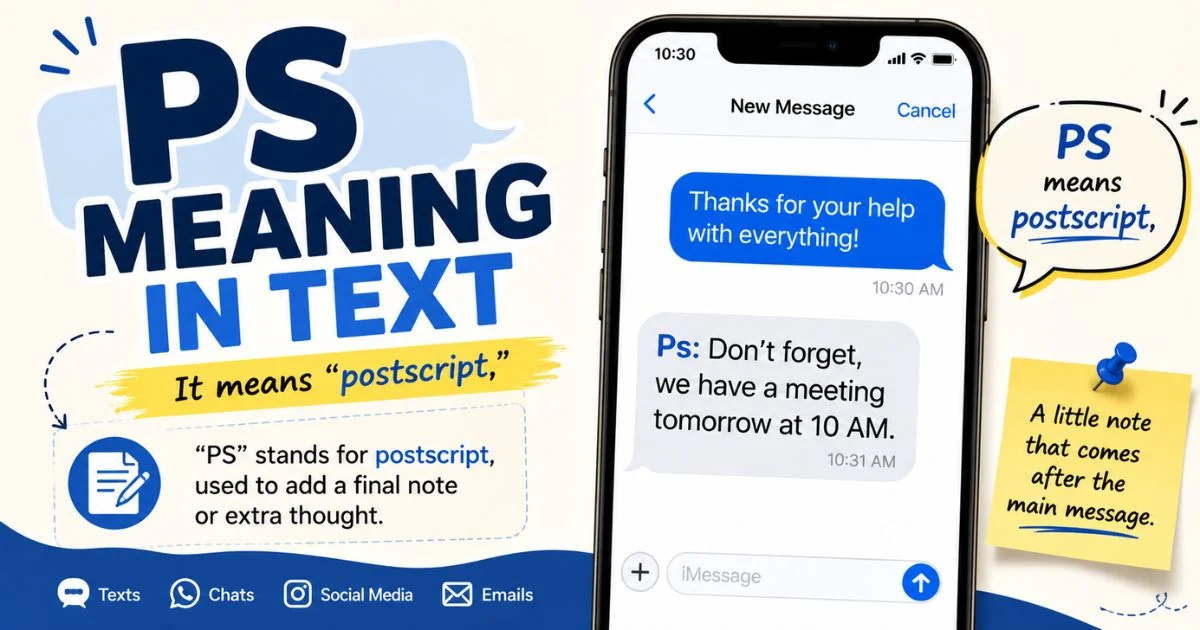
In a text message, PS (or P.S.) stands for “postscript,” which comes from the Latin phrase post scriptum, meaning “written after”. It is used to add an extra thought, reminder, or side note at the very end of a message after you have already finished your main point.
You’re texting a friend when they reply with “PS” at the end of a message, and you’re not quite sure what they mean. If you’re searching for Ps Meaning In Text, the answer is usually “postscript,” a short extra note added after the main message. It can also appear as “P.S.” in emails, letters, captions, and social media posts.
The confusion is understandable because “PS” can have different meanings depending on the conversation and context. In casual texting, it often introduces an afterthought, reminder, or extra detail that the sender forgot to mention earlier.
In this article, you’ll learn what PS means in texting, how people use it, examples of PS in messages, and how to reply naturally. Let’s look at the meaning and common uses more closely.
Read Also : Nmms Mean In A Text: Meaning, Slang & Funny Examples!
Definition of PS in Text
PS in text usually means “postscript.” It is an extra thought, note, reminder, or detail added after the main message. You may see it written as PS, P.S., or P.S.:.
For example, someone might text, “I’ll call you after work. PS: Don’t forget your keys.” The main message is about calling, while the PS adds a separate reminder.
PS is common in text messages, emails, letters, social media captions, and online chats. It is especially useful when someone remembers something after finishing their main message.
In casual texting, PS can also make a message feel more personal or playful. For example, “Great seeing you today! PS: Your new haircut looks awesome.”
The meaning is usually clear from the surrounding conversation, but context still matters. That becomes easier to understand when you look at what the abbreviation actually stands for.
What Does PS Stand For?
PS stands for “postscript.” The word comes from the Latin phrase post scriptum, meaning “written after.” It refers to something added after the main body of a written message.
The term originally became common in letters. A person could finish a letter, sign their name, and then remember an important detail. Instead of rewriting the entire letter, they could simply add a P.S. at the end.
Today, the same idea appears in digital communication. Someone might write:
“Thanks for helping me with my project. PS: I’ll send you the final file tonight.”
Here, the PS introduces information that was added after the main thought.
You may also see PPS, which means post-postscript. It is used when someone adds another note after a PS, although it is much less common in everyday texting.
Background History & Origin of PS
PS comes from the Latin phrase “post scriptum,” which means “written after.” It developed as a way for writers to add a final thought after completing the main part of a letter.
Before digital communication, a writer could finish and sign a letter and then remember an important detail. Instead of rewriting the entire letter, they could add a P.S. at the bottom.
The same idea continues today in emails, text messages, captions, and online posts. The format has changed, but the purpose remains simple: PS tells the reader that an extra thought follows the main message.
Usage in Different Contexts
PS can appear in many types of communication, but its basic purpose stays the same. It usually introduces an additional note, reminder, comment, or afterthought.
The tone can change depending on where it appears. A PS in a personal text may sound playful, while one in a business email may provide a quick reminder.
| Context | Common Use of PS |
| Texting | Extra thought or reminder |
| Letters | Final note or afterthought |
| Social media | Additional comment |
| Emails | Reminder or secondary detail |
| Personal messages | Emotional or friendly note |
| Marketing | Final message or call to action |
Casual Chat & Texting
In casual texting, PS is usually used to add something the sender remembered after writing the main message. It can be a reminder, joke, question, or personal comment.
For example:
“I’ll meet you at 6. PS: Bring some snacks.”
It can also make a message sound more relaxed:
“Thanks for helping me today! PS: You’re seriously awesome.”
Because texting is informal, you do not need to follow strict punctuation rules. PS, P.S., and PS: are all commonly understood.
Social Media
On social media, PS can add a final thought to a caption, post, or comment. It often helps the writer share a small detail without changing the main message.
For example:
“Had an amazing weekend with my favorite people. PS: We need to do this again!”
A creator might also use PS to add a reminder or playful comment:
“The new video is live! PS: Watch until the end.”
On platforms where captions are short and conversational, PS can feel natural and personal.
Professional Communication
In professional communication, PS is most useful for a secondary reminder or non-essential detail. It can appear in emails, business letters, newsletters, and other written messages.
For example:
“I’ve attached the updated report. P.S. Our meeting starts at 10 AM tomorrow.”
However, avoid using PS for information that the recipient absolutely needs. Important instructions should appear clearly in the main body of the email.
A well-placed postscript can add a friendly finishing touch without distracting from the main purpose of the message.
Emotional Messages
PS can make personal messages feel warmer because it gives the sender space for one final thought. People often use it to express affection, gratitude, encouragement, or humor.
Examples include:
- “P.S. I’m really proud of you.”
- “PS: Thanks for always being there.”
- “P.S. I miss you already.”
- “PS: You made my whole day better.”
The emotional meaning comes from the words after PS, not from the abbreviation itself. PS simply signals that the writer has added a final thought.
Meanings Across Platforms
The meaning of PS is generally consistent across messaging and social platforms. In most conversations, it means postscript or an extra note added after the main message.
However, the surrounding content can change how PS is understood. On gaming-related platforms, for example, PS may refer to PlayStation rather than postscript.
This is why context is important. Look at the words around the abbreviation before deciding what the sender means.
On WhatsApp, PS usually means “postscript.” Someone may add it after their main message to share a reminder, joke, or extra detail.
Example:
“I’ll be there around 8. PS: Can you save me a seat?”
WhatsApp conversations are informal, so people often use PS casually. If the conversation is about gaming, however, PS could refer to PlayStation, especially when terms like PS5, games, or controllers appear nearby.
On Instagram, PS can appear in captions, comments, direct messages, and Stories. It usually introduces an extra thought that does not fit naturally into the main caption.
For example:
“Beach day with the best people! PS: I definitely got sunburned.”
It can also be used for humor or a small reminder:
“New post is up. PS: Tell me your favorite photo!”
In this setting, PS often adds a conversational touch rather than serving a formal writing purpose.
TikTok
On TikTok, PS can be used in captions, comments, or direct messages to add a final thought. It may introduce a joke, clarification, or extra detail about the video.
For example:
“Trying this trend for the first time. PS: That last attempt was a disaster.”
TikTok users may also use PS in comments when they remember something after posting their original thought. The meaning is normally still postscript unless the surrounding conversation points to another meaning.
Snapchat
On Snapchat, PS may appear in chats or captions as a quick afterthought. Since Snapchat communication is usually casual, the abbreviation can be used in a playful or informal way.
Example:
“Meet me at the mall. PS: I’m already running late 😂”
The meaning remains postscript in most ordinary conversations. As with other platforms, context should guide interpretation if PS appears in a specialized conversation.
Other Fields Where PS Is Used
PS has meanings beyond texting and social media. The correct interpretation depends heavily on the subject being discussed.
Some common examples include:
- Gaming: PS can mean PlayStation.
- Physics: PS may appear as an abbreviation or symbol in specialized contexts.
- Education: PS can be used for different school-related terms depending on the institution.
- Business: Organizations may use PS as an internal abbreviation.
- Technology: PS can refer to specific software, systems, or technical terms.
These meanings are not interchangeable with postscript. If someone says “I bought a new PS5,” they clearly mean PlayStation 5, not an extra note.
Common Misconceptions & Mistakes
One common mistake is assuming that PS always means postscript. While that is the standard meaning in written messages, the abbreviation can mean something else in a different context.
Another mistake is treating PS as rude, negative, or offensive. PS itself has no insulting meaning. The tone depends on what the sender writes after it.
People also sometimes use PS for information that should have been part of the main message. If the detail is essential, placing it in the main text makes the message easier to understand.
Finally, do not confuse PS with PPS. PS means postscript, while PPS generally means post-postscript, or an additional note added after the PS.
What Does PS Mean?
In texting, PS means an extra note or afterthought added to the end of a message. It does not usually change the meaning of the main message. Instead, it gives the sender a place to add something they remembered later.
For example:
- “Dinner starts at 7. PS: Bring your jacket.”
- “I loved the movie! PS: Stay for the credits.”
- “I’ll meet you tomorrow. PS: Can you bring my book?”
The extra information often feels separate from the main conversation. That makes PS useful when the sender wants to add a quick reminder without rewriting the original message.
PS can also be used for humor, emphasis, affection, or a final thought. Someone might text, “Good luck with your exam! PS: You’ve got this!”
When you see PS in a message, the safest interpretation is “here’s one more thing I wanted to tell you.” However, abbreviations can have different meanings in specific communities or conversations, so the surrounding context should always be considered.
PS Full Form Explained
The full form of PS is “postscript.” Its older form, post scriptum, is Latin for “written after.” This explains why PS normally appears after the main part of a message.
| Term | Meaning | Common Use |
| PS | Postscript | Extra note after a message |
| P.S. | Postscript | Traditional written form |
| PPS | Post-postscript | Another note after a PS |
| Post scriptum | Written after | Original Latin expression |
The abbreviation became useful in letters because writers sometimes remembered something after completing or signing a letter. A postscript allowed them to add that information without starting over.
In modern communication, the same function remains. The difference is that PS is now often used for emails, texts, online messages, captions, and social posts.
For example, “PS: Please call me when you arrive” simply means the sender has one additional point to share. Understanding this basic meaning makes it easier to recognize how PS works in everyday messages.
How to Use PS Real Examples
Use PS when you have already finished your main message but want to add a related thought, reminder, or extra detail. Put it near the end of the message, usually after the main information.
Here are some realistic examples:
Friendly text:
“I had a great time today! PS: Thanks for the coffee.”
Reminder:
“I’ll see you at 6 PM. PS: Don’t forget the tickets.”
Funny message:
“Your birthday gift is ready. PS: No, I’m not telling you what it is!”
Work message:
“I’ve attached the updated report. PS: I also corrected the final table.”
Social media caption:
“Weekend well spent with good friends. PS: We definitely need to do this again.”
Romantic message:
“Thanks for making my day better. PS: I miss you already.”
You do not need to use periods between the letters. PS and P.S. are both widely understood, although P.S. is more traditional.
For casual texting, keep the postscript short and relevant. If the extra information is long or important, it is usually clearer to include it in the main message instead.
Read More: LBVS Meaning in Text (Definition, Examples & Text Usage)
What Does “PS” Mean? How to Use It Correctly
PS usually means “postscript,” or an extra thought added after the main message. It is commonly used in texts, emails, letters, notes, and social media captions when someone wants to add one more detail.
For example: “I’ll see you at 7 PM. PS: Bring your jacket.” The first sentence gives the main information, while the PS adds a reminder.
Use PS when the additional thought feels separate from the main message. You can write it as PS, P.S., or P.S.:. All are easily understood.
A simple format is:
Main message → PS → Extra detail
For casual texting, PS can also make a message feel friendly or playful. It is not limited to formal writing, so you can use it naturally in everyday conversations.
What’s the meaning of PS in letters?
In letters, PS means “postscript.” It traditionally appears after the main body of a letter, often after the writer has finished or signed it.
People used PS when they remembered something they wanted to add without rewriting the entire letter. For example:
“P.S. Please send me the photos when you get a chance.”
The postscript may contain a reminder, personal comment, extra information, or even a humorous closing thought.
Although modern letters are less common than digital messages, the traditional use of PS remains the same. It signals that the writer has one more thing to say.
PS in emails and other digital communications
In emails, PS is often used to add a final reminder, personal note, or extra detail after the main message. It can appear after the closing or at the very end of an informal email.
For example:
“Thanks for sending the details. I’ll review everything tonight.
P.S. Don’t forget our meeting tomorrow.”
PS also works in:
- Text messages
- Social media captions
- Direct messages
- Online comments
- Newsletters
- Personal notes
In professional emails, use PS sparingly. If the information is essential, place it in the main body instead. A postscript works best for something useful but secondary.
Is PS Rude or Offensive?
No, PS is not normally rude or offensive. It is a neutral abbreviation used to introduce an additional thought or message.
The tone depends more on the words that follow PS than on the abbreviation itself. For example, “PS: Thanks again!” sounds friendly, while “PS: You forgot your keys again” could sound annoyed depending on the relationship and conversation.
In casual communication, PS can even make a message warmer or more personal. Context, punctuation, and the sender’s overall tone all matter when interpreting it.
Common Uses of PS
PS has several common uses in everyday communication. The most frequent one is adding something that the sender remembered after writing the main message.
1. Adding a reminder
“P.S. Bring your ID tomorrow.”
2. Sharing an afterthought
“P.S. I forgot to tell you that Sarah called.”
3. Adding humor
“P.S. I still expect you to win the rematch.”
4. Showing affection
“P.S. Love you!”
5. Adding a useful detail
“P.S. The restaurant closes at 10.”
6. Making a final comment
“P.S. Your presentation was really good.”
These examples all follow the same basic idea: PS introduces information that comes after the main message.
Read More : TTY Meaning in Text (Definition, Uses, and Text Examples)
PS Alternatives and Similar Slang
There is no exact slang replacement for PS, but several phrases can serve a similar purpose in casual conversations.
| Alternative | Meaning | Example |
| BTW | By the way | “BTW, I’ll be late.” |
| Oh, and… | Adds another thought | “Oh, and bring your charger.” |
| Also… | Adds information | “Also, check your email.” |
| One more thing… | Introduces a final point | “One more thing: call me.” |
| BTW, | Casual extra detail | “BTW, happy birthday!” |
BTW is especially common in texting, while PS feels more like a deliberate final note. The best choice depends on the tone and type of conversation.
Primary Meaning
The primary meaning of PS in text is “postscript.” It refers to an extra note or thought added after the main message.
A quick example is:
“I’ll call you tonight. PS: Don’t forget the documents.”
Here, the first sentence is the main message. The PS introduces an additional reminder.
This meaning is the standard use in letters, emails, texts, and other written communication. It comes from the Latin post scriptum, meaning “written after.”
Secondary Meanings (Context-Based)
Although postscript is the standard meaning, abbreviations can sometimes have different meanings in specific contexts. For example, PS can refer to PlayStation when people are discussing video games.
It can also appear as an abbreviation for other terms in specialized subjects, organizations, names, or online communities. Therefore, context matters when PS appears outside normal written communication.
| Context | Possible Meaning |
| Texts and letters | Postscript |
| Emails | Postscript |
| Gaming | PlayStation |
| Business or technical writing | May have a specialized meaning |
| Casual chat | Usually postscript |
If someone writes “PS5,” for example, they almost certainly mean PlayStation 5, not postscript. Looking at the surrounding words usually makes the intended meaning clear.
Simple Examples
Seeing PS in complete messages makes its meaning easier to understand.
- “Dinner is at 8. PS: Bring your jacket.” — Adds a reminder.
- “Thanks for helping me today. P.S. You’re the best!” — Adds a personal note.
- “I sent the email. PS: Check your spam folder if you don’t see it.” — Adds useful information.
- “Great job on the test! PS: I knew you could do it.” — Adds encouragement.
- “See you tomorrow. PS: Don’t be late!” — Adds a final reminder.
- “That movie was amazing. P.S. The ending surprised me.” — Adds an extra opinion.
In each example, PS tells the reader that the sender has one additional thought after the main message.
Similar Terms & Alternatives
If you want to express the same idea as PS, several phrases work well depending on the situation. In casual texting, “BTW” (by the way) is one of the closest alternatives because it introduces an extra thought.
Other natural alternatives include:
- BTW — adds another piece of information.
- Oh, and… — sounds casual and conversational.
- One more thing… — introduces a final detail.
- Also… — adds related information.
- Before I forget… — useful for reminders.
- Quick note… — works well in messages and emails.
PS is slightly different because it usually appears after the main message. These alternatives can appear anywhere in a conversation.
Read More: WYGG Meaning in Text (Definition, Uses & Examples)
How to Respond to PS (With Chat Examples)
You usually do not need a special response to PS. Simply respond to the information that follows it, just as you would respond to any other part of the message.
Example 1: Reminder
Them: “I’ll meet you at 7. PS: Bring your charger.”
You: “Sure, I’ll bring it.”
Example 2: Friendly message
Them: “Thanks for helping me today. PS: You’re awesome!”
You: “Haha, thanks! Glad I could help.”
Example 3: Funny PS
Them: “Dinner is ready. PS: I didn’t burn anything this time 😂”
You: “That deserves a celebration 😂”
Example 4: Romantic message
Them: “Goodnight. PS: I miss you.”
You: “Goodnight ❤️ I miss you too.”
The key is to focus on the actual words after PS. The abbreviation itself usually does not require a separate explanation or response.
Differences From Similar Words
PS is related to several expressions that introduce additional information, but they are not exactly interchangeable.
| Term | Main Meaning | Typical Position |
| PS | An extra thought after the main message | Usually at the end |
| BTW | By the way | Anywhere in a message |
| Also | Adds related information | Usually within the message |
| FYI | For your information | Often before useful information |
| PPS | Another note after a PS | After PS |
For example, “BTW, I’ll be late” adds information during the conversation. “PS: I’ll be late” sounds more like a final note added after the main message.
FYI is also different because it usually introduces information the reader should know, while PS simply signals an additional thought.
Relevance in Online Conversations & Dating Apps
PS can appear in online conversations, dating apps, direct messages, and social platforms. Its meaning remains the same in most cases: an extra thought added after the main message.
In dating conversations, the words after PS may carry a more personal or playful tone.
For example:
“I had a great time tonight. PS: Your laugh is adorable.”
Or:
“Goodnight! PS: I’m looking forward to seeing you again.”
However, PS itself is not a secret dating code. Its meaning comes from the message around it. If someone uses PS in a romantic conversation, pay attention to the actual wording and overall tone rather than assuming the abbreviation has a hidden meaning.
Popularity & Trends Over Time
PS has remained useful because the communication style it represents has stayed relevant. It began as a feature of letters and later moved naturally into emails, messages, captions, and social media.
Its traditional form, P.S., is still common in personal writing. In casual digital communication, people may shorten it to PS because texting favors quick and simple formatting.
There is no single trend that gives PS a new universal meaning in modern texting. Its most common interpretation remains postscript, although context-specific meanings such as PlayStation are also widely recognized.
PS Meaning in Letter
In a letter, PS means “postscript.” It is an additional note written after the main body of the letter.
For example:
“I hope you have a wonderful trip.
P.S. Call me when you arrive.”
The writer has already completed the main thought but adds one final detail.
A PS in a letter can contain a reminder, personal message, joke, clarification, or extra information. Its purpose is to let the reader know that the following sentence is an additional thought rather than part of the main letter.
Meaning of PS I Love You
In “PS, I Love You,” PS still means “postscript.” The phrase suggests that “I love you” is an additional final message added after the main communication.
The phrase is also strongly associated with the title P.S. I Love You, a romantic novel by Cecelia Ahern and its 2007 film adaptation. In that context, the phrase has an emotional meaning because the postscript carries a personal message of love.
In ordinary texting, however, someone writing “PS: I love you” simply means they are adding “I love you” as a final thought.
PS Meaning in Text from a Guy
If a guy sends “PS” in a text, it normally means postscript, just as it does when anyone else uses it. The abbreviation itself does not indicate romantic interest or a particular feeling.
The meaning depends on what he writes afterward.
For example:
“See you tomorrow. PS: Looking forward to it.”
This could be friendly or romantic depending on the wider conversation. Similarly, “PS: I miss you” carries a personal message, but the emotional meaning comes from “I miss you,” not from PS.
Look at his word choice, tone, relationship with you, and the surrounding conversation rather than treating PS as a hidden signal.
PS Meaning in Text from a Girl
When a girl uses PS in a text, it generally has the same meaning: postscript or an extra thought added at the end.
For example:
“Thanks for today! PS: I had so much fun.”
The PS simply adds a final personal comment.
It does not automatically mean that she is flirting, interested romantically, or trying to send a secret message. The words after PS and the overall context provide much more useful information about her intended tone.
Conclusion
Understanding PS Meaning In Text is simple once you know that it usually stands for “postscript,” an extra thought added after the main message. It can appear in texts, letters, emails, social media posts, and direct messages to add a reminder, personal note, or final comment.
Throughout this article, we explored the meaning, full form, real examples, platform-specific uses, possible alternatives, and natural ways to respond to PS. We also covered how context can change its meaning, such as when PS refers to PlayStation.
With this knowledge, you can easily recognize what PS means and use it naturally in everyday conversations.
FAQs About Ps Meaning In Text
1. What Does PS Mean In Gen Z?
In Gen Z conversations, PS usually means “postscript,” or an extra thought added after the main message. It is not generally a special Gen Z slang term. The context determines whether PS means postscript or something else, such as PlayStation.
2. How To Use PS In Social Media?
Use PS at the end of a caption, comment, or message when you want to add a final thought, reminder, joke, or personal note. For example: “Great weekend with friends! PS: We need to do this again.”
3. What Does My PS Mean In Slang?
“My PS” does not have one fixed slang meaning. In a normal text or social media conversation, PS usually means “postscript,” meaning an extra note added after the main message. The surrounding conversation can provide a different meaning.
4. What Does PS I Love You Meaning?
“P.S. I Love You” means “postscript, I love you.” The phrase presents “I love you” as a final message or afterthought. It is also the title of a novel by Cecelia Ahern and its 2007 film adaptation.
5. Is PS Rude In Texting?
No, PS is not normally rude or offensive. It simply introduces an additional thought. The tone depends on the words that follow it and the context of the conversation.
6. What Does PS Stand For In A Text?
PS stands for “postscript,” from the Latin post scriptum, meaning “written after.” In texting, it usually introduces an extra detail, reminder, joke, or final thought after the main message.

Hi, I am James Whitman, the author of Skypunz.com. I create funny puns and jokes to make your day brighter and bring a smile to every reader.