
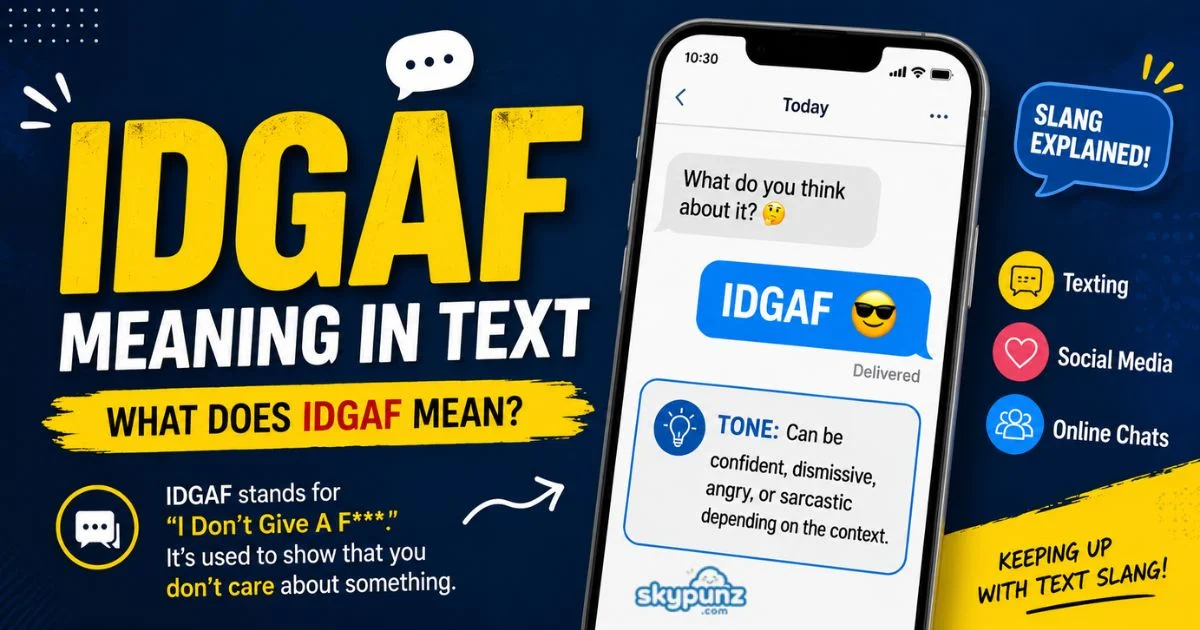
IDGAF Meaning in Text can feel a little blunt or confusing when a friend suddenly uses it in a message. IDGAF stands for “I don’t give a f” and usually shows that someone does not care about a situation, opinion, or outcome. This text slang can sound dismissive, angry, confident, or even playful, depending on the conversation and tone.
Understanding this text abbreviation can help you read the speaker’s meaning correctly and avoid taking the message the wrong way. You may see IDGAF in text messages, social media posts, online chats, gaming conversations, and casual speech. Each example can show a slightly different context or attitude.
Knowing how people use this internet slang also helps you decide when IDGAF fits a conversation and when it may sound too rude or informal. Let’s look at its common uses, meanings, and real-life examples.
IDGAF Meaning in Text + Definition
IDGAF means “I don’t give a f***.” People use this slang abbreviation to show that they do not care about something or do not feel affected by it. The phrase often carries a strong, blunt, or rebellious tone.
The exact feeling depends on the conversation. Someone may use IDGAF seriously when they feel annoyed, or casually when they want to show confidence or indifference. Because it contains profanity, it usually fits informal conversations rather than professional or polite settings.
Read Next: TTYS Meaning in Text: What Does It Really Mean? (2026)
Quick Definition Table
| Term | Meaning | Common Use | Tone |
| IDGAF | I don’t give a f*** | Texts, chats, social media | Blunt or dismissive |
| IDGAF about it | I do not care about it | Showing indifference | Strong |
| IDGAF anymore | I no longer care | Expressing frustration or detachment | Emotional |
| IDGAF what they think | Their opinion does not matter to me | Showing confidence | Defiant |
What Does IDGAF Mean in a Text Message?
In a text message, IDGAF usually means “I don’t give a f***.” The sender uses it to say that something does not matter to them, or that they have stopped caring about another person’s opinion or reaction.
The abbreviation can express different emotions. It may sound angry, frustrated, confident, careless, or joking. Context matters because the same three letters can feel very different depending on the words around them.
IDGAF can also make a message sound stronger than simply saying “I don’t care.” For that reason, it can come across as rude or aggressive, especially when someone uses it during an argument.
Example
Person A: “People are going to complain about your new style.”
Person B: “IDGAF. I like it.”
Here, IDGAF shows that Person B does not care about other people’s opinions. The reply sounds confident and slightly defiant.
Another example:
Person A: “Are you still upset about what he said?”
Person B: “No, IDGAF anymore.”
In this case, the abbreviation shows emotional detachment. The person says they have stopped caring about the situation.
The Origin of IDGAF
IDGAF developed from the phrase “I don’t give a f***,” which people shortened into an initialism for faster and easier communication. Like many internet abbreviations, it became useful because people could express a strong idea with only a few letters.
The phrase itself existed before social media and modern texting became common. Written examples of similar profanity-based expressions appeared in informal English long before smartphones. Digital communication helped turn the longer phrase into a recognizable abbreviation.
When the Abbreviation Became Popular
IDGAF became more visible as texting, online forums, instant messaging, and social media grew. People began shortening common phrases to save time and create a casual online style.
Its popularity also grew through music, entertainment, memes, and youth internet culture. Today, many people recognize IDGAF even when they do not personally use the expression.
The abbreviation remains strongly informal because it represents a profanity-based phrase. Readers should consider the audience and setting before using it.
Keep Reading: LOML Meaning in Text: Is It Love or Just Internet Slang? 2026
How Internet Slang Influenced IDGAF
Internet slang made short abbreviations a normal part of online communication. Terms such as LOL, OMG, WTF, and IDK showed that people could communicate familiar phrases without writing every word.
IDGAF fits this pattern but carries a much stronger tone. Its meaning combines an abbreviation with an emotional attitude, usually indifference or defiance.
Online communities also helped spread the term across different platforms. As users moved between text messages, forums, social networks, gaming chats, and comment sections, slang such as IDGAF became easier to recognize.
How IDGAF Is Used Today
People still use IDGAF mainly in informal digital conversations. It can communicate indifference, frustration, confidence, or a refusal to worry about other people’s opinions.
The meaning stays fairly consistent, but the tone changes with the situation. A close friend might use it jokingly, while someone in an argument may use it to sound openly dismissive.
1. Text Messaging
IDGAF appears often in private texts between friends or people who use casual language. It lets the sender make a strong statement without typing the full phrase.
Example:
“IDGAF what they say. I’m doing what feels right.”
The message shows confidence and a lack of concern about outside opinions. Still, the profanity can make the message sound harsh.
2. Social Media
On social media, people may use IDGAF in captions, posts, replies, or short status updates. It often appears when someone wants to show independence or say that they will not worry about criticism.
Example:
“IDGAF about the comments. I’m happy with my choice.”
Here, the abbreviation creates a bold and unapologetic tone. The surrounding message helps readers understand whether the person feels serious, playful, or frustrated.
3. Online Discussions
People sometimes use IDGAF during online arguments or debates. In these situations, it usually signals that the person does not want to accept another opinion or continue worrying about the discussion.
Example:
“You can disagree with me. IDGAF.”
This response sounds dismissive and can end a conversation quickly. Because of its strong tone, using IDGAF in a debate may make the discussion more hostile.
4. Gaming Chats
Gamers may use IDGAF in fast-moving chats when reacting to criticism, losses, strategies, or other players. The abbreviation can show frustration or a carefree attitude.
Example:
“IDGAF about the score. I’m just playing for fun.”
In this setting, the phrase can sound casual rather than seriously angry. Friends who already understand each other’s humor may use it without taking offense.
5. Comment Sections
IDGAF can appear in comment sections when users respond to criticism or unwanted opinions. A person may use it to make it clear that they will not change their behavior because of other people’s reactions.
Example:
“IDGAF if you don’t like my outfit.”
The comment communicates confidence, but it can also sound rude. Readers should look at the full conversation before deciding how seriously to take the statement.
6. Meme Culture
Meme culture often uses IDGAF to express exaggerated confidence, humor, or complete indifference. A meme may pair the abbreviation with a funny image to show that a character ignores rules, criticism, or an awkward situation.
Example:
“Everyone told him not to dance, but IDGAF was basically his attitude.”
In memes, the phrase does not always represent genuine anger. It may simply create a dramatic or humorous reaction. The image, caption, and surrounding comments usually reveal the intended tone.
Because meme language changes quickly, IDGAF can also appear alongside newer slang and internet expressions. Its basic meaning remains the same, but users may adapt it to fit different jokes and online situations.
Continue Reading: GBTS Meaning in Text: What Does This Slang Really Mean? 2026
Examples of IDGAF in Text Conversations
IDGAF can carry different meanings depending on the situation and the relationship between the people texting. The words stay the same, but the tone can change from confident and playful to frustrated or harsh. Looking at the surrounding message helps you understand what the sender really means.
Confident Tone
A confident use of IDGAF shows that someone feels comfortable with their choice and does not worry about other people’s opinions.
Example:
“IDGAF what they think. I like my new style.”
Here, the sender sounds confident and comfortable with their decision. The message focuses on personal choice rather than anger.
Frustrated Tone
Someone may use IDGAF after dealing with the same problem for a long time. In this case, the abbreviation can show emotional exhaustion or frustration.
Example:
“I tried explaining it three times. IDGAF anymore.”
The sender likely feels tired of the situation. The phrase shows that they no longer want to spend energy on the problem.
Humorous Tone
Friends sometimes use IDGAF as a joke. The humor often comes from exaggerating how little they care about a small or unimportant situation.
Example:
“IDGAF about the diet today. I’m ordering pizza.”
The sender probably does not express serious anger. Instead, the phrase adds humor and makes the message sound playful.
Dismissive Tone
A dismissive use of IDGAF shows that someone does not want to consider another person’s opinion or argument.
Example:
“You can keep complaining. IDGAF.”
This reply sounds cold and uninterested. It can quickly end a conversation, especially when the other person expects a serious response.
Independent Tone
IDGAF can also show independence when someone chooses to follow their own preferences instead of seeking approval.
Example:
“IDGAF if nobody comes with me. I’m still going.”
The sender emphasizes personal freedom. The phrase shows that other people’s decisions will not change their plans.
See More: ISO Meaning in Text: What It Really Means in Chats! (2026)
Tone of IDGAF in Texting
The tone of IDGAF depends heavily on context, punctuation, previous messages, and the relationship between the people involved. A close friend may understand it as playful, while someone unfamiliar with the sender may read it as rude.
Before replying, consider the complete conversation rather than focusing only on the abbreviation. The words around IDGAF often reveal whether the sender feels relaxed, annoyed, sarcastic, or genuinely angry.
Friendly Tone
Among close friends, IDGAF can appear in casual jokes or playful conversations. Familiarity can make the strong language feel less serious.
Example:
“IDGAF what movie we watch. You pick.”
The sender simply gives the other person freedom to choose. In this context, the phrase may sound relaxed rather than aggressive.
Neutral Tone
A neutral use of IDGAF communicates a lack of concern without showing strong emotion. The surrounding message usually keeps the statement straightforward.
Example:
“IDGAF which restaurant we choose. Any place is fine.”
The sender does not strongly object to any option. The abbreviation simply communicates that the choice does not matter to them.
Strong Tone
A strong tone makes IDGAF sound firm and serious. People often use it when they want to make their position very clear.
Example:
“IDGAF what anyone says. I’m making my own decision.”
The sender strongly rejects outside pressure. The wording creates a forceful and determined impression.
Sarcastic Tone
IDGAF can also work as sarcasm when the sender exaggerates their lack of concern for comic effect.
Example:
“IDGAF about being five minutes late. It’s only five minutes.”
The sender may actually know that being late matters but uses the phrase jokingly. The surrounding situation helps reveal the sarcasm.
Rude or Harsh Tone
IDGAF can sound rude when someone uses it to reject another person’s feelings, concerns, or opinions. This tone becomes especially clear during an argument.
Example:
“You already told me your opinion. IDGAF.”
This response sounds openly dismissive. Because IDGAF contains profanity, it can easily offend someone, so it works best in informal settings where the relationship and context support that language.
IDGAF Examples by Context
IDGAF can appear in many casual online conversations. The basic meaning stays the same, but the tone can change based on the situation, relationship, and surrounding words.
Texting a Friend
Friends may use IDGAF to show that they do not care about a small problem or another person’s opinion.
Example:
“IDGAF what we eat tonight. You choose.”
Here, the sender simply says that the choice does not matter to them.
Social Media
On social media, IDGAF often appears in posts or captions that show confidence or a carefree attitude.
Example:
“IDGAF about the negative comments. I’m having fun.”
The phrase shows that the person does not want criticism to affect them.
Group Chat
In a group chat, someone may use IDGAF when several people discuss a decision or disagree about a topic.
Example:
“IDGAF which movie we watch. Just pick one.”
This use can sound casual, especially when friends already understand the sender’s communication style.
Gaming Chat
Gamers may use IDGAF when talking about scores, losses, strategies, or other players.
Example:
“IDGAF if we lose. I’m just here to have fun.”
The message shows that winning is not important to the speaker.
Online Discussion
During an online discussion, IDGAF can show that someone does not want to change their opinion because of criticism.
Example:
“You disagree with my choice? IDGAF.”
This wording sounds firm and dismissive. It can also make an argument feel more hostile.
Comments and Replies
People may use IDGAF when responding directly to criticism or unwanted opinions in comment sections.
Example:
“IDGAF if you don’t like my post.”
The sender clearly says that negative reactions will not change their decision. Because the phrase contains profanity, the reply can sound aggressive.
Explore This: JSP Meaning in Text: Stop Guessing Its Real Meaning! 2026
Why People Use IDGAF
People use IDGAF because it communicates a strong message in only a few letters. It can show indifference, confidence, frustration, independence, or a desire to stop discussing something.
The reason behind the abbreviation often depends on the situation. Understanding that context helps you decide whether the sender sounds serious, playful, annoyed, or dismissive.
Saves Time
IDGAF is much shorter than writing the complete phrase. Short abbreviations work well in fast conversations where people want to respond quickly.
For example, “IDGAF what happens” takes less space than the full expression. This makes the abbreviation convenient for texting and online chats.
Shows Strong Emotion
IDGAF can express a strong emotional reaction. The sender may use it when they feel frustrated, angry, confident, or completely uninterested.
The profanity also gives the message more force than a simple statement such as “I don’t care.”
Expresses Independence
People often use IDGAF to show that they make their own choices without worrying about outside opinions.
Example:
“IDGAF what everyone thinks. I’m doing it my way.”
The message emphasizes personal freedom and confidence.
Sets a Clear Boundary
IDGAF can signal that someone does not want to continue discussing a topic. It may communicate that another person’s opinion will not affect their decision.
Example:
“I’ve made my decision. IDGAF what they say.”
Although this creates a clear boundary, the wording may sound harsh depending on the relationship.
Popular on Social Media
Social media has helped spread short forms, slang, and casual expressions. IDGAF fits platforms where users often communicate through short captions, comments, memes, and replies.
Its recognizable form lets people express a strong attitude without writing the entire phrase.
Fits Casual Conversations
IDGAF works best in informal communication. Friends may use it in texts, group chats, gaming conversations, or social media interactions.
It usually does not fit professional emails, workplace messages, school assignments, or other formal situations because of its profanity and strong tone.
Adds Emphasis to a Message
IDGAF can make a statement sound stronger and more direct. Instead of simply saying that something does not matter, the sender uses the abbreviation to emphasize complete indifference.
Example:
“IDGAF about the result. I enjoyed the experience.”
Here, the abbreviation makes the speaker’s lack of concern very clear.
Discover More Meanings: BRB Meaning in Text: What It Really Means Today! 2026
IDGAF vs Similar Texting Abbreviations
IDGAF shares a similar idea with several common texting abbreviations, but the tone and meaning are not always the same. Some expressions simply show that something does not matter, while IDGAF adds a stronger and more emotional edge.
IDGAF vs IDC
IDGAF means “I don’t give a f***,” while IDC means “I don’t care.” Both expressions show indifference, but IDGAF sounds much stronger because it includes profanity.
Example:
“IDC what they choose.” sounds fairly casual.
“IDGAF what they choose.” sounds more forceful and dismissive.
IDGAF vs I Don’t Care
“I don’t care” communicates the same basic idea without using an abbreviation or profanity. It can work in more situations because it usually sounds less aggressive.
IDGAF feels more informal and intense. The better choice depends on how strongly you want to express your lack of concern.
IDGAF vs Whatever
“Whatever” can show indifference, annoyance, or a desire to end a conversation. Its meaning depends heavily on context and can sometimes sound passive-aggressive.
IDGAF gives a much clearer message of strong indifference. Both can sound dismissive, but IDGAF usually carries more force.
IDGAF vs IDK
IDK means “I don’t know.” It shows uncertainty or a lack of information, not a lack of concern.
For example, “IDK where he went” means the sender does not know his location. “IDGAF where he went” means the sender does not care where he went. The two abbreviations communicate very different ideas.
IDGAF vs IMO
IMO means “in my opinion.” People use it when sharing a personal view or judgment.
IDGAF does not introduce an opinion. Instead, it shows that the speaker does not care about something. These abbreviations can sometimes appear in the same conversation, but they serve different purposes.
Alternative Ways to Say IDGAF
You can express the same basic idea without always using IDGAF. The best alternative depends on how casual, polite, funny, or direct you want the message to sound.
Casual Alternatives
Casual phrases work well when talking with friends or people who understand your communication style.
Examples include:
- “I don’t care.”
- “It doesn’t matter to me.”
- “I’m not worried about it.”
- “Whatever works.”
- “I’m good either way.”
These options usually sound less intense than IDGAF.
Polite Alternatives
Polite wording helps when you want to communicate indifference without sounding disrespectful.
Examples include:
- “I’m fine with either option.”
- “It’s up to you.”
- “I don’t have a preference.”
- “Either choice works for me.”
- “I’m not concerned about it.”
These phrases work better in conversations where respect and professionalism matter.
Less Aggressive Alternatives
Sometimes you want to show that something does not bother you without creating tension.
You could say:
- “I’m not bothered by it.”
- “It doesn’t really affect me.”
- “I’m not worried about what they think.”
- “I’ll let them have their opinion.”
- “It’s not a big deal to me.”
These expressions communicate confidence or indifference without the harshness of profanity.
Funny Alternatives
Humorous alternatives can make a message playful instead of confrontational.
Examples include:
- “My care level is officially zero.”
- “Couldn’t care less.”
- “Not even a little bothered.”
- “Care mode: off.”
- “That’s tomorrow’s problem.”
The right choice depends on the joke and the relationship between the people involved.
More Direct Alternatives
When you want to be clear without using IDGAF, direct language can work well.
Examples include:
- “I don’t care what they think.”
- “Their opinion won’t change my decision.”
- “I’m doing what I want.”
- “That does not matter to me.”
- “I’ve made my choice.”
These phrases leave less room for confusion while avoiding profanity.
Explore More Slang: IDEK Meaning in Text: What It Really Means Quick Explained! 2026
When Should You Use IDGAF?
IDGAF works best when you are having an informal conversation with people who understand your style. It can show confidence, frustration, humor, or strong indifference.
Because the phrase contains profanity, think about the setting before using it. The same message that sounds funny among close friends may sound disrespectful to a teacher, coworker, customer, or stranger.
Good Situations
IDGAF can fit casual situations such as:
- Texting close friends
- Talking in a private group chat
- Sharing a joke with people you know well
- Casual gaming conversations
- Informal social media posts
- Responding playfully to minor criticism
Even in these settings, make sure the people involved are comfortable with strong language.
Situations to Avoid
Avoid IDGAF when the conversation requires professional or respectful language.
Examples include:
- Workplace emails
- Job interviews
- Customer service conversations
- School assignments
- Formal messages
- Professional meetings
- Serious conversations with unfamiliar people
In these settings, a calmer phrase such as “I don’t have a preference” or “It doesn’t concern me” usually works better.
Knowing Your Audience
Your audience plays a major role in how IDGAF will be understood. A close friend may read it as a joke, while someone you barely know may see it as rude.
Think about your relationship with the person before sending the message. If you are unsure how they will react, choose a softer expression.
Considering the Conversation Tone
Look at the tone of the conversation before using IDGAF. If everyone is joking and using casual slang, the abbreviation may fit naturally.
If the conversation already involves anger or conflict, IDGAF can make the situation worse. A calmer response may communicate the same idea without adding unnecessary tension.
Discover the Meaning: HB Meaning in Text (Slang, Definition & Uses)
Is IDGAF Rude?
IDGAF can sound rude, but the level of rudeness depends on the context, relationship, and tone of the conversation. The abbreviation contains profanity and often expresses strong indifference, so some people may find it disrespectful.
Close friends may use it casually without intending to offend anyone. However, using IDGAF toward a stranger, coworker, teacher, customer, or someone during a serious conversation can sound dismissive.
Why IDGAF Can Sound Harsh
IDGAF includes profanity, which gives the statement more emotional force than simply saying “I don’t care.” It can make the sender appear angry, impatient, or unwilling to listen.
For example, “IDGAF what you think” can sound like a direct rejection of another person’s opinion. The wording may feel confrontational, especially during an argument.
When IDGAF Sounds Casual
IDGAF can sound casual when friends use it jokingly or when the topic does not involve serious feelings. Familiarity can make strong slang feel less offensive between people who communicate that way.
For example, “IDGAF which pizza we get 😂” may simply mean that the sender is happy with any choice. The emoji and relaxed topic make the message feel more playful.
How Context Changes the Meaning
Context helps determine whether IDGAF sounds funny, confident, frustrated, or rude. Look at the surrounding words, punctuation, emojis, topic, and relationship between the people involved.
“IDGAF about the weather” may sound carefree, while “IDGAF about your feelings” can sound intentionally hurtful. The same abbreviation can therefore create very different reactions.
Check the Meaning: NTY Meaning in Text (Origin, Platforms & Real Examples)
Is IDGAF a Bad Word?
IDGAF itself is not a traditional dictionary word. It is an abbreviation for a phrase that contains the profanity “f***.” Because of that, many people consider IDGAF inappropriate in formal or family-friendly settings.
Whether someone considers it a “bad word” depends on their personal standards and the situation. In casual internet slang, people may use it freely, but that does not make it suitable for every audience.
Understanding the Profanity
The final word in the phrase represented by IDGAF is a strong English swear word. It adds emphasis and emotion to the expression.
That profanity makes IDGAF stronger than phrases such as “I don’t care,” “It does not matter,” or “I have no preference.” Readers should understand this difference before using the abbreviation.
Why Some People Avoid IDGAF
Some people avoid IDGAF because they dislike profanity or prefer respectful language. Others may avoid it because they do not want their message to sound angry, careless, or aggressive.
People may also avoid it in professional communication. A workplace message that uses IDGAF could create a negative impression even if the sender only intended to sound casual.
When a Cleaner Alternative Works Better
A cleaner alternative works better when you want to express the same idea without profanity. Options such as “I don’t mind,” “It’s up to you,” or “I’m not concerned about it” can communicate indifference more politely.
For example, instead of saying “IDGAF which option you choose,” you could say, “Either option works for me.” The second version keeps the meaning while creating a calmer tone.
Alternate Meanings of IDGAF
IDGAF has one widely recognized meaning in texting and internet slang: “I don’t give a f***.” People normally use it to express strong indifference or a lack of concern.
Unlike some abbreviations that have several established definitions, IDGAF does not commonly have another standard texting meaning. Still, unusual uses can appear in specific communities, usernames, jokes, or private conversations.
Does IDGAF Have Other Common Meanings?
No widely accepted alternative meaning competes with “I don’t give a f***” in ordinary texting and social media conversations. If someone sends IDGAF without additional explanation, this is usually the meaning they intend.
A private group or specific online community could assign its own meaning to an abbreviation. However, that would depend on the group rather than representing a common definition of IDGAF.
How Context Helps Identify the Meaning
The surrounding message usually makes the intended meaning clear. If someone writes “IDGAF what they say,” the abbreviation clearly expresses indifference toward other people’s opinions.
When the context seems unusual, check the messages before and after IDGAF. The topic, wording, and relationship between the speakers can help you understand whether the sender means genuine indifference, humor, frustration, or another community-specific use.
Common Mistakes When Using IDGAF
IDGAF works best in informal conversations where strong slang feels natural. Problems can arise when someone uses it without thinking about the audience, situation, or emotional tone. A little context can help you avoid sending the wrong message.
Using It in Professional Settings
IDGAF usually does not belong in professional communication. Using it with a manager, client, teacher, customer, or coworker can make you sound disrespectful or careless.
Choose clearer and more professional wording instead. Phrases such as “I don’t have a preference” or “It does not concern me” can communicate the same basic idea without profanity.
Assuming Everyone Is Comfortable With It
Not everyone uses or accepts profanity in casual conversations. Some people may find IDGAF offensive even when the sender intends it as a joke.
Consider your relationship with the reader before using strong slang. If you do not know how they communicate, a cleaner expression is usually safer.
Confusing It With IDC
IDGAF and IDC both express a lack of concern, but they do not have the same strength. IDC means “I don’t care,” while IDGAF represents a more forceful version that includes profanity.
For example, “IDC which movie we watch” can sound neutral or relaxed. “IDGAF which movie we watch” sounds much stronger and may appear dismissive.
Using It Without Considering Tone
Text messages do not carry facial expressions or voice tone, so readers may interpret IDGAF differently from what you intended. A phrase meant as humor can look serious when the reader cannot hear your voice.
Emojis, surrounding words, and the relationship between the speakers can provide useful context. Still, if the situation feels sensitive, a clearer and softer phrase may work better.
Using It in Serious Conversations
IDGAF can make serious conversations more difficult, especially when someone is discussing their feelings or a personal problem. Saying it at the wrong moment may make the other person feel ignored.
If the conversation involves conflict, grief, relationships, or another sensitive subject, take a moment before responding. Calm and respectful wording can prevent unnecessary tension.
How to Reply to IDGAF in a Text
The best reply depends on why the person used IDGAF. They may be joking, frustrated, confident, or trying to end the conversation. Read the surrounding messages before choosing your response.
Casual Replies
When the conversation feels relaxed, you can respond in a simple and friendly way.
Examples:
- “Fair enough.”
- “Got it.”
- “Okay, your choice.”
- “No worries.”
- “That works.”
These replies acknowledge the message without creating extra tension.
Respectful Replies
If IDGAF sounds serious or harsh, keep your response calm. You do not need to match the sender’s strong language.
Examples:
- “I understand. I just wanted to share my opinion.”
- “That’s okay. We can leave it there.”
- “I respect your decision.”
- “Understood. I won’t push the topic.”
A calm response can keep the conversation respectful.
Funny Replies
If a close friend uses IDGAF jokingly, you can respond with similar humor.
Examples:
- “Noted. Zero cares detected.”
- “Message received loud and clear.”
- “Okay, Captain Unbothered.”
- “Your care level has left the chat.”
These replies work best when both people understand the joke and normally use playful language.
When to Stop the Conversation
Sometimes IDGAF clearly shows that the person does not want to continue discussing the subject. Continuing to argue may only create more tension.
A simple response such as “Okay, we can leave it there” can end the topic respectfully. If the conversation becomes hostile, giving the person space may be the better choice.
How to Respond When Someone Says IDGAF
When someone says IDGAF, first consider the emotion behind the message. They may feel annoyed, make a joke, reject an opinion, or simply want to move on.
Your response should match the situation without making the conflict worse. You do not need to respond with the same level of profanity or emotion.
If They Sound Frustrated
A frustrated person may use IDGAF because they feel tired, annoyed, or overwhelmed. A calm response can help lower the tension.
You could say:
“I get that you’re frustrated. We can talk about it later.”
This shows that you recognize their mood without arguing with them.
If They Are Joking
If the message clearly comes from a playful conversation, you can respond with light humor.
For example:
“Alright, I see how much you care 😂.”
A playful reply can keep the conversation relaxed when both people understand the joke.
If They Are Being Dismissive
If someone uses IDGAF to shut down your opinion, avoid turning the exchange into a bigger argument. You can acknowledge their position and decide whether the topic deserves another response.
For example:
“Okay, I understand that you feel strongly about it.”
This keeps your response calm without accepting unnecessary disrespect.
If They Want to End the Topic
Sometimes IDGAF means the person simply wants to stop talking about something. In that case, respect the boundary instead of continuing to push for an answer.
You can reply with:
“Alright, we can leave it there.”
This gives the conversation a natural ending and avoids unnecessary conflict.
IDGAF in Social Media and Online Culture
IDGAF appears often in online spaces because social media favors short, expressive language. People use it to show confidence, frustration, humor, or a strong lack of concern. The meaning usually stays the same, but the tone depends on the post and surrounding conversation.
IDGAF in Comments
People often use IDGAF when replying to criticism or unwanted opinions. The abbreviation can make a response sound confident, but it may also appear rude or dismissive.
Example:
“IDGAF if you disagree. I like my choice.”
The comment shows that the person does not plan to change their decision because of someone else’s opinion.
IDGAF in Memes
Meme creators use IDGAF to express exaggerated indifference or a carefree attitude. The humor often comes from pairing the phrase with a funny image or an unexpected situation.
Example:
“Everyone told him to stop, but his IDGAF attitude continued.”
In meme culture, the phrase may not signal real anger. It can simply make a reaction seem more dramatic or funny.
IDGAF in Captions
IDGAF can appear in social media captions when someone wants to project confidence or independence. People may use it to show that they do not worry about criticism, trends, or other people’s expectations.
Example:
“IDGAF about the opinions. I’m enjoying my life.”
The caption creates a bold and self-confident tone.
IDGAF in Viral Slang
Internet slang spreads quickly through posts, memes, videos, comments, and online communities. IDGAF has remained recognizable because it expresses a strong attitude in only a few letters.
Its meaning does not depend on a particular social media platform. Users can understand it across different online spaces, although younger users and different communities may use slang in slightly different ways.
IDGAF in Different Types of Conversations
The meaning of IDGAF can stay consistent while its tone changes from one conversation to another. The relationship between the speakers matters just as much as the words themselves.
Between Friends
Close friends may use IDGAF casually or as part of a joke. Familiarity can make the strong language feel less serious.
Example:
“IDGAF which restaurant we choose. You pick.”
Here, the sender simply says that either option works for them.
With Family
IDGAF may appear in casual family conversations, especially between people who regularly use informal language. However, some family members may consider the profanity disrespectful.
Example:
“IDGAF what movie we watch. Everyone else can decide.”
The meaning remains simple, but the appropriateness depends on the family’s communication style.
In Group Chats
Group chats often contain casual slang, jokes, and quick reactions. Someone may use IDGAF when they have no preference or want to show that a particular issue does not bother them.
Example:
“IDGAF where we meet. Just send me the location.”
The sender shows flexibility while keeping the message short.
With Online Friends
Online friends may use IDGAF in gaming communities, social platforms, or private chats. The phrase can feel natural when both people already understand each other’s humor and language.
Example:
“IDGAF about the ranking. I’m playing for fun.”
The context makes the message sound relaxed rather than aggressive.
During Arguments
IDGAF can become much harsher during an argument. Someone may use it to reject another person’s opinion or show that they do not want to continue the discussion.
Example:
“You already made your point. IDGAF anymore.”
This wording can increase tension because it sounds dismissive. A calmer response may work better when the conversation involves serious disagreement.
Can IDGAF Be Used in Professional Communication?
IDGAF usually does not belong in professional communication. The abbreviation contains profanity and can sound dismissive, careless, or disrespectful, even when the sender does not intend it that way.
Professional messages should focus on clear and respectful language. A neutral phrase can communicate the same basic idea without creating unnecessary tension.
Why It Usually Does Not Fit
Workplaces often require communication that remains respectful and appropriate for different audiences. IDGAF can create the wrong impression in an email, meeting, customer message, or formal workplace conversation.
For example, telling a manager “IDGAF which option you choose” could sound openly disrespectful. Even if the employee means that either option works, the wording creates a much stronger impression.
Better Professional Alternatives
You can replace IDGAF with phrases that clearly communicate indifference without profanity.
Useful alternatives include:
- “I don’t have a preference.”
- “Either option works for me.”
- “I’m comfortable with either choice.”
- “The decision is up to you.”
- “I’m not concerned about that issue.”
- “I’m happy to go with your recommendation.”
These expressions work better when you need to sound professional, cooperative, and respectful.
When Informal Workplace Chats Differ
Some workplaces use relaxed language in private team chats, especially among coworkers who know each other well. Even then, IDGAF may not suit everyone, so consider the group’s communication style before using it.
A casual workplace does not automatically make profanity appropriate. If managers, clients, or people from outside your usual team can see the conversation, a cleaner phrase remains the safer choice.
IDGAF Capitalization and Formatting
IDGAF usually appears in uppercase letters because each letter represents the first letter of a word in the original phrase. However, people may change the capitalization when they want their message to look more casual or expressive.
The formatting does not normally change the basic meaning. Instead, capitalization, punctuation, and surrounding words can affect how the message feels.
IDGAF in All Capital Letters
IDGAF is commonly written in all capital letters. This format makes the abbreviation easy to recognize and gives it a clear, direct appearance.
Example:
“IDGAF what they think.”
The uppercase style can also make the statement feel firm or emotionally strong, especially when the message already has an intense tone.
Idgaf in Casual Messages
Some people write idgaf or Idgaf in casual conversations. This style usually feels less formal and may appear when someone types quickly.
Example:
“idgaf, you can choose.”
Lowercase writing does not create a different meaning. It simply reflects the sender’s personal texting style.
IDGAF With Punctuation
Punctuation can change the way IDGAF sounds. A period may make the statement feel firm, while an exclamation mark can add stronger emotion.
Examples:
“IDGAF.”
“IDGAF!”
“IDGAF, honestly.”
The first can sound final or dismissive. The second may sound more emotional, while the third gives additional context.
IDGAF in Memes and Captions
Memes and social media captions may use IDGAF in creative formats. Users often combine the abbreviation with images, emojis, hashtags, or short statements to create humor or show confidence.
Example:
“IDGAF about the weather. We’re going anyway 😂”
In this setting, the surrounding content helps readers understand whether the phrase is serious, playful, or exaggerated.
Related Texting Abbreviations
IDGAF belongs to a larger group of texting abbreviations that help people communicate quickly. Some express opinions, uncertainty, honesty, or indifference.
Understanding these related terms can make online conversations easier to follow, especially when several abbreviations appear in the same chat.
IDC Meaning
IDC means “I don’t care.” It expresses indifference, but it usually sounds less intense than IDGAF.
Example:
“IDC which movie we watch.”
The sender simply says that either choice is acceptable.
IDK Meaning
IDK means “I don’t know.” People use it when they lack information or feel unsure about an answer.
Example:
“IDK when the game starts.”
Unlike IDGAF, IDK describes a lack of knowledge rather than a lack of concern.
IMO Meaning
IMO means “in my opinion.” It introduces a personal view or judgment.
Example:
“IMO, that was the best part.”
The abbreviation signals that the statement represents the sender’s personal opinion.
TBH Meaning
TBH means “to be honest.” People commonly use it when they want to give a direct opinion or honest reaction.
Example:
“TBH, I didn’t really enjoy the movie.”
TBH can introduce a personal feeling or straightforward observation.
IIRC Meaning
IIRC means “if I remember correctly.” People use it when they believe something is true but are not completely certain.
Example:
“IIRC, the meeting starts at 10.”
This abbreviation signals some uncertainty, which makes it different from the strong and definite tone often associated with IDGAF.
Frequently Asked Questions About IDGAF Meaning in Text
What does IDGAF mean in texting?
IDGAF means “I don’t give a f.” People use it to show strong indifference toward a situation, opinion, result, or person. The tone can sound confident, frustrated, humorous, or dismissive depending on the conversation.
Is IDGAF considered rude?
IDGAF can sound rude because it contains profanity and often expresses strong indifference. Close friends may use it casually, but it can sound disrespectful when used with strangers, coworkers, teachers, or during serious conversations.
What does IDGAF stand for?
IDGAF stands for “I don’t give a f***.” It is a texting and internet abbreviation that shortens the full phrase into four letters.
Is IDGAF appropriate for friends?
IDGAF can be appropriate between friends who are comfortable with profanity and casual slang. Still, consider the topic and your friend’s communication style because the phrase can sound harsh in sensitive situations.
Can IDGAF be used professionally?
IDGAF usually does not fit professional communication. The profanity and strong tone can create a negative impression. Phrases such as “I don’t have a preference” or “Either option works for me” are better choices.
What is the difference between IDGAF and IDC?
IDGAF means “I don’t give a f***,” while IDC means “I don’t care.” Both express indifference, but IDGAF sounds stronger and more aggressive because it contains profanity.
Can IDGAF have another meaning?
IDGAF has one widely recognized meaning in texting: “I don’t give a f.” A specific online group could use the letters differently, but there is no other common texting meaning that normally replaces this definition.
How should I respond to IDGAF?
Your response should match the tone of the conversation. You can say “Okay,” “Fair enough,” or “I understand” if the sender sounds serious. If they are joking, a light response may work better. If they want to end the topic, it is often best to respect that.
Is IDGAF commonly used on social media?
Yes. IDGAF appears in social media captions, comments, memes, posts, and replies. People often use it to express confidence, independence, humor, or a lack of concern about criticism.
What does IDGAF mean from a girl or guy?
IDGAF has the same basic meaning regardless of whether a girl or guy uses it. The sender is usually expressing indifference, confidence, frustration, or dismissal. The surrounding conversation helps explain the exact tone.
Conclusion:
IDGAF means “I don’t give a f” and usually expresses strong indifference. People commonly use it in texting, social media, gaming chats, memes, comments, and other informal conversations.
The meaning stays consistent, but the tone can change. It may sound funny between friends, confident in a casual post, or harsh during an argument. Since IDGAF contains profanity, it is best to consider your audience and the situation before using it.
Understanding the context can help you recognize whether someone is joking, frustrated, setting a boundary, or simply saying that something does not matter to them.

Hi, I am James Whitman, the author of Skypunz.com. I create funny puns and jokes to make your day brighter and bring a smile to every reader.