
You are chatting with a friend when they suddenly reply with “JSP.” You stop for a second because you’re not sure what it means. Don’t worry. Many people get confused by text abbreviations, chat slang, and online acronyms because they can have different meanings.
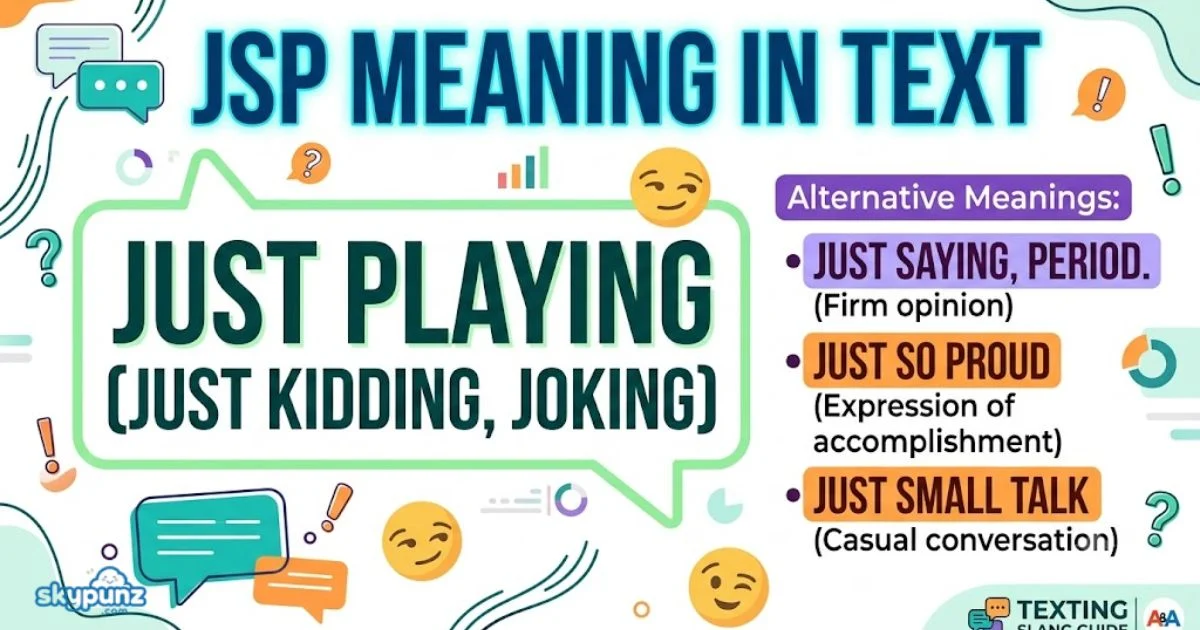
If you’re looking for the JSP meaning in text, it most often means “Just Playing.” People use it to show they are joking and don’t want their message taken seriously. Understanding JSP helps you avoid confusion when chatting on WhatsApp, Instagram, Snapchat, TikTok, or other social media apps.
In this article, you’ll learn what JSP means, when people use it, other possible meanings, real text examples, and the best ways to reply. By the end, you’ll know exactly what JSP means whenever you see it in a conversation.
Read Also : BRB Meaning in Text: What It Really Means Today!
What Does JSP Mean?
In text messages, JSP most commonly means “Just Playing.” People use it after a joke, playful comment, or teasing message to let others know they are not being serious. It helps avoid confusion and keeps the conversation friendly.
For example, if someone texts, “I’m never talking to you again… JSP!” they are simply joking. The abbreviation adds a light tone and tells the other person not to take the message literally.
In some situations, JSP can have other meanings, but in casual texting and social media chats, “Just Playing” is the meaning you will see most often. Understanding the conversation always helps you choose the correct meaning.
Definition
JSP stands for “Just Playing.” It is a popular text abbreviation used to show that a message was meant as a joke or friendly teasing.
People often add JSP at the end of a sentence when they think someone might misunderstand their words. It works much like saying “just kidding,” “JK,” or “I’m only joking.”
| Term | Meaning | When It’s Used |
| JSP | Just Playing | Friendly jokes or teasing |
| JK | Just Kidding | Casual conversations |
| LOL | Laughing Out Loud | Showing something is funny |
Using JSP can make online conversations feel lighter and help prevent unnecessary misunderstandings.
Background & Origin
The exact origin of JSP is difficult to trace because many internet abbreviations developed naturally as texting became more popular. People started shortening common phrases to type faster on phones and messaging apps.
Over time, “Just Playing” became a quick way to show playful intent after a joke. Although it is less common than JK, many users still use JSP in text messages, group chats, gaming communities, and social media conversations.
Like many forms of internet slang, its meaning depends on the context. Knowing who sent the message and what they were talking about makes it easier to understand.
JSP Full Form Explained
The full form of JSP in texting is “Just Playing.”
Here’s what each word means:
- Just – Simply or only.
- Playing – Joking, teasing, or not being serious.
Together, the phrase tells the reader that the previous message was meant for fun. It helps avoid hurt feelings and makes conversations more relaxed.
Keep in mind that JSP can also stand for other terms in different fields. For example, in web development, JSP means JavaServer Pages, a technology used to build dynamic websites. However, when chatting with friends or on social media, “Just Playing” is usually the intended meaning.
Read More: IDEK Meaning in Text: What It Really Means Quick Explained!
How to Use JSP Real Examples
You can use JSP after a playful message when you want people to know you are joking.
Example 1
Friend: You’re buying everyone dinner tonight.
You: Sure… JSP.
Example 2
Friend: I forgot your birthday.
You: I guess we’re not friends anymore. JSP!
Example 3
Friend: Your team is the worst.
You: Haha, JSP. They actually played well today.
Example 4
Friend: I’m deleting your number.
You: Don’t scare me like that! JSP?
In each example, JSP makes the tone clear and helps avoid confusion. It is best used with friends or people who understand your sense of humor.
JSP on Different Platforms (2026)
The meaning of JSP stays mostly the same across popular platforms. However, the way people use it can change depending on the audience and the type of conversation.
1. On WhatsApp
On WhatsApp, JSP usually means “Just Playing.” Friends and family use it in personal chats after making a joke or teasing someone.
Example:
“I blocked your number… JSP 😂”
It helps keep conversations friendly and prevents misunderstandings.
2. On Snapchat
On Snapchat, messages are quick and casual, so JSP often appears after funny comments, playful snaps, or lighthearted jokes.
Example:
“That selfie is terrible… JSP!”
It lets the other person know the comment was meant for fun.
3. On TikTok
On TikTok, people may use JSP in comments, captions, or replies after making a humorous opinion or playful remark.
Example:
“Worst dance ever… JSP, that was awesome!”
The abbreviation adds humor without making the comment sound rude.
4. On Instagram
On Instagram, JSP appears in direct messages, comments, Stories, and captions. It is commonly used after playful teasing between friends.
Example:
“I’m unfollowing you… JSP.”
It keeps the conversation light and friendly.
5. On YouTube
On YouTube, viewers sometimes use JSP in the comment section when joking with creators or other viewers.
Example:
“This video made me fail my homework… JSP!”
Adding JSP makes it clear the comment is not serious.
6. On Facebook
On Facebook, JSP is mostly seen in Messenger chats and comment sections between friends.
Example:
“You still owe me lunch from last year… JSP.”
It helps show that the message is playful rather than demanding.
7. On LinkedIn
On LinkedIn, JSP is rarely used because the platform focuses on professional networking. Most users avoid casual texting abbreviations in business conversations.
If it does appear, it is usually in a friendly private message between coworkers who already know each other well. In professional posts or job-related messages, writing the full sentence instead of using abbreviations is usually the better choice.
JSP Medical and Other Fields
The meaning of JSP changes depending on the industry or topic. While it usually means “Just Playing” in text messages, professionals in healthcare, technology, business, education, and government may use the same abbreviation for completely different terms. Always look at the context to understand the correct meaning.
1. JSP Meaning in Medical Terms
In the medical field, JSP can stand for Joint Strategic Plan or other organization-specific terms. There is no single medical meaning used by every hospital or healthcare system.
Example:
“The hospital updated its JSP to improve patient care over the next five years.”
2. JSP Meaning in Technology
In technology, JSP stands for JavaServer Pages. It is a server-side technology that helps developers create dynamic web pages using Java.
Example:
“The developer used JSP to build the website’s login page.”
3. JSP Meaning in Business
In business, JSP often means Joint Strategic Plan. Companies use it to outline shared goals, responsibilities, and long-term plans between teams or business partners.
Example:
“Both companies agreed on a JSP before starting the new project.”
4. JSP Meaning in Education
In education, JSP may refer to a Job Skills Program or another school-specific program. The exact meaning depends on the institution.
Example:
“Students joined the JSP to improve their workplace and communication skills.”
5. JSP Meaning in Government
In government, JSP commonly stands for Joint Service Publication in some countries. These official documents provide rules, policies, and guidance for government departments or military services.
Example:
“Staff followed the latest JSP before carrying out the new procedure.”
Read More: NTY Meaning in Text (Origin, Platforms & Real Examples)
Is JSP Rude or Offensive?
No, JSP is usually not rude or offensive. It most often means “Just Playing,” which tells the other person that a message was meant as a joke. People use it to avoid misunderstandings after teasing a friend or making a playful comment.
However, context still matters. If the joke is hurtful or disrespectful, adding JSP does not automatically make it okay. Some people may still feel upset, especially if they do not know you well. When chatting with someone new or in a professional setting, it is better to use clear language instead of slang.
How to Reply to JSP
Your reply depends on the conversation and your relationship with the other person. Here are some natural responses for different situations.
1. Casual Responses
Use these when chatting with friends or family.
- “Haha, I figured.”
- “You almost got me!”
- “Good one!”
- “I knew you were joking.”
- “No worries!”
2. Funny Responses
Keep the playful mood going with a light joke.
- “Nice save!”
- “Too late, I already believed you!”
- “You’re lucky you added JSP!”
- “That almost gave me a heart attack!”
- “I’ll get you back next time.”
3. Flirty Responses
If you’re talking to someone you like, these replies can keep the conversation fun.
- “You like teasing me, don’t you?”
- “I almost fell for it.”
- “You’re kind of cute when you joke.”
- “Now it’s my turn to tease you.”
- “I’ll remember this!”
4. Supportive Responses
These replies help keep the conversation positive and friendly.
- “No problem, I understand.”
- “I’m glad you were joking.”
- “It’s all good.”
- “Thanks for clearing that up.”
- “We’re good!”
5. Sarcastic Responses
Use these only with people who enjoy sarcasm and know your sense of humor.
- “Wow, I never would have guessed.”
- “Very funny!”
- “Sure… I totally believed you.”
- “Nice try.”
- “You’re a real comedian.”
6. Responses in a Relationship
These replies work well between partners who often joke with each other.
- “You scared me for a second.”
- “You’re impossible!”
- “I should have seen that coming.”
- “Don’t play with my feelings like that.”
- “I still like you anyway.”
7. Responses in Group Chats
These responses keep the conversation fun without making things awkward.
- “Haha, good one!”
- “You fooled everyone.”
- “That was actually funny.”
- “Nice joke!”
- “Let’s hear the next one!”
Read More: WDP Meaning in Text (WhatsApp, TikTok & Snapchat)
JSP Alternatives and Similar Slang
If you want to say “Just Playing” in a different way, there are several common text abbreviations that express a similar idea. Each one fits slightly different situations.
| Slang | Full Form | Meaning | Best Used For |
| JSP | Just Playing | I’m joking or teasing | Friendly chats |
| JK | Just Kidding | I wasn’t serious | Everyday texting |
| J/K | Just Kidding | Same as JK | Casual messages |
| LOL | Laughing Out Loud | Something is funny | Texts and social media |
| LMAO | Laughing My Ass Off | Very funny | Informal conversations |
| IDC | I Don’t Care | Showing little concern | Casual chats |
| SMH | Shaking My Head | Disappointment or disbelief | Social media and texts |
| NVM | Never Mind | Ignore the previous message | Everyday conversations |
Among these, JK is the closest alternative to JSP because both let the other person know you were only joking.
When JSP Can Sound Rude
Although JSP is usually friendly, it can sound rude if it follows a mean or hurtful comment. Simply adding “Just Playing” does not always erase the impact of what was said.
For example, saying “Nobody likes you JSP” may still hurt someone’s feelings. It can also sound insensitive if the other person is upset or the topic is serious.
When you’re unsure how someone will react, it’s better to skip the joke or explain yourself more clearly.
When to Use JSP
Use JSP when you want to make it clear that your message is playful and not meant to be taken seriously.
Good times to use JSP include:
- Teasing a close friend.
- Making a lighthearted joke.
- Adding humor to a casual chat.
- Clearing up a playful comment before it is misunderstood.
JSP works best with people who already understand your sense of humor.
When NOT to Use JSP
Avoid using JSP when the situation calls for honesty, respect, or professionalism.
Do not use JSP:
- During serious conversations or arguments.
- In work emails or professional messages.
- After making a rude, offensive, or hurtful comment.
- When talking to someone who may not understand texting slang.
- In formal school or business communication.
When the conversation is important, writing your message clearly is usually better than using an abbreviation.
JSP vs Similar Slang
Many texting abbreviations are used to show humor, but they do not all mean the same thing. The table below explains how JSP compares with other popular slang terms.
| Slang | Full Form | Meaning | When to Use |
| JSP | Just Playing | Shows you’re joking or teasing | After a playful comment |
| JK | Just Kidding | Says something wasn’t serious | Everyday conversations |
| LOL | Laughing Out Loud | Shows you found something funny | Reacting to a joke or funny message |
| LMAO | Laughing My Ass Off | Means something is extremely funny | Very casual chats |
| SMH | Shaking My Head | Shows disappointment or disbelief | Reacting to a mistake or surprising situation |
| NVM | Never Mind | Tells someone to ignore a previous message | Changing the topic or correcting yourself |
The biggest difference is that JSP and JK explain that you were joking, while terms like LOL and LMAO show your reaction to something funny. Choosing the right abbreviation helps make your message clearer.
Read More: OOTD Meaning in Text: Social Media Slang Explained
Why Do People Still Use JSP in Text Messages?
Even though newer slang appears every year, many people still use JSP because it is short, easy to type, and quickly shows that a message is meant as a joke. It helps prevent misunderstandings, especially in text messages where the other person cannot hear your tone of voice.
People also use JSP to keep conversations fun and friendly on apps like WhatsApp, Snapchat, Instagram, and TikTok. While JK is more common, JSP is still recognized by many users and remains a simple way to say, “I’m only playing.”
Conclusion
Understanding JSP meaning in text makes online conversations much easier to follow. In most chats, JSP means “Just Playing,” letting others know a message is meant as a joke.
As you’ve seen, its meaning can change depending on the context, platform, or even the industry. Knowing when to use it, how to reply, and how it compares with other texting slang helps you avoid confusion and communicate more clearly.
Whether you’re chatting on WhatsApp, Snapchat, Instagram, TikTok, or another social media app, you’ll now be able to recognize JSP and use it naturally. The next time you see JSP in a message, you’ll know exactly what it means and how to respond with confidence.
FAQs about JSP Meaning in Text
1. What does JSP mean in programming?
In programming, JSP stands for JavaServer Pages. It is a Java technology used to create dynamic web pages by combining HTML with Java code.
2. Is JSP considered internet slang?
Yes, in text messages and online chats, JSP can be internet slang. In French texting, it commonly means “Je ne sais pas,” which translates to “I don’t know.”
3. Should I use JSP in professional emails?
It’s best to avoid JSP in professional emails unless you’re referring to JavaServer Pages. Writing the full phrase helps prevent confusion.
4. What does JSP mean in French?
In French, JSP is short for “Je ne sais pas,” meaning “I don’t know.” It is widely used in casual texting and online conversations.
5. Is JSP the same as JK?
No. JK usually means “Just Kidding,” while JSP can mean “JavaServer Pages” or “Je ne sais pas,” depending on the context.
6. Can JSP mean JavaServer Pages?
Yes. In software development, JSP almost always refers to JavaServer Pages, a server-side technology for building dynamic websites.
7. Is JSP popular among Gen Z?
Some Gen Z users may use JSP in French-speaking communities, but it is not as common globally as abbreviations like LOL, OMG, or IDK.
8. How can I tell which JSP meaning is correct?
Look at the conversation. If the topic is coding, JSP likely means JavaServer Pages. In casual chats, especially in French, it usually means “I don’t know.”
9. Does JSP have more than one meaning?
Yes. JSP has multiple meanings depending on the context, including JavaServer Pages, “Je ne sais pas,” and a few less common industry-specific abbreviations.
10. Is JSP still used in web development?
Yes. Although many developers now use modern frameworks, JavaServer Pages is still used in maintaining older Java web applications and some enterprise systems.
11. Can JSP be used on social media?
Yes. On social media, JSP may appear as a casual abbreviation, particularly in French-speaking communities, where it means “I don’t know.”
12. Should I ask if I’m unsure what JSP means?
Yes. If the context is unclear, asking the sender what they mean is the easiest way to avoid misunderstanding, since JSP can have different meanings in different situations.

Hi, I am James Whitman, the author of Skypunz.com. I create funny puns and jokes to make your day brighter and bring a smile to every reader.