
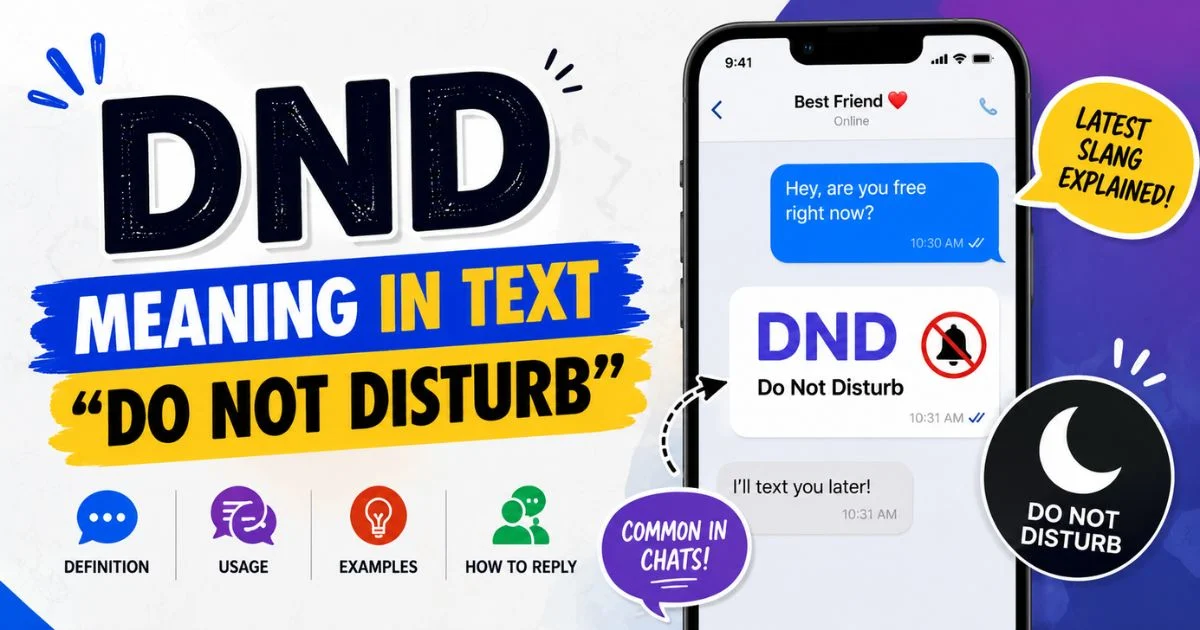
You get a message that says “DND” and are not sure what the person means. The DND Meaning in Text usually refers to “Do Not Disturb,” especially in texting, chats, and social media. It can tell someone that a person does not want interruptions, notifications, or messages and plans to stay unavailable for a while.
If you have seen DND in a text message, phone notification, or status update, the confusion is completely normal because the abbreviation can have different meanings in other contexts. The surrounding message, conversation context, and tone usually make the intended meaning clear.
Below, you’ll see how DND works in everyday conversations, what it means on phones and messaging apps, examples of how people use it, and how its tone and usage can change by context. Let’s start with the most common meaning and how to recognize it.
Read Also : Su Meaning In Text: The Tiny Slang With Big Confusion!
What Does DND Mean in Text?
DND Meaning in Very Simple Words
DND usually means “Do Not Disturb” in text messages. People use it when they do not want calls, messages, or interruptions for a certain period. For example, someone might text, “I’m on DND right now,” to say they are unavailable or want some quiet time.
The meaning can depend on the situation. In casual texting, “Do Not Disturb” is the most common meaning, especially when someone talks about being busy, sleeping, studying, working, or taking a break.
DND Full Form in Texting
The DND full form in texting is “Do Not Disturb.” It comes from the common phrase used to ask others not to interrupt someone.
You may see DND in messages such as:
- “I’ll be on DND tonight.”
- “Sorry, I missed your text. My phone was on DND.”
- “DND, I’m studying for my exam.”
- “Put your phone on DND and get some sleep.”
In these examples, DND relates to phone settings, notifications, availability, and personal space. The phrase can sound practical rather than rude, depending on how the person uses it.
Quick Answer About DND
DND means “Do Not Disturb” in most texting and messaging situations. It tells others that someone does not want to be interrupted or may not respond immediately.
However, DND can have other meanings in specific settings. For example, gaming communities may use DND for Dungeons & Dragons, a popular tabletop role-playing game. The surrounding conversation helps you identify the correct meaning.
Where the Term DND Comes From
How DND Entered Texting Culture
The phrase “Do Not Disturb” existed long before texting. People used it in everyday life to show that they wanted privacy or did not want interruptions.
As online chatting, mobile phones, and short messages became common, people began shortening familiar phrases. DND fit naturally into this style because three letters could communicate the idea quickly.
History of Do Not Disturb
“Do Not Disturb” has long served as a simple request for privacy. You might see the phrase on a hotel room door, office sign, or other place where someone wants to avoid interruptions.
The abbreviation DND later became closely connected with communication technology. Instead of writing the full phrase, users could simply write DND to explain that they were unavailable or wanted quiet.
How Phones Popularized DND
Smartphones made DND much more familiar because Do Not Disturb became a built-in phone feature. This setting can silence or limit notifications, calls, alerts, and other interruptions based on the user’s preferences.
As people started using this feature regularly, DND became common in everyday conversations. Someone might say, “My phone was on DND,” meaning they did not see or hear notifications at the time.
Read More: Spwm Meaning In Text: What Does This Slang Really Mean?
How DND Is Used in Modern Texting
Why People Use DND in Text Messages
People use DND to communicate limited availability without writing a long explanation. It can mean they are busy, resting, studying, working, driving, sleeping, or simply taking time away from their phone.
For example, “DND until 8” clearly tells the other person not to expect an immediate reply. This can make communication easier because the sender understands why a response may take longer.
How DND Is Used in Daily Conversations
In everyday chats, DND often appears as a short status or quick explanation. Its tone usually depends on the relationship between the people and the rest of the message.
For example:
- “I’m on DND for an hour.”
- “DND tonight, I need to focus.”
- “Was on DND earlier, just saw this.”
- “Please don’t call me. I’m on DND.”
The same abbreviation can sound casual, polite, or firm depending on the wording around it.
DND as a Short Texting Phrase
DND works as a texting abbreviation because it saves time while keeping the message clear. People often use it with words such as “on,” “until,” or “right now.”
A message like “I’m on DND” usually means the person has enabled the Do Not Disturb setting or does not want interruptions. A message like “DND for the next two hours” gives a more specific idea of when they will become available again.
When People Usually Write DND
People commonly write DND when they want to explain their availability. Typical situations include:
- Studying or doing homework
- Working or attending a meeting
- Sleeping or resting
- Driving or traveling
- Taking a break from social media
- Spending private time with family or friends
- Focusing on an important task
DND does not always mean someone is ignoring you. In many cases, it simply means they want to respond later when they have time.
DND Meaning in Personal and Casual Chats
DND Meaning Between Friends
Between friends, DND usually means “Do Not Disturb” and often carries a relaxed tone. A friend might say, “DND today, I need some me time,” without intending to sound unfriendly.
Friends may also use it to explain a delayed reply. If someone says, “Sorry, I was on DND,” they are usually saying that notifications were turned off or limited.
DND Meaning in Family Chats
In family group chats, DND can explain why someone has not answered calls or messages. For example, a family member might write, “I’m putting my phone on DND while I sleep.”
Parents, children, siblings, and relatives may use the abbreviation simply to set expectations about phone availability. It usually does not carry a hidden meaning unless the conversation gives it one.
DND Meaning in Relationship Texts
In relationship texts, DND can mean that someone wants uninterrupted time, needs to focus, or does not want to use their phone for a while. For example, “I’m on DND during work, I’ll text you later” sounds clear and reassuring.
Tone matters more in personal relationships. A short message such as “DND. Talk later” may sound firm, while “I’m going on DND for a bit, but I’ll message you tonight” feels more considerate.
DND Meaning When Someone Needs Space
When someone says they are on DND because they need space, they may be asking for quiet time and fewer interruptions. That does not automatically mean they are angry or upset with you.
A respectful response is usually to give them the space they requested. If they say, “I’m on DND for a while. I need some time alone,” it is better to wait rather than repeatedly call or message. Understanding this context helps you interpret DND as a boundary, not necessarily a rejection.
Read More: Nmms Mean In A Text: Meaning, Slang & Funny Examples!
DND Meaning in Social Media
On social media, DND usually means “Do Not Disturb.” People use it to show that they are unavailable, taking a break, or do not want to receive interruptions. The meaning often connects to notifications, online status, private time, and message availability.
DND in Social Media Messages
In direct messages, DND can explain why someone may not reply quickly. A person might write, “I’m on DND right now,” to let friends know that they are not checking messages.
It can also work as a short personal boundary. For example, “DND until tomorrow” clearly suggests that the person plans to respond later rather than ignore the conversation completely.
DND in Comments and Posts
People sometimes use DND in posts, captions, or comments when they want to announce that they are temporarily unavailable. A post saying “DND tonight” may simply mean the person wants some quiet time away from messages.
The exact meaning still depends on context. In some communities, DND can refer to Dungeons & Dragons, so a gaming-related post may use the abbreviation differently.
DND on Messaging Apps
On messaging apps, DND commonly relates to muted notifications or a Do Not Disturb setting. Someone may mention DND when explaining why they did not notice a message or call.
For example, “Sorry, I had DND enabled” usually means notifications were silenced or limited. It does not necessarily mean the person intentionally avoided the sender.
DND and Online Availability
DND can also signal that someone does not want to appear available for conversation. They may still be using their phone while choosing not to answer messages.
This distinction matters because being online does not always mean being available. Someone can browse social media, watch videos, or check something quickly while still wanting uninterrupted personal time.
DND Meaning in Professional Communication
In professional communication, DND usually means “Do Not Disturb” and signals limited availability. Employees may use it to focus on work, attend meetings, complete tasks, or protect time outside working hours.
The abbreviation can help coworkers understand that an immediate reply may not be possible.
DND Meaning in Work Chats
In work chats, someone might set a DND status while working on an important task. A message such as “DND until 3 PM” tells coworkers that the person prefers not to receive interruptions during that period.
This can make team communication clearer because people know when to expect a response.
DND in Workplace Messaging
Workplace messaging platforms often include availability and notification controls. Employees may use DND to reduce alerts while concentrating on reports, projects, calls, or other responsibilities.
For example, a coworker might write, “I’m on DND for the next hour. Please send anything urgent by email.” This gives others a clear alternative for important matters.
DND During Meetings
DND can be especially useful during meetings, presentations, interviews, and focused work sessions. Turning on the setting can reduce phone alerts and other distractions.
If someone says, “I’ll be on DND during the meeting,” they usually mean they will not actively monitor incoming messages until the meeting ends.
DND and Work-Life Boundaries
DND can also support healthy work-life boundaries. Someone may enable it after working hours so business notifications do not interrupt dinner, family time, rest, or sleep.
For example, “I’m on DND after 7 PM, but I’ll check messages tomorrow” clearly sets expectations. It shows that delayed replies can reflect personal availability rather than a lack of interest or professionalism.
DND in Gaming Communities
In gaming communities, DND has two common meanings. It can mean “Do Not Disturb,” especially when players want to focus on a game, but it can also mean Dungeons & Dragons, the well-known tabletop role-playing game.
The surrounding conversation usually makes the intended meaning clear.
DND During Gaming Sessions
A player may use DND to say they do not want phone calls or unrelated messages during a gaming session. For example, “I’m on DND until the match ends” means they want to stay focused.
This usage is especially common when a player needs concentration during a competitive match or long gaming session.
DND in Game Chats
In game chats, DND can mean Do Not Disturb when players discuss communication or availability. A player might say, “DND for the next round,” to explain that they do not want outside interruptions.
However, if the conversation involves characters, campaigns, dice, or tabletop adventures, DND probably means Dungeons & Dragons instead.
DND and Player Availability
Players may use DND to show that they are temporarily unavailable for invitations, calls, or messages. This can help friends understand why a player does not respond immediately.
For example, “DND tonight, I’ll play tomorrow” gives a simple explanation without requiring a long message.
DND in Multiplayer Communication
In multiplayer games, DND can help communicate a player’s availability and focus. Someone may enable a Do Not Disturb mode while playing so notifications do not interrupt the match.
The abbreviation can also appear alongside other gaming terms, so context remains important. If people are discussing a campaign or tabletop role-playing, the meaning may be completely different.
DND Meanings Across Platforms
Across phones, messaging services, and social platforms, DND most often refers to “Do Not Disturb.” The exact features can differ by device or app, but the basic idea stays the same: reduce interruptions and limit notifications or communication.
DND on iPhone
On an iPhone, Do Not Disturb is part of Apple’s Focus features. It can silence or limit notifications and calls based on settings chosen by the user.
Someone saying “My iPhone was on DND” usually means they had Do Not Disturb or a related Focus mode enabled. The person may still have used the phone without seeing every notification immediately.
DND on Android
On Android phones, Do Not Disturb can control how calls, notifications, and alerts reach the user. The available options can vary between Android versions and phone manufacturers.
When someone says their Android was on DND, they generally mean that their device was configured to reduce interruptions for a period of time.
DND on Messaging Apps
Messaging apps may offer their own notification controls, including mute, quiet modes, status settings, or notification pauses. Users sometimes call these features DND even when the app uses different wording.
For that reason, DND does not always mean that a person cannot receive a message. It may simply mean they will not receive an immediate alert.
DND on Social Platforms
On social platforms, DND can describe a person’s temporary unavailability or reduced interaction. Someone might use the term in a status, bio, message, or post to signal that they are taking a break.
The safest way to understand DND is to check the surrounding context. If the conversation involves phones, notifications, or replies, “Do Not Disturb” is usually the intended meaning. If it involves tabletop gaming, Dungeons & Dragons may be the better interpretation.
Other Meanings of DND
DND Meanings in Different Contexts
DND most commonly means “Do Not Disturb,” but the abbreviation can mean different things in specific settings. For example, in gaming, DND often refers to Dungeons & Dragons, while in other fields it may have a specialized meaning.
Can DND Have Other Meanings?
Yes. The intended meaning depends on where you see it and what people are discussing. In a text about phone settings, DND almost certainly means Do Not Disturb, while a conversation about tabletop games may use DND for Dungeons & Dragons.
How Context Changes DND
The words around DND usually provide the answer. Terms such as notifications, calls, messages, sleep, and silence point toward Do Not Disturb, while words such as campaign, character, dice, and dungeon suggest Dungeons & Dragons.
| Context | Likely DND Meaning |
| Texting | Do Not Disturb |
| Phone settings | Do Not Disturb |
| Social media | Do Not Disturb |
| Tabletop gaming | Dungeons & Dragons |
| Workplace | Do Not Disturb or limited availability |
Other Places Where DND Appears
DND in Hotels
Hotels may use “Do Not Disturb” signs on guest room doors. A guest places the sign outside the room to tell hotel staff not to enter for routine cleaning or other non-urgent services.
DND in Healthcare
Healthcare settings may use Do Not Disturb notices in specific situations where privacy, rest, or uninterrupted care matters. However, healthcare workers may also use other specialized abbreviations, so DND should always be interpreted from the surrounding context.
DND in Aviation and Military
DND may appear in aviation, military, or government-related communication with specialized meanings that differ from everyday texting. These fields often use many established abbreviations, so readers should not automatically assume DND means Do Not Disturb.
DND in Studios
In studios, offices, or creative workspaces, a DND sign may tell others that someone is recording, working, or unavailable. The purpose remains similar: reduce interruptions during focused work.
DND in Corporate Settings
Companies may use DND to describe a person’s unavailable status in workplace communication tools. Employees might turn it on during meetings, focused work, or scheduled breaks.
DND Signs and Notices
A DND sign usually communicates a simple request: please do not interrupt. You may see it on hotel doors, office rooms, workspaces, or other private areas.
DND and Phone Do Not Disturb Mode
What Phone DND Mode Does
Phone DND mode helps users reduce unwanted interruptions by controlling incoming notifications, calls, alerts, and sounds. Users can often choose when the mode activates and which people or apps can still reach them.
How DND Affects Notifications
When DND is active, many notifications may become silent or less noticeable. The exact behavior depends on the phone and the user’s settings, so DND does not always block every notification.
DND Calls and Text Messages
DND can silence incoming calls and text alerts without necessarily preventing the messages from arriving. Depending on the settings, selected contacts or repeated calls may still get through.
DND Settings on Modern Phones
Modern phones allow users to customize DND with schedules, allowed contacts, app exceptions, alarms, and notification controls. This lets someone stay focused while still allowing important alerts to reach them.
Common Misunderstandings About DND
DND can cause confusion because people often assume it completely cuts someone off. In most cases, Do Not Disturb simply changes how notifications or interruptions reach the person. The exact effect depends on the device, app, and settings.
Myth: DND Means the Person Is Ignoring You
Being on DND does not automatically mean someone is ignoring you. They may be studying, sleeping, working, driving, or simply taking a break from notifications.
A person can still care about your message while choosing to respond later.
Myth: Messages Do Not Get Delivered
DND usually does not stop messages from being delivered. It mainly controls alerts and notifications, so a message can arrive even when the recipient does not receive an immediate sound or vibration.
That means a delayed reply does not necessarily mean the message failed to reach them.
Myth: DND Equals Airplane Mode
DND and Airplane Mode serve different purposes. DND manages interruptions, while Airplane Mode disables or restricts wireless connections such as cellular and Wi-Fi, depending on what the user turns back on.
Someone can use DND while remaining connected to the internet and receiving messages.
Myth: DND Means the Same in Every Context
DND does not always have one meaning. In texting and phone settings, it usually means Do Not Disturb. In gaming conversations, it may mean Dungeons & Dragons.
Always check the surrounding words before deciding what DND means.
Myth: DND Always Means Someone Needs Privacy
DND can indicate a desire for privacy, but that is not always the reason. Someone may enable it automatically during sleep, work, meetings, driving, or scheduled focus time.
The setting itself does not tell you why the person turned it on.
DND vs Similar Texting Terms
DND can look similar to other terms that describe limited availability. Knowing the difference helps you understand what someone actually means when they mention their phone or messaging status.
DND vs Airplane Mode
DND reduces interruptions, while Airplane Mode primarily manages wireless connections. With DND, a phone can remain connected to cellular data or Wi-Fi and continue receiving messages.
Airplane Mode can prevent normal calls and mobile messages from reaching the device while the relevant connections remain disabled.
DND vs Silent Mode
Silent Mode generally turns off or reduces sounds and alerts. DND offers more control over which calls, notifications, and alerts can interrupt the user.
For example, someone may use DND to allow calls from selected contacts while silencing most other notifications.
DND vs Block
DND is not the same as blocking someone. Blocking usually prevents a specific person or account from contacting you through a particular service, while DND is designed to reduce interruptions more broadly.
Someone on DND can still receive your message, depending on their settings.
DND vs Muted Chats
A muted chat usually affects notifications from one specific conversation or group. DND can apply to a wider range of calls, apps, alerts, or notifications across the device.
For example, you might mute a busy group chat but use DND when you want fewer interruptions from your entire phone.
DND vs Offline
Offline generally means a person or device is not currently connected or available through a particular service. DND does not necessarily take someone offline.
A person can remain active online while their phone quietly handles notifications in the background.
DND vs Busy
Busy describes a person’s availability, while DND often describes a phone or notification setting. Someone may show a busy status because they are working or in a meeting, even if DND is not enabled.
In casual texting, however, people sometimes use DND as a quick way to say they are busy or unavailable. The surrounding message reveals the intended meaning.
Read More: LBVS Meaning in Text (Definition, Examples & Text Usage)
Similar Terms and Alternatives to DND
Do Not Disturb
Do Not Disturb is the full phrase behind DND. It works well when you want to clearly explain that you are reducing interruptions from calls, messages, or notifications.
Busy Right Now
Busy right now is a more casual alternative to DND. It tells someone that you cannot give them your attention at the moment without suggesting that you want to avoid them completely.
Not Available
Not available gives a simple and neutral message. You can use it when you are working, sleeping, traveling, or doing something that prevents you from responding quickly.
Please Do Not Contact Me
Please do not contact me, it sounds much stronger than DND. It works when someone needs a clear boundary and does not want calls or messages for a specific reason or period.
I Need Some Quiet Time
I need some quiet time that sounds personal and gentle. Friends, partners, or family members may use it when they want a break from conversations without creating unnecessary tension.
Chat-Style Examples of DND
DND in a Friendly Conversation
Example:
“Hey, I’m on DND for a couple of hours. I’ll text you later.”
Here, DND simply means the person wants to focus on something and will respond afterward. It does not suggest that they are upset with their friend.
DND in a Relationship Conversation
Example:
“I’m going on DND for a while. I just need some time to myself. We can talk tonight.”
In this situation, DND communicates personal space and temporary unavailability. Adding a time or reassurance can make the message feel clearer and less likely to cause confusion.
DND in a Work Conversation
Example:
“I’m on DND while I finish this report. Please message me if it’s urgent.”
Here, DND means the person wants to avoid distractions while working. The message also gives coworkers a clear exception for genuinely urgent matters.
DND in an Urgent Situation
If something requires an immediate response, DND does not necessarily mean the person cannot be reached. Some phone settings allow selected contacts or repeated calls to bypass Do Not Disturb.
For example:
“I’m on DND, but call twice if it’s urgent.”
This wording makes the person’s availability and emergency preference clear without assuming that every notification will be blocked.
Is DND Polite or Rude?
DND is not automatically polite or rude. Its tone depends on the wording, timing, relationship, and reason behind the message. A short “DND” can sound neutral between close friends but may feel abrupt in a professional conversation.
When DND Sounds Polite
DND usually sounds polite when you give a little context or explain when you will be available again. For example, “I’m on DND for the next hour, but I’ll reply afterward” sets a clear expectation without dismissing the other person.
When DND May Sound Rude
A message such as “DND. Don’t text me” can sound harsh, especially without any explanation. The same idea can feel more respectful when you mention that you are busy, resting, or need some quiet time.
How Tone Changes the Meaning
The tone of a DND message comes from the words around the abbreviation. Friendly language can make it feel like a simple status update, while commands or very short replies may make it seem like a firm boundary.
Your relationship with the sender also matters. Close friends may understand a blunt “DND run” immediately, while a coworker may expect more context.
How to Make DND Sound More Friendly
Add a brief explanation and, when possible, a time for reconnecting. For example:
“I’m going on DND for a bit. I’ll get back to you later.”
You can also say, “I’m busy right now, but I’ll message you when I’m free.” This keeps the boundary clear while showing consideration.
Read More: TTY Meaning in Text (Definition, Uses, and Text Examples)
How to Reply When Someone Says DND
When someone says DND, the best response usually respects their availability and personal boundary. You do not need to keep sending messages unless the matter genuinely requires immediate attention.
Simple Respectful Replies
For a casual conversation, you can keep your response short:
- “No worries.”
- “Sure, talk later.”
- “Got it.”
- “Take your time.”
- “Okay, message me when you’re free.”
These replies acknowledge their request without putting pressure on them.
If It Is Professional
In a work setting, respond clearly and respectfully. You might say:
“Understood. I’ll follow up later.”
If the matter is not urgent, there is usually no need to send additional messages while the person has DND enabled.
If the Relationship Is Close
With a close friend or partner, you can show support while still giving them room.
“Of course. Take the time you need. I’ll be here when you’re ready.”
This response recognizes their need for space without assuming they are upset with you.
If the Message Is Urgent
If something genuinely requires immediate attention, check whether the person has given an emergency option. They may have said something like, “Call twice if it’s urgent.”
If they have not provided one, use the normal urgent contact method available to you rather than repeatedly sending ordinary messages.
When You Should Wait for a Reply
If someone clearly says they are on DND and gives no urgent exception, waiting is usually the best choice. Give them the time they requested instead of sending repeated follow-ups.
If they provide a specific time, such as “DND until 5,” waiting until around that time makes your response more respectful and predictable.
Read More: WYGG Meaning in Text (Definition, Uses & Examples)
When Should You Use DND in Text?
You can use DND when you want others to know that you are temporarily unavailable or reducing interruptions. It works especially well when you expect delayed replies and want to set clear expectations.
When You Need Personal Space
DND can be useful when you want some quiet time without having to respond to every message. You might use it while relaxing, spending time alone, or taking a break from conversations.
A simple message such as “I’m on DND for a while. I’ll text later” communicates the boundary clearly.
When You Are Working
Use DND when you need uninterrupted time for work, studying, writing, or focused tasks. It can help reduce distractions from calls, messages, and app notifications.
For example:
“On DND while I finish this project. I’ll reply this afternoon.”
When You Are Sleeping
DND works well during sleep because unexpected notifications can disturb your rest. You can also schedule Do Not Disturb on many modern phones so it activates automatically at certain times.
When You Are Busy
If you are driving, attending a meeting, cooking, exercising, or handling another task, DND can help you avoid constant interruptions.
You can simply tell people, “Busy right now, I’m on DND. I’ll get back to you later.”
When You Need Fewer Notifications
Sometimes you do not want to stop using your phone completely. You may simply want fewer alerts and interruptions for a while.
DND gives you a way to manage notifications while staying connected. Depending on your settings, important contacts, alarms, or selected alerts may still reach you.
When You Should Not Use DND
DND can help reduce interruptions, but it is not suitable for every situation. If people need to reach you quickly or your absence could create a serious problem, staying reachable may be the better choice.
During Important Emergencies
Avoid using DND when you are responsible for handling an emergency or urgent situation. Important calls or messages could require your immediate attention.
If you need quiet time but still expect emergencies, check your phone settings for options that allow selected contacts or repeated calls to reach you.
When Someone Needs an Immediate Response
If a friend, coworker, family member, or client needs a quick answer, DND may delay communication at the wrong time. Consider staying available until the matter is resolved.
For less urgent situations, you can use DND and tell the person when you expect to respond.
When Clear Communication Is Important
DND may not be the best choice during situations where people need regular updates. Meetings, team projects, appointments, or important personal conversations may require you to stay reachable.
If you must use DND, explain your availability clearly so others know when and how to contact you.
When DND Could Cause Confusion
A simple “DND” message can leave people unsure whether you are busy, upset, sleeping, or simply taking a break. This becomes more likely when the relationship or situation requires extra context.
A short explanation can prevent misunderstandings. For example, “I’m on DND while studying. I’ll reply tonight” gives the other person a clear expectation.
Common Problems When Using DND
DND usually works well when people understand what it means and why you are using it. Problems can arise when the setting or abbreviation creates uncertainty about your availability.
Confusion About the Meaning
Not everyone interprets DND the same way. Some people may understand it as Do Not Disturb, while others may know DND as Dungeons & Dragons.
The surrounding conversation usually clarifies the meaning. Adding a few words can make your message easier to understand.
Misreading the Person’s Intent
Someone may assume that DND means you are angry, avoiding them, or deliberately ignoring their messages. In reality, you may simply be sleeping, working, or trying to reduce notifications.
Giving a little context can prevent the other person from making the wrong assumption.
Missing Important Messages
DND can reduce interruptions, but it may also cause you to overlook something important. Depending on your settings, calls, alerts, or notifications may remain silent until you check your phone.
Review your DND exceptions and allow important contacts or urgent alerts through when necessary.
Creating Communication Gaps
Using DND for long periods without explaining your availability can create communication gaps. Friends, family members, or coworkers may not know when you plan to respond.
A simple message such as “I’m unavailable until this evening” keeps expectations clear while still giving you the uninterrupted time you need.
Easy Solutions to Avoid DND Confusion
DND is usually easy to understand when you look at the situation around it. If the abbreviation still feels unclear, a few simple steps can help you understand what the sender intended.
Check the Conversation Context
Look at the messages before and after DND. If the person mentions sleeping, working, notifications, calls, or being busy, they probably mean “Do Not Disturb.”
If the conversation involves tabletop games, characters, dice, or campaigns, DND may instead mean Dungeons & Dragons.
Ask What DND Means
There is nothing wrong with asking for clarification. A simple response such as, “What do you mean by DND here?” can prevent you from guessing incorrectly.
This works especially well when the abbreviation could have more than one meaning.
Consider the Person’s Tone
Pay attention to how the person normally communicates. “DND for a bit, talk later” sounds different from “DND. Stop texting.”
The words around DND, punctuation, timing, and your relationship with the sender can all help you understand the intended tone.
Use Clearer Words When Needed
If you are using DND yourself, consider writing the full phrase when the other person might misunderstand it. For example, “I’m on Do Not Disturb while I study” is clearer than simply sending “DND.”
You can also add a time or reason, such as “I’m on DND until 6 PM. I’ll reply afterward.”
Why DND Matters in Today’s Online World
DND matters because people receive constant notifications, messages, calls, and app alerts throughout the day. A simple Do Not Disturb setting gives people more control over when they respond.
Digital Boundaries Are Normal Now
People do not need to be available every minute. Using DND can help establish a healthy digital boundary between personal time and communication.
It can also make expectations clearer when someone cannot respond immediately.
Managing Constant Notifications
Phones and apps can send alerts throughout the day. DND helps reduce these interruptions so people can focus on work, study, rest, or other activities.
Instead of reacting to every notification, users can choose when they want to check their messages.
Protecting Personal Time
DND can protect time for sleep, family, hobbies, exercise, relaxation, and personal activities. It allows people to step away from conversations without permanently disconnecting.
For many users, that small break can make phone use feel more manageable.
Reducing Digital Distractions
Frequent notifications can interrupt concentration even when the message itself is not important. DND provides a simple way to reduce these distractions during focused periods.
Users can often customize exceptions so important calls or alerts still get through.
DND and Modern Relationships
DND can affect personal relationships because people often connect through instant messages. Clear communication about availability can prevent a temporary break from feeling like rejection or avoidance.
DND in Dating Conversations
In dating conversations, DND can simply mean that someone is busy, sleeping, working, or taking time away from their phone. It does not automatically mean they have lost interest.
For example, “I’m going to DND for the evening. I’ll message you tomorrow” gives a clear expectation without creating unnecessary uncertainty.
DND and Personal Boundaries
DND can be a practical way to communicate a personal boundary. Someone may need uninterrupted time without wanting to explain every detail.
Respecting that boundary usually means giving the person the space they requested and waiting for them to reconnect.
DND Between Close Friends
Close friends often use DND casually because they already understand each other’s communication habits. A message like “DND for a few hours” may need little explanation.
Even in close friendships, adding a quick reason can help when the timing might otherwise seem unusual.
DND and Communication Expectations
DND works best when people have realistic expectations about replies. Being on DND does not necessarily mean someone will respond at a specific time, but a message can give others a general idea of when communication will resume.
Clear phrases such as “I’ll reply later,” “I’m unavailable until tonight,” or “Call only if it’s urgent” can make DND easier to understand and reduce unnecessary misunderstandings.
DND on Smartphones
DND on smartphones means Do Not Disturb, a feature that helps reduce interruptions from calls, notifications, and alerts. The exact options vary by device, but most modern phones let users control when DND turns on and what can still get through.
DND Notifications
DND can silence or limit notifications from apps, messages, and other services. Depending on the settings, the notifications may still appear later when the user checks the phone.
This makes DND useful when someone wants to focus without constantly hearing sounds or feeling vibrations.
DND Calls
DND can reduce or silence incoming call alerts. Many phones also let users allow calls from selected contacts, which can help prevent important calls from being missed.
Some settings may also allow repeated calls to bypass DND when the system treats them as potentially urgent.
DND Text Messages
DND usually does not stop text messages from arriving. Instead, it can prevent the phone from making a sound, vibrating, or showing an immediate alert.
A person may therefore receive your message normally but not notice it until they check their phone.
DND Automatic Schedules
Modern smartphones can often schedule DND automatically. Users might set it to turn on during sleeping hours, meetings, work periods, or other regular activities.
Automatic schedules make it easier to manage notifications without manually switching DND on and off every day.
Read More: LOML Meaning in Text: Is It Love or Just Internet Slang?
DND on Messaging Apps
Messaging apps handle DND-related features differently. Some offer their own notification controls, while others depend mainly on the phone’s system settings.
| Feature | What It Usually Means |
| DND status | Shows that someone may be unavailable or limiting interruptions |
| Notification controls | Manage sounds, vibrations, banners, or alerts |
| Message delivery | Messages can usually still arrive while DND is active |
| Read receipts | DND normally does not determine whether a message shows as read |
| Muted chats | Usually affects notifications from a specific conversation |
DND in Everyday Life
DND can be useful in many ordinary situations. It gives people a simple way to reduce interruptions while staying connected when they choose.
DND While Sleeping
Many people use DND during sleep to reduce calls, message alerts, and app notifications. A scheduled setting can automatically activate at bedtime and turn off in the morning.
Users can often allow alarms or selected contacts to remain active.
DND While Studying
DND can help students focus on homework, reading, exams, or online classes. Fewer notifications can make it easier to stay focused on one task.
A student might schedule DND for an hour and check messages after finishing a study session.
DND While Driving
DND can reduce distractions while driving. Some phones offer driving-related Focus or DND options that limit incoming notifications or provide automated responses.
The safest approach is to avoid checking or handling the phone while driving.
DND During Family Time
DND can help people stay present during meals, family visits, or other personal moments. Instead of reacting to every alert, they can choose to check their phone later.
This can create a healthier balance between online communication and face-to-face time.
DND During Travel
Travel often involves long periods when someone may not want constant notifications. DND can help reduce interruptions during flights, train journeys, sightseeing, or rest periods.
If someone needs to remain reachable while traveling, they can adjust DND exceptions instead of blocking every alert.
Read More: GBTS Meaning in Text: What Does This Slang Really Mean?
DND Etiquette in Texting
Good DND etiquette means respecting a person’s availability without assuming what they are feeling. Since DND can mean different things in different conversations, clear wording and reasonable expectations help prevent misunderstandings.
Respecting Someone’s DND Status
If someone says they are on DND, give them the space they requested. Avoid sending repeated messages unless you have a genuine reason to contact them immediately.
DND does not necessarily mean the person is avoiding you. They may simply be working, sleeping, studying, or taking a break from notifications.
Knowing When to Follow Up
If the message is not urgent, wait before following up. When someone gives a specific time, such as “DND until 5 PM,” waiting until around that time is usually appropriate.
If no time is provided, consider the situation and your normal communication habits before sending another message.
Keeping Urgent Messages Clear
When something truly needs immediate attention, make the urgency obvious. A message such as “Urgent: please call me when you see this” is clearer than sending several short messages.
If the person has shared an emergency contact method or exception for DND, use that option when appropriate.
Setting Healthy Communication Boundaries
You can use DND to communicate your own boundaries without being rude. A short explanation can help others understand when you are unavailable and when they can expect a response.
For example, “I’m on DND while I study. I’ll reply after 7” sets a clear boundary while keeping communication friendly.
Read More: ISO Meaning in Text: What It Really Means in Chats!
Why DND Is Popular in Modern Texting
DND has become common because people now receive messages, alerts, calls, and app notifications throughout the day. A short phrase and a simple phone setting can help people control when they want to engage.
Short and Easy Communication
DND is much faster to type than “Do Not Disturb.” Short abbreviations work well in casual texting because both people can understand the message without a long explanation.
A quick “DND for a bit” can communicate temporary unavailability in just a few words.
The Rise of Mobile Messaging
Mobile messaging has made people more reachable than ever. Friends, family, coworkers, and online communities can contact someone at almost any time.
DND gives users a practical way to step away from constant communication while keeping their phone connected.
Growing Need for Digital Privacy
People increasingly want control over when they respond and who can interrupt them. DND supports this by reducing unwanted alerts without requiring someone to disconnect completely.
It can be especially useful during personal time, sleep, work, or other situations where privacy and quiet matter.
Managing Online Availability
DND helps people manage the gap between being connected and being available. Someone can stay online, receive messages, and still choose not to respond immediately.
That flexibility makes DND useful for everyday communication, especially when people want fewer interruptions without completely switching off their phones.
Key Insight
1. What Does Dnd Mean In Text?
DND usually means “Do Not Disturb” in text messages. It tells someone that a person may be unavailable, busy, resting, or not checking notifications.
2. Does Dnd Mean Someone Is Ignoring Me?
No. DND does not automatically mean someone is ignoring you. They may have turned on Do Not Disturb because they are sleeping, working, studying, or taking a break from their phone.
3. Do Messages Still Arrive When DNd Is On?
Usually, yes. DND generally controls notifications and alerts rather than stopping messages from being delivered. The person may simply not receive an immediate notification.
4. What Does Dnd Mean On A Phone?
On a phone, DND means Do Not Disturb. It is a feature that can silence or limit calls, notifications, and other interruptions based on the user’s settings.
5. Is Dnd The Same As Airplane Mode?
No. DND reduces interruptions, while airplane mode primarily manages wireless connections. A phone can remain connected to Wi-Fi or mobile networks while DND is active.
6. What Does Dnd Mean In Gaming?
In gaming, DND can mean Dungeons & Dragons, especially when people discuss tabletop role-playing, campaigns, characters, or dice. Context determines which meaning applies.
7. How Should I Reply When Someone Says Dnd?
A simple response works well. You can say “No worries,” “Got it,” “Take your time,” or “Message me when you’re free.” If the matter is urgent, explain why you need a quick response.
8. Is Dnd Polite Or Rude In Texting?
DND is usually neutral, but the tone depends on the wording and situation. “I’m on DND for a while, I’ll reply later” sounds considerate, while “DND, don’t text me” may sound more direct or rude.
Conclusion
DND Meaning in Text usually refers to “Do Not Disturb,” especially when someone talks about phone settings, notifications, or temporary unavailability. Understanding the term helps you read messages correctly without assuming that someone is ignoring you or avoiding contact.
We covered how DND is used in texting, social media, work chats, gaming, smartphones, and everyday conversations, along with examples, similar terms, polite replies, and common misunderstandings. Context remains important because DND can also mean “Dungeons & Dragons” in gaming.
With these basics in mind, you can recognize DND Meaning in Text, understand the sender’s intent, and respond appropriately whenever you see it.

Hi, I am James Whitman, the author of Skypunz.com. I create funny puns and jokes to make your day brighter and bring a smile to every reader.