
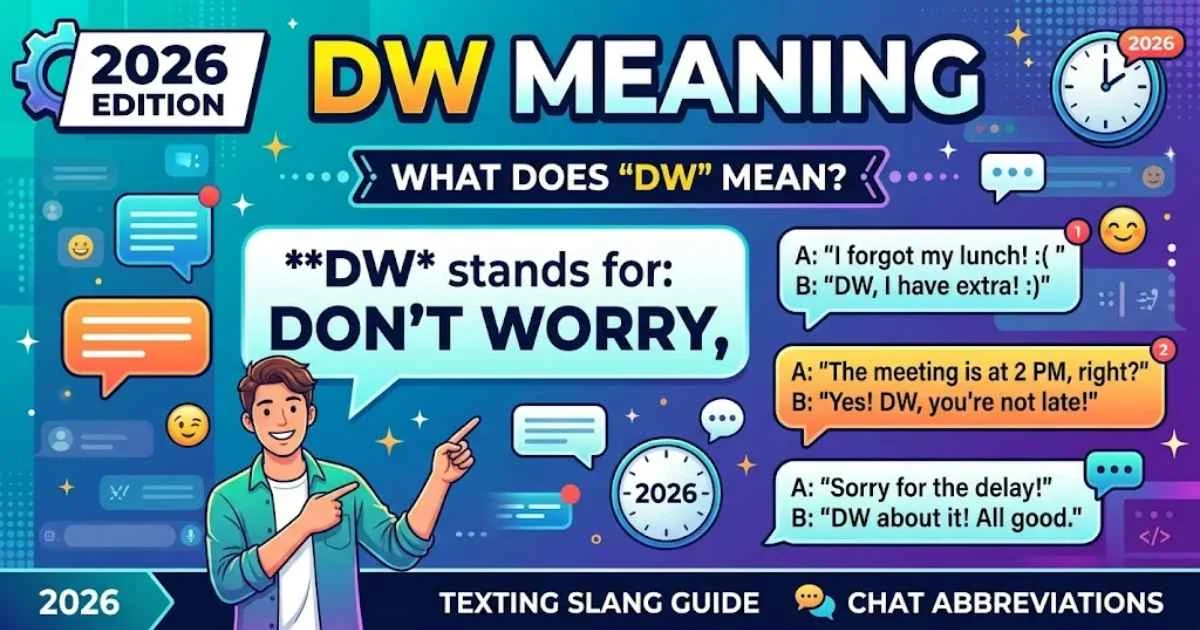
“Why did they just say DW, and should I actually be worried?” If you have ever paused over a short message like this, you are not alone. In everyday texting, DW is most commonly used to mean “Don’t Worry,” but its meaning can change when the conversation moves into a different context.
You can come across DW while chatting on WhatsApp (messaging), browsing Facebook, exchanging DMs on Instagram, watching or commenting on TikTok and YouTube, sending quick messages on Snapchat, posting on X (formerly Twitter), or talking in a Telegram group. Imagine a friend telling you, “I’m running late,” and you replying, “DW, take your time.” Those two letters quickly communicate reassurance without making the conversation sound formal.
But there is more to DW meaning in text than simply knowing its most common definition. The abbreviation can carry different tones depending on the words around it, the relationship between the people chatting, and the platform where it appears. In some professional, technical, or entertainment-related conversations, DW may even represent something completely different.
In this guide, you’ll learn what DW means in texting, how people use it on social media, what its tone can suggest, its alternative meanings, common examples, similar abbreviations, and when you should or should not use it. By the end, you’ll be able to recognize the intended meaning of DW from the context instead of guessing.
Read Also : “RSS Meaning”: Definition, Origin, Slang & Social Media Uses!
Stands for What
In modern texting and internet slang, DW most commonly stands for “Don’t Worry.”
It is a short, informal abbreviation used to reassure someone, reduce their concern, or let them know that a problem is not serious.
DW = Don’t Worry
Quick examples
- “DW, I got it.” → Don’t worry, I got it.
- “DW about being late.” → Don’t worry about being late.
- “DW, everything is okay.” → Don’t worry, everything is okay.
- “DW 😂 I’m not mad.” → Don’t worry, I’m not mad.
The exact meaning still depends on context, because DW can represent other words or phrases outside casual texting.
Meaning in Text
When you see DW in a text message, the safest first interpretation is “Don’t Worry.”
It often appears when someone wants to make another person feel less anxious, guilty, embarrassed, or concerned.
For example:
Person A: “Sorry, I forgot to bring your book.”
Person B: “DW, you can bring it tomorrow.”
Here, DW makes the response sound relaxed and forgiving.
You may also see it at the beginning or end of a sentence:
- “DW, I’ll handle it.”
- “You’re good, DW.”
- “DW about what happened.”
- “DW! It wasn’t your fault.”
The abbreviation is particularly common in quick chats, where people prefer shorter and faster messages.
Meaning & Definition
DW is an informal texting abbreviation that most commonly means “Don’t Worry.” It communicates reassurance, comfort, or a casual dismissal of concern.
It can function similarly to phrases such as:
- Don’t stress
- No worries
- It’s okay
- You’re fine
- No need to worry
- Everything is good
- Forget about it
The emotional tone depends heavily on the surrounding message.
For example:
“DW 😊” can sound warm and friendly.
“DW.” may sound more neutral or even slightly cold depending on the relationship and situation.
Old and New Slang Meaning with Comparison
| Era / Context | DW Meaning | Typical Use | Tone |
| Older internet/chat use | Don’t Worry | Instant messaging and forums | Casual |
| Early social media | Don’t Worry | Comments and direct messages | Friendly |
| Modern texting | Don’t Worry | WhatsApp, SMS, DMs | Very common |
| Modern meme/chat culture | Don’t Worry | Short replies and reactions | Casual/playful |
| Professional/technical context | Data Warehouse | Business and technology | Formal/technical |
| Entertainment context | Doctor Who | TV discussions | Context-specific |
The “Don’t Worry” meaning remains the most useful interpretation when DW appears in an ordinary personal conversation.
Pronunciation of DW
When DW means “Don’t Worry,” people generally read the abbreviation as the individual letters D-W rather than pronouncing it as one word.
The spoken phrase itself is simply “Don’t Worry.”
Breakdown
D = Don’t
W = Worry
Together:
DW → Don’t Worry
The abbreviation removes the unnecessary words while keeping the main message intact.
This is typical of texting shorthand, where users shorten frequently used expressions to make communication faster.
Other Meanings and Descriptions
Although Don’t Worry is the dominant texting interpretation, DW can have other meanings.
| DW Meaning | Context |
| Don’t Worry | Texting and social media |
| Data Warehouse | Technology and business analytics |
| Doctor Who | Television and fandom discussions |
| Dear Wife | Informal personal/family shorthand |
| Down With | Informal slang, depending on wording |
| Driveway | Some address/property-related shorthand |
| Deutsche Welle | International media organization |
| Distilled Water | Scientific or technical contexts |
Always check the surrounding words before deciding what DW means.
Meanings Across Platforms
DW generally keeps the same basic meaning across social platforms, but the style of use can change.
On WhatsApp, DW commonly means “Don’t Worry.”
“DW, I’ll call you later.”
Because WhatsApp conversations are usually personal or informal, this interpretation is highly likely.
On Facebook Messenger and comments, DW can be used as a quick reassurance.
“DW, we can sort it out tomorrow.”
On Instagram DMs, DW may appear in short conversations between friends.
“DW about the picture 😂”
TikTok
TikTok comments and direct messages often use DW as part of fast-moving internet slang.
“DW, you’re not the only one who thought that 😂”
YouTube
In YouTube comments, DW can occasionally mean “Don’t Worry,” although other meanings may appear depending on the topic.
Snapchat
Snapchat encourages short, fast messages, making abbreviations such as DW convenient.
“DW I saved it.”
X
On X, DW may appear in replies, posts, fandom discussions, and casual conversations.
Telegram
Telegram chats and group conversations commonly use DW in the same informal “Don’t Worry” sense.
The platform itself usually does not determine the meaning; the conversation does.
Psychological / Emotional Meaning
DW often carries an emotional message beyond its literal words. When someone writes “DW,” they may be trying to reduce another person’s anxiety or make a situation feel less serious.
Positive
A positive use of DW can communicate:
- Reassurance
- Kindness
- Emotional support
- Forgiveness
- Comfort
- Confidence
- Friendliness
Example:
“DW, you didn’t ruin anything. We’re good.”
This tells the other person that they should stop feeling guilty or anxious.
Neutral
Sometimes DW is simply practical.
“DW, I’ll send the file tomorrow.”
There may be little emotional depth behind it. The sender is simply saying that the issue is not a problem.
Negative
DW can occasionally sound dismissive.
“DW. Just leave it.”
If the sender gives no additional explanation, the abbreviation might make the conversation feel cold or impatient.
The negative interpretation usually comes from tone and context, not from the letters themselves.
Read More: “DTF Meaning”: What It Really Means in Text and Slang!
Grammar and Linguistic Notes
DW is an initialism/abbreviation used in informal digital communication.
It is not normally treated like a standard English word in formal writing.
Instead of:
“DW about the mistake.”
A formal version would be:
“Don’t worry about the mistake.”
DW commonly appears:
- At the beginning of a sentence
- Before a topic
- As a short standalone response
- In direct messages
- In group chats
- In comments
Examples:
Beginning: “DW, I understand.”
Middle: “You can DW about it.” — less natural
Standalone: “DW!”
The standalone form works particularly well when the context is already obvious.
Similar Terms & Alternatives
If you want to express the same general idea as DW, you can use:
- Don’t worry
- No worries
- No problem
- It’s okay
- You’re good
- All good
- Don’t stress
- It’s fine
- No big deal
- You’re fine
- Forget about it
- No need to worry
However, these aren’t always exact replacements.
For example, “No problem” often responds to an apology or request, while “Don’t worry” specifically reassures someone.
Read More: “444 Meaning”: What Does This Angel Number Really Mean?
Origin and History of DW
The exact first use of DW is difficult to establish because informal abbreviations developed organically across early online messaging, chat rooms, forums, SMS, and instant messaging.
The abbreviation follows a simple pattern: take the initial letters of “Don’t Worry” and use them as a shorthand expression.
As digital communication became faster and more character-focused, abbreviations such as DW, BTW, FYI, IDK, LOL, BRB, and OMG became increasingly familiar.
Timeline
| Period | Development |
| Early online chat | Shortened expressions became useful for faster communication |
| SMS era | Character limits encouraged abbreviations |
| Instant messaging era | DW became useful in quick personal conversations |
| Early social media | Internet shorthand spread into public posts and comments |
| Smartphone era | Abbreviations became normal in everyday texting |
| Modern social media | DW continues to appear in DMs, group chats, comments, and online communities |
DW therefore belongs to the broader history of digital shorthand and internet language.
Usage in Different Contexts
The meaning of DW changes depending on where you encounter it.
Casual Chats
This is the most common environment for DW = Don’t Worry.
First “DW, I’ll bring it tomorrow.”
Second “DW 😂 I’m not upset.”
Third “DW about the money.”
Social Media
On social media, DW is often used in:
- Comments
- Replies
- DMs
- Group conversations
- Meme discussions
- Fan communities
It helps users communicate quickly without typing the complete phrase.
Professional Use
You should be more careful with DW at work.
In an informal workplace chat, someone might understand:
“DW, I’ll take care of it.”
But in a formal email or official document, writing “Don’t worry” is clearer and more professional.
In technology or analytics, DW may instead mean Data Warehouse.
For example:
“The DW contains historical sales data.”
Here, interpreting DW as “Don’t Worry” would be completely wrong.
Gaming & Group Chats
Gaming communities often use abbreviations heavily.
A player might say:
“DW, we can still win.”
Or:
“DW about that mistake.”
In a group chat, the meaning is usually obvious from the surrounding conversation.
Read More: “PMO Meaning”: What Does PMO Mean in Slang?
Advantages and Disadvantages
| Advantages of DW | Disadvantages of DW |
| Very quick to type | Can be ambiguous |
| Easy to understand in casual chats | Less suitable for formal writing |
| Saves time | Tone can be misunderstood |
| Sounds conversational | New users may not know it |
| Useful for reassurance | May seem dismissive in some situations |
| Works well in group chats | Has multiple meanings |
The biggest advantage is speed, while the biggest drawback is contextual ambiguity.
Real-Life Examples & Memes
DW frequently appears in humorous conversations because people often exaggerate reassurance.
Example 1: Friend
Friend: “I accidentally sent the wrong photo.”
You: “DW 😂”
Example 2: School or college
Student: “I forgot the assignment.”
Friend: “DW, the teacher extended the deadline.”
Example 3: Gaming
Player: “Sorry, I lost the round.”
Teammate: “DW, we got the next one.”
Example 4: Relationship
Person A: “Sorry I couldn’t call last night.”
Person B: “DW ❤️”
Meme-style use
DW can become funny when someone says:
“DW, I have a plan.”
…and the next moment everything goes completely wrong.
This creates an ironic contrast between reassurance and chaos, which is common in meme culture.
Read More: “SYBAU Meaning”: What Does This Viral Slang Mean?
Cultural or Regional Interpretations
The basic texting meaning is widely recognizable in English-speaking online communities, but usage frequency and familiarity can vary.
| Region | Common Interpretation | Typical Environment |
| United States | Don’t Worry | Texting, DMs, social media |
| United Kingdom | Don’t Worry | Messaging and online chats |
| India | Don’t Worry | WhatsApp, Instagram, group chats |
| Pakistan | Don’t Worry | WhatsApp, Facebook, messaging |
| Philippines | Don’t Worry | Social media and messaging |
| Australia | Don’t Worry | Casual digital communication |
United States & UK
In the US and UK, DW is generally easy to understand in casual digital conversations.
Asia (India, Pakistan, Philippines)
In countries such as India, Pakistan, and the Philippines, English-based texting abbreviations are widely used alongside local languages. DW can therefore appear naturally in mixed-language conversations.
For example:
“DW yaar, it’s okay.”
or:
“DW, sab theek hai.”
The surrounding language can help confirm that DW means “Don’t Worry.”
Australia
Australian users may use DW in casual texting and social media in much the same way as other English-speaking communities.
Regional differences are generally less important than the specific conversation and relationship between the speakers.
Read Also : SUS Meaning: Definition, Origin, Slang & Examples
Common Mistakes & Misconceptions
One of the biggest mistakes is assuming that DW always means “Don’t Worry.”
It does not.
Mistake 1: Ignoring context
If someone writes:
“Our DW needs more storage.”
DW probably does not mean “Don’t Worry.” In a technology conversation, it could mean Data Warehouse.
Mistake 2: Using DW in formal documents
Writing:
“DW about the delay.”
in a formal business email may appear too casual.
Use:
“Please don’t worry about the delay.”
Mistake 3: Assuming DW is always friendly
The phrase can sound dismissive when used without explanation.
Mistake 4: Confusing DW with other abbreviations
DW is not automatically equivalent to:
- BTW
- IDK
- FYI
- NVM
- NP
- IDC
Each has a different function.
The Vibe Behind DW
The typical DW vibe is:
casual + reassuring + relaxed
It often makes a message feel less formal.
Compare:
“Please don’t worry about it.”
with:
“DW about it.”
The second sounds shorter, more conversational, and more like everyday texting.
The vibe can also be:
- Friendly: “DW 😊”
- Playful: “DW 😂”
- Comforting: “DW, I’ve got you.”
- Neutral: “DW, I’ll handle it.”
- Dismissive: “DW. It’s fine.”
Emoji, punctuation, and the relationship between the people can significantly change the perceived tone.
Read More: Cap and No Cap Meaning: What Does It Really Mean?
Is It Offensive or Friendly?
DW is generally friendly and not offensive.
It is normally used to reassure someone.
However, context matters. A blunt “DW.” can sometimes sound dismissive if the other person is discussing something serious.
For sensitive conversations, a fuller response is often better:
“Please don’t worry. I understand.”
rather than simply:
“DW.”
So, DW itself is not offensive; the way you use it can affect how it feels.
How to Respond
Your response depends on what the sender means.
If someone says:
“DW, everything is fine.”
You can respond:
- “Thanks!”
- “Okay 😊”
- “I appreciate it.”
- “Good to hear.”
- “Alright, thanks.”
- “Got it!”
If someone says:
“DW about the mistake.”
You could say:
“Thanks for understanding.”
If you’re unsure what DW means, simply ask:
“What do you mean by DW here?”
That’s especially useful when the conversation could involve a technical or professional meaning.
Read More : Janky Meaning: Definition, Origin, Slang & Examples
Differences from Similar Words
| Term | Meaning | Main Purpose |
| DW | Don’t Worry | Reassurance |
| NP | No Problem | Response to thanks/apology/request |
| NVM | Never Mind | Withdraw or dismiss a previous point |
| IDC | I Don’t Care | Express indifference |
| IDK | I Don’t Know | Express uncertainty |
| FYI | For Your Information | Provide information |
| BTW | By The Way | Introduce an additional point |
| OMG | Oh My God | Express surprise/emotion |
| BRB | Be Right Back | Temporary absence |
| LOL | Laughing Out Loud | Express amusement |
The closest everyday alternatives to DW are “Don’t worry,” “No worries,” “It’s okay,” and “You’re good.”
Relevance in Dating & Online Culture
In dating and online relationships, DW can be particularly useful for reducing tension.
For example:
“Sorry I didn’t reply earlier.”
“DW ❤️”
This can communicate that the delay did not cause a problem.
In romantic conversations, however, the emotional tone can depend on punctuation and emojis.
Compare:
First “DW ❤️” → warm and affectionate
Second “DW lol” → casual/playful
Third “DW.” → potentially cold or dismissive
Because online communication lacks facial expressions and voice tone, short abbreviations can sometimes be interpreted differently than intended.
Common Examples of DW
Here are some natural examples:
- “DW, I got this.”
- “DW about it.”
- “DW, you’re not in trouble.”
- “DW 😊 everything’s okay.”
- “Sorry!” — “DW!”
- “DW, I’ll text you later.”
- “DW about being late.”
- “DW, we still have time.”
- “DW, it wasn’t your fault.”
- “DW 😂 we’re good.”
These examples show why DW is so convenient: a few letters can communicate reassurance without requiring a full sentence.
Read More: BTW Meaning in Text: What It Really Means & Examples
Popularity & Trends
DW remains useful because it fits the way people communicate online: quickly, casually, and conversationally.
Its continued appearance across messaging apps and social platforms is supported by the broader popularity of internet slang, texting abbreviations, acronyms, and digital shorthand.
Unlike some slang terms that become strongly associated with one generation or platform, DW is relatively straightforward and evergreen. The phrase “Don’t Worry” is common in everyday English, so its abbreviated form remains easy to understand.
Its meaning can still shift when it appears in specialized communities, especially technology, entertainment, business, or fandom discussions.
When Not to Use
Avoid DW when clarity or professionalism is more important than speed.
Avoid it in:
- Formal business letters
- Official reports
- Academic writing
- Legal documents
- Professional customer communication
- Serious emotional conversations where more explanation is needed
- Messages to someone unfamiliar with texting abbreviations
Instead of:
“DW about the issue.”
use:
“Please don’t worry about the issue.”
The complete phrase is clearer and more appropriate in formal communication.
FAQs About Dw Mean In Texting
1. What does DW mean in texting?
DW usually means “Don’t Worry.”
2. What does DW mean on WhatsApp?
On WhatsApp, DW commonly means “Don’t Worry.”
3. Is DW slang?
Yes. DW is an informal texting abbreviation commonly used in digital communication.
4. Is DW rude?
Usually not. It is generally friendly and reassuring, although a very short “DW.” can sometimes sound dismissive.
5. What does DW mean from a girl?
It usually means “Don’t Worry,” regardless of gender. The context and tone matter more than who sent it.
6. What does DW mean from a guy?
Most commonly, it means “Don’t Worry.” The surrounding conversation determines the exact interpretation.
7. What is the opposite of DW?
There is no exact opposite, but expressions such as “Be concerned” or “You should worry” convey the opposite idea.
8. Can DW have other meanings?
Yes. Depending on context, DW can mean Data Warehouse, Doctor Who, Dear Wife, or other terms.
9. Is DW appropriate at work?
It depends. It may be acceptable in an informal team chat, but “Don’t worry” is usually better in formal professional communication.
10. What should I reply to DW?
You can reply with “Thanks,” “Okay,” “I appreciate it,” “Good to know,” or another response appropriate to the conversation.
Final Thoughts
DW most commonly means “Don’t Worry” in texting, messaging, and social media conversations. It is a short, convenient way to reassure someone, reduce tension, or let them know that something is not a problem.
You’ll often see DW on WhatsApp, Facebook, Instagram, TikTok, Snapchat, X, Telegram, and other online platforms. However, context remains essential because DW can also refer to terms such as “data warehouse” or “Doctor Who.”
The easiest rule is simple: look at the words around DW before deciding what it means. In a casual personal conversation, “Don’t Worry” is usually the right interpretation; in a technical or professional discussion, another meaning may make more sense.
That ability to read the context, tone, and platform is what helps you understand DW, and other internet abbreviations, correctly.

Hi, I am Isabel, the Author of Skypunz.com, where I share witty puns, jokes, and fun content to brighten your day.