
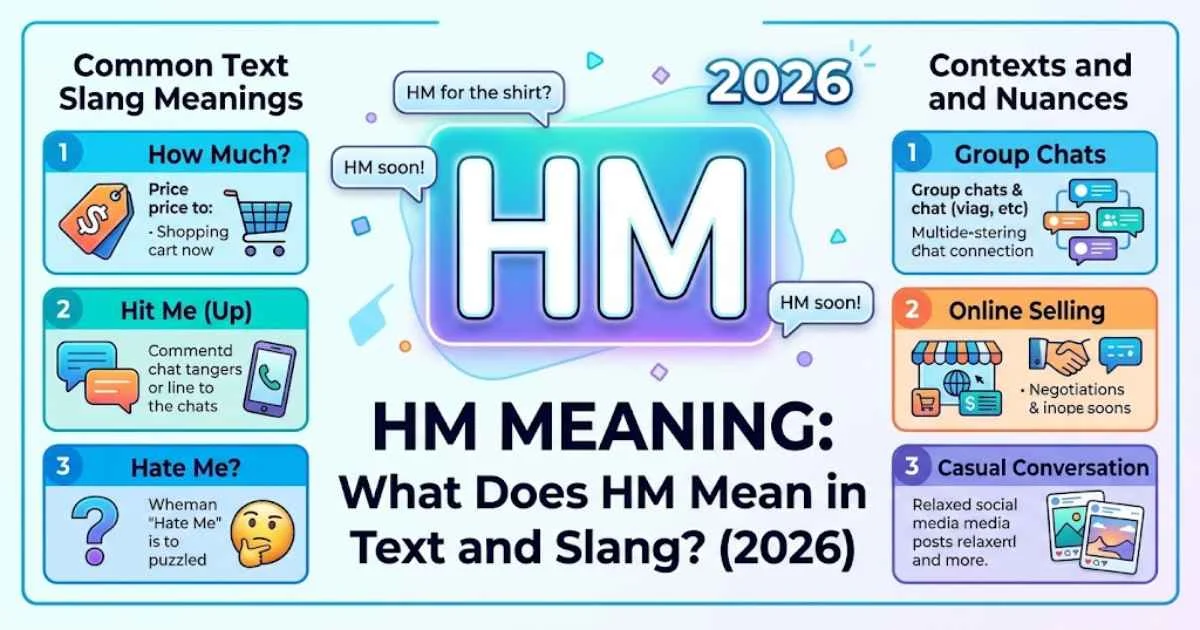
Have you ever received a simple “HM…” in a message and paused for a moment, wondering what the person really meant? Sometimes, just two letters can leave you more curious than a long sentence.
In texting, HM is commonly used as a short way of expressing “hmm,” often showing that someone is thinking, hesitating, wondering, or deciding what to say next. But the meaning can shift with the situation, punctuation, and tone of the conversation. You may see HM in WhatsApp messaging, Facebook, Instagram, TikTok, YouTube, Snapchat, X (formerly Twitter), or Telegram, especially when people want to keep their replies quick and informal.
Picture this: you send your friend a suggestion and expect an immediate “yes” or “no.” Instead, they reply, “HM…”. Are they considering your idea? Do they have doubts? Or are they simply taking a moment to think? That tiny response can carry several different shades of meaning, which makes HM meaning in text worth understanding.
Whether you came across HM in a text message, saw it in a social media comment, noticed it during an online conversation, or want to know how to use it naturally yourself, understanding the context is the key.
In this guide, we’ll explore what HM means, how it is used, its emotional tone, pronunciation, history, examples, related expressions, platform-specific meanings, common misunderstandings, and the situations where you should or shouldn’t use it.
Read Also : “RSS Meaning”: Definition, Origin, Slang & Social Media Uses!
Stands for What
HM is a short abbreviation that can have different meanings depending on the conversation. In texting, chats, and social media, one of the most common uses is as a written form of “hmm,” expressing hesitation, thought, uncertainty, curiosity, or a moment of consideration.
For example:
“HM, I’m not sure about that.”
Here, HM communicates something similar to “hmm” or “let me think.”
However, HM does not have one universal definition. In some conversations, people may use it as an abbreviation for phrases such as “how much?”, depending on the context and the writer’s personal texting style. Outside internet slang, HM can also appear as an abbreviation or initialism for completely different terms.
So, when you see HM in a text message, don’t automatically assume it has only one meaning. Look at the surrounding words and the tone of the conversation.
Meaning in Text
In texting, HM most commonly works as a quick expression of thinking, hesitation, uncertainty, or consideration.
You might receive:
“HM… maybe.”
This usually means the person is thinking about the suggestion rather than immediately agreeing.
Depending on punctuation and context, HM can communicate slightly different feelings:
- “”HM?”—curiosity, questioning, or uncertainty
- “HM…””—hesitation or deep thought
- “HM, “okay”—consideration or mild acknowledgment
- “HM “interesting”—curiosity or surprise
- “HM, I’ll think about it.” — uncertainty or deliberation
Because texting removes many facial expressions and vocal cues, short expressions such as HM can help reproduce the feeling of a spoken reaction.
The safest approach is to read HM together with the complete message, rather than interpreting the abbreviation by itself.
Meaning & Definition
“HM” can be defined as a short informal expression used in digital communication to represent a thinking sound, hesitation, uncertainty, or consideration.
In many casual conversations, it functions similarly to “hmm.” The person may be thinking about what you said, deciding what to do, or signaling that they are not completely convinced.
Old and New Slang Meaning with Comparison
| Usage | Older/Common Interpretation | Newer Digital Interpretation | Example |
| HM | Thinking or hesitation | Quick “hmm” reaction | “HM, let me think.” |
| HM? | Questioning | Confusion or curiosity | “HM? What happened?” |
| HM… | Thoughtful pause | Uncertainty or skepticism | “HM… I don’t know.” |
| HMM | Thinking sound | More expressive digital reaction | “HMM, that’s interesting.” |
| How much? | Contextual abbreviation | Possible marketplace/chat shorthand | “HM for this?” |
The important point is that HM is highly context-dependent. The same two letters can carry a different meaning in another conversation.
Pronunciation of HM
When HM is being used as a written form of “hmm,” it is generally understood like the spoken sound “hmm.”
In casual conversation, you normally do not pronounce each letter separately when HM is intended to represent a thinking sound.
If HM is being used as an initialism for another phrase, however, its pronunciation may change according to the full expression.
Breakdown
The meaning of HM can be understood through its conversational function:
- H can begin the written representation of a hesitation sound.
- M helps reproduce the closed-mouth sound associated with “hmm.”
- HM is therefore often a shortened visual form of a spoken reaction.
- Punctuation can change its emotional tone.
- The surrounding message determines the intended interpretation.
For example:
“HM” may sound reserved.
“HM…” may suggest uncertainty.
“HM?” can indicate a question.
“HM, interesting,” he may show curiosity.
Other Meanings and Descriptions
Depending on context, HM may also appear as an abbreviation for other words, names, titles, or phrases.
Possible interpretations include:
- Hmm—hesitation or thinking
- How much? — sometimes used in informal buying/selling conversations
- His Majesty / Her Majesty—formal or historical usage in certain contexts
- HM as initials—names, organizations, brands, technical terms, or other specialized expressions
This is why context is essential. A text conversation and a formal document may use HM in completely different ways.
Read More: “DTF Meaning”: What It Really Means in Text and Slang!
Meanings Across Platforms
The meaning of HM can remain similar across social platforms, but the tone may change depending on the environment.
On WhatsApp, HM is commonly used as a short reaction:
“HM… okay.”
It may communicate hesitation, thought, or mild uncertainty.
On Facebook Messenger or comments, HM may appear as a quick response when someone wants to acknowledge a statement without giving a full answer.
On Instagram DMs, HM can be a brief reaction to a photo, opinion, suggestion, or personal message.
TikTok
TikTok users may use HM in comments or messages as a quick reaction to something surprising, confusing, or thought-provoking.
YouTube
In YouTube comments, HM can function as a short reaction, although longer comments are usually preferred when someone wants to explain an opinion.
Snapchat
Because Snapchat communication is often fast and informal, HM can work as a quick conversational response.
X
On X, HM may appear in replies as a compact reaction to someone’s claim, statement, or question.
Telegram
Telegram chats and group conversations may use HM similarly to other messaging apps, especially when users want to respond quickly.
The common thread across these platforms is brevity. HM saves typing while still conveying a reaction.
Psychological / Emotional Meaning
Although HM is only two letters, its emotional meaning can be surprisingly flexible.
The emotional interpretation depends heavily on punctuation, timing, previous messages, and the relationship between the people chatting.
Positive
HM can express:
- Curiosity
- Interest
- Thoughtfulness
- Consideration
- Pleasant surprise
- Genuine reflection
Example:
“HM, that’s actually a good idea.”
Here, HM suggests that the person is considering the idea positively.
Neutral
A neutral HM may simply indicate that someone is processing information.
“HM, I need to check.”
The person is neither agreeing nor disagreeing. They are simply thinking.
Negative
In certain conversations, HM can suggest:
- Doubt
- Suspicion
- Skepticism
- Disagreement
- Irritation
- Emotional distance
For example:
“HM… if you say so.”
The meaning becomes more negative because of the surrounding words and punctuation.
This shows why you should avoid interpreting HM alone as positive or negative.
Read More: “444 Meaning”: What Does This Angel Number Really Mean?
Grammar and Linguistic Notes
HM is generally an informal conversational expression or abbreviation, rather than a standard English word.
When it represents “hmm,” it behaves more like an interjection than a conventional noun or verb.
You can place it at the beginning of a message:
“HM, maybe you’re right.”
Or use it by itself:
“HM…”
Punctuation is especially important.
- HM? → questioning or uncertainty
- HM… → hesitation or contemplation
- HM! → surprise or emphasis
- HM, okay. → acknowledgment
Capitalization is also flexible in casual digital communication. Users may write HM, hm, or Hm.
Similar Terms & Alternatives
Several expressions can perform a similar conversational function.
| Term | Meaning/Tone |
| Hmm | Thinking or hesitation |
| Hmmm. | Stronger or longer hesitation |
| Uh-huh. | Acknowledgment |
| Okay. | Acceptance or acknowledgment |
| I see | Understanding |
| Interesting | Curiosity or attention |
| IDK | Uncertainty or lack of knowledge |
| Maybe | Uncertainty |
| Well | Introduction to a thought or response |
| Wait | Surprise or need for clarification |
If you want a clearer message, “hmm,” “I see,” or “I’m not sure” may communicate more precisely than HM.
Origin and History of HM
The use of HM as a digital expression is closely connected to the long-standing written representation of the spoken hesitation sound “hmm.”
People have used written forms such as hm, hmm, and hmmm to represent thought, hesitation, or uncertainty for a long time. Digital communication made these expressions even more common because texting attempts to reproduce aspects of spoken conversation without voice or facial expressions.
The exact origin of the two-letter texting form HM is difficult to assign to one person, platform, or date. Internet slang usually develops organically through repeated user behavior rather than through an official naming process.
Timeline
| Period | Development |
| Before digital communication | Written forms such as “hm” and “hmm” represented hesitation or thought. |
| Early online communication | Short expressions became useful in forums and chat rooms. |
| SMS/texting era | Abbreviated forms became increasingly common because users valued speed. |
| Social media era | HM became a compact reaction in DMs, comments, and replies. |
| Modern messaging | Context, punctuation, and capitalization increasingly shape the emotional meaning. |
Therefore, HM is better understood as part of the broader history of informal written conversation rather than as a slang term with one clearly documented inventor.
Read More: “PMO Meaning”: What Does PMO Mean in Slang?
Usage in Different Contexts
The meaning of HM becomes easier to understand when you identify the setting.
Casual Chats
In personal conversations, HM often means:
“I’m thinking about that.”
Example:
Friend: “Want to go out tonight?”
You: “HM, maybe.”
It can show that you have not decided yet.
Social Media
On social platforms, HM may be used as a quick reaction to:
- A controversial opinion
- A surprising post
- A funny statement
- A confusing video
- A personal story
- A new idea
Example:
“HM… I never thought about it that way.”
Professional Use
Be cautious with HM in professional communication.
Although people may understand it, HM can appear vague or overly casual in an email or workplace message.
Instead of:
“HM, I’ll see.”
Use:
“I’ll consider it and get back to you.”
Clear language is usually better in professional settings.
Gaming & Group Chats
In gaming and group chats, HM can be a quick reaction when teammates are discussing a strategy.
Example:
“HM… we could try the other route.”
Here, HM creates a brief thinking pause before suggesting an option.
Advantages and Disadvantages
| Advantages | Disadvantages |
| Very short | Can be ambiguous |
| Saves typing time | Tone may be misunderstood |
| Works well in casual chats | Can appear uninterested |
| Mimics natural conversation | Not ideal for formal writing |
| Can show hesitation naturally | Meaning changes with context |
| Easy to combine with punctuation | May sound passive-aggressive |
The biggest advantage of HM is brevity, while its biggest weakness is ambiguity.
Real-Life Examples & Memes
Here are natural examples showing how HM can work in everyday digital communication:
Example 1 — Thinking
“HM… let me think about it.”
Example 2 — Doubt
“HM, are you sure?”
Example 3 — Curiosity
“HM, that’s interesting.”
Example 4 — Hesitation
“HM… I don’t know.”
Example 5—Group chat
“HM, maybe we should wait.”
Example 6 — Online discussion
“HM? How did you get that answer?”
HM can also appear in memes where a character is shown looking suspicious, confused, or deeply thoughtful. The humor usually comes from exaggerating the idea of someone silently thinking before responding.
Cultural or Regional Interpretations
HM generally retains a similar basic function across English-speaking online communities, but communication styles can differ.
| Region | Common Interpretation | Typical Tone |
| United States | Thinking, hesitation, uncertainty | Casual |
| UK | Thought, doubt, consideration | Casual |
| India | Context-dependent reaction or “hmm” | Informal |
| Pakistan | Often understood as “hmm” or a thinking response | Informal |
| Philippines | Casual reaction in English-based digital communication | Informal |
| Australia | Thinking, hesitation, or acknowledgment | Casual |
United States & UK
In American and British digital communication, HM may function similarly to “hmm.” The exact emotional tone depends on punctuation and the surrounding conversation.
Asia (India, Pakistan, Philippines)
Because English is widely used online alongside local languages in these regions, HM may appear in mixed-language conversations.
For example:
“HM, dekhte hain.”
The user may combine HM with another language while maintaining the same basic idea of hesitation or consideration.
Australia
Australian online conversations can use HM in much the same way as other English-speaking communities. The surrounding sentence usually determines whether it sounds thoughtful, doubtful, or casual.
Common Mistakes & Misconceptions
One of the biggest mistakes is assuming that HM always has one fixed meaning.
Mistake 1: Assuming HM Always Means “Hmm”
This is common, but HM can represent other abbreviations in specific contexts.
Mistake 2: Treating HM as Automatically Negative
HM does not automatically mean annoyance or disagreement.
“HM, that’s a great point.”
Here, it is positive or thoughtful.
Mistake 3: Ignoring Punctuation
Compare:
“HM?”
with:
“HM…”
They can communicate very different reactions.
Mistake 4: Using HM in Every Situation
HM is most natural in informal digital communication. It may sound too vague in a formal email, business proposal, or academic document.
Mistake 5: Confusing HM With Other Abbreviations
Short abbreviations can overlap. Always consider the complete message before choosing a definition.
The Vibe Behind HM
The vibe of HM is usually thoughtful, hesitant, curious, or uncertain.
Depending on the context, it can feel:
- Casual
- Quiet
- Reflective
- Curious
- Skeptical
- Slightly mysterious
- Occasionally passive-aggressive
The punctuation often controls the vibe.
“HM.” → reserved
“HM…” → thoughtful or doubtful
“HM?” → questioning
“HM, interesting.” → curious
This makes HM a small expression with a surprisingly broad emotional range.
Is It Offensive or Friendly?
HM is generally neither offensive nor inherently rude. It is usually a neutral or casual expression.
However, context matters.
If someone says:
“HM…”
After you make a serious statement, you might interpret it as doubt or skepticism.
But if someone says:
“HM, that’s actually really cool.”
The expression is clearly friendly.
If you are unsure about someone’s intention, don’t judge the entire message from HM alone. Consider the relationship, previous messages, punctuation, and overall tone.
How to Respond
Your response should depend on what the sender appears to mean.
If HM Shows Uncertainty
You can say:
“Take your time.”
If HM Shows Confusion
You can say:
“What part is confusing?”
If HM Shows Doubt
You can say:
“Yeah, I can explain why I think that.”
If HM Is Just an Acknowledgment
You can continue naturally:
“Anyway, what do you think?”
If You Think They Are Being Passive-Aggressive
Ask directly but calmly:
“Is something bothering you?”
The goal is to respond to the context, not just the abbreviation.
Differences from Similar Words
| Expression | Main Meaning | Typical Tone |
| HM | Thinking or hesitation | Casual |
| Hmm | Thinking or consideration | Neutral |
| Hmmm | Extended thought or doubt | More expressive |
| IDK | I don’t know | Uncertain |
| Maybe | Uncertain possibility | Neutral |
| Okay | Acknowledgment | Neutral |
| Interesting | Curiosity or attention | Curious |
| What? | Confusion or surprise | Direct |
| Wait | Surprise or interruption | Informal |
HM is usually less explicit than these alternatives. That is why it can be useful for casual conversation but less useful when you need precision.
Relevance in Dating & Online Culture
In dating conversations, HM can be especially difficult to interpret because emotional tone matters.
For example:
“HM…”
could mean:
- “I’m thinking about what you said.”
- “I’m not sure.”
- “I’m interested but cautious.”
- “I don’t know how to respond.”
- “I’m skeptical.”
If someone sends HM after you ask them out, it does not automatically mean yes or no.
For example:
“Want to grab coffee this weekend?”
“HM…”
The best response is not to assume. You can give the person space or ask naturally:
“No pressure—just let me know.”
In online dating, this is especially useful because text removes many of the emotional cues available in face-to-face conversations.
Common Examples of HM
Here are some simple examples you may encounter online:
- “HM, let me think.” — considering something.
- “HM?” — asking for clarification.
- “HM… maybe.” — uncertain.
- “HM, interesting.” — curious.
- “HM, I see.” — processing information.
- “HM, not sure.” — expressing doubt.
- “HM, that could work.” — considering an idea.
- “HM… really?” — skepticism or surprise.
- “HM, okay.” — acknowledging a message.
- “HM, I’ll decide later.” — postponing a decision.
These examples demonstrate why the surrounding words matter so much.
Popularity & Trends
HM remains useful because digital communication favors short, fast, expressive messages.
People often shorten their reactions when communicating through:
- Text messages
- Messaging apps
- Social media
- Group chats
- Gaming communities
- Online forums
- Dating apps
However, HM does not have one universal popularity level across every platform. Its use can vary by age group, community, language background, and personal texting habits.
Modern internet communication also offers many competing alternatives, including hmm, idk, lol, okay, wait, fr, ngl, tbh, and emojis.
As a result, HM is best viewed as a contextual conversational abbreviation, rather than a slang term with one fixed definition.
When Not to Use
You should avoid HM when clarity and professionalism are more important than conversational brevity.
Avoid relying on HM in:
- Formal business emails
- Job applications
- Academic writing
- Official documents
- Customer-service communication
- Legal communication
- Important workplace discussions
Instead of:
“HM, I’ll check.”
write:
“I’ll check and get back to you.”
Instead of:
“HM?”
write:
“Could you clarify what you mean?”
Clear wording reduces the chance of misunderstanding.
FAQs About HM Mean In Texting
1. What does HM mean in texting?
In texting, HM often means “hmm,” expressing thought, hesitation, uncertainty, or consideration.
2. Is HM a slang word?
HM is better described as an informal abbreviation or conversational expression than a traditional slang word.
3. Does HM mean “hmm”?
Often, yes. In casual chats, HM can function as a shortened written form of “hmm.”
4. What does HM mean from a girl?
It has no gender-specific meaning. A girl may use HM to show thought, hesitation, uncertainty, or curiosity, depending on context.
5. What does HM mean from a guy?
The same basic interpretation applies. You need to consider the surrounding message and tone.
6. Is HM rude?
Not inherently. HM is generally neutral and informal, although it can sound doubtful or dismissive in certain contexts.
7. What does HM mean with three dots?
“HM…” often suggests hesitation, thought, uncertainty, or skepticism.
8. What does HM mean with a question mark?
“HM?” can indicate confusion, curiosity, or a request for clarification.
9. Can HM have other meanings?
Yes. HM can represent different words or phrases in specialized, formal, or context-specific situations.
10. Should I use HM professionally?
Usually, no. In professional communication, a complete phrase such as “I’ll consider it” or “Could you clarify?” is clearer.
Final Thoughts
HM is a small but flexible expression that can say much more than its two letters suggest. In casual texting and online conversations, it most commonly works like “hmm,” signaling thought, hesitation, curiosity, uncertainty, or consideration.
The key to understanding HM is context. Look at the punctuation, surrounding words, conversation topic, and relationship between the people communicating. “HM?” “HM…” and “HM, interesting” can all create different impressions.
If you are writing casually with friends, HM can be a quick and natural response. For professional or important conversations, however, clearer language is usually the better choice.
In short, when you see HM in a text, don’t rely on the abbreviation alone. Read the message as a whole, identify the tone, and you’ll usually be able to understand what the sender intended.

Hi, I am Isabel, the Author of Skypunz.com, where I share witty puns, jokes, and fun content to brighten your day.