
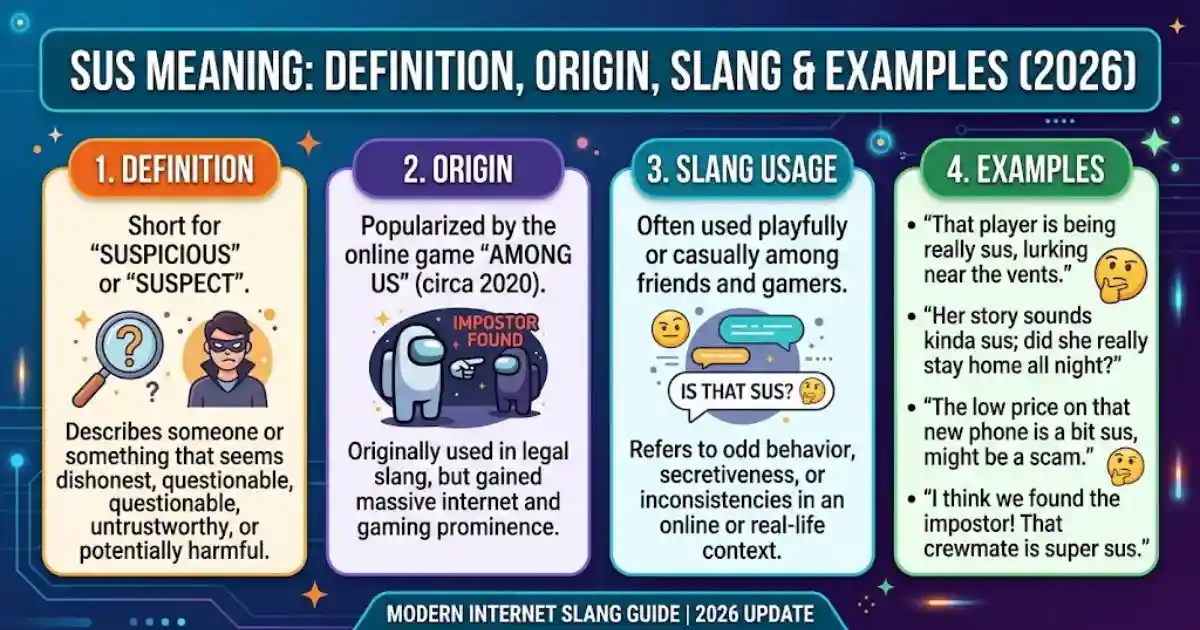
If you’ve ever been sent “sus” by a friend and you’re confused and trying to figure out what it means, you’ve come to the right place.
You use it when someone’s behavior, explanation, message, or situation seems strange, unusual, or hard to trust. Sus is informal slang for “suspicious” or “questionable.” For example, if your friend suddenly disappears after saying that they didn’t eat the last slice of pizza, you could jokingly say, “That’s sus!”
The word has become a major part of internet slang, online communication, gaming culture, memes, and social media language. You can encounter sus in WhatsApp messages, Facebook comments, Instagram captions, TikTok videos, YouTube comments, Snapchat chats, X (formerly Twitter) posts, and Telegram groups. Its popularity also grew significantly through gaming culture, especially Among Us, where players used sus to call out suspicious behavior.
But does “sus” always mean someone is lying? Is it offensive, friendly, or simply a joke? And how does its meaning change in texting, dating, gaming, memes, and everyday conversations?
In this guide, you’ll discover what “sus” means, where it came from, how to use it correctly, real-life examples, similar slang terms, regional interpretations, and the situations where you should, or shouldn’t, use it.
Read Also : Cap and No Cap Meaning: What Does It Really Mean?
Meaning & Definition
SUS is a popular slang abbreviation for “suspicious” or “suspect.” When someone calls a person, message, action, or situation “sus,” they usually mean that something seems strange, questionable, dishonest, or not quite right.
For example:
“Why did you leave the group chat right after I asked about the money? That’s sus.”
Here, Sus suggests that the person’s behavior seems questionable. You’ll commonly see it in text messages, social media comments, memes, gaming chats, and online conversations.
The word became especially popular through the multiplayer game Among Us, where players had to identify an impostor hiding among the crew. However, sus existed as an abbreviation of “suspicious” before the game’s popularity.
Old and New Slang Meaning with Comparison
| Version | Meaning | Typical Use | Example |
| Older use | Short for suspicious/suspect | Informal speech and writing | “That guy seems sus.” |
| Modern slang | Something feels questionable, shady, weird, or suspicious | Texting, memes, social media, gaming | “That excuse is sus.” |
| Gaming use | Someone may be hiding something or acting like an impostor | Multiplayer games, especially Among Us | “Blue is acting sus.” |
| Meme use | Often exaggerated for humor | Memes, comments, TikTok, Discord | “Bro, that sandwich looks sus.” |
Pronunciation of “SUS”
Sus is pronounced like “suss.”
- Pronunciation: /sʌs/
- Sounds like “suss”
- Syllables: 1
- Full word: suspicious
You generally pronounce it as one short word rather than saying each letter separately.
Breakdown
The simplest way to understand SUS is:
Suspicious → Susp → Sus
Instead of typing or saying the complete word “suspicious,” internet users shorten it to sus.
Depending on context, “sus” can describe:
- Suspicious behavior
- A questionable explanation
- A strange-looking situation
- Someone who seems dishonest
- An unexpected action
- Something that feels “off”
- A person who might be hiding something
For example:
“That website looks sus.”
→ The website looks questionable or potentially unsafe.
“Why are you being so sus?”
→ Why are you acting suspiciously?
“That excuse is sus.”
→ That explanation doesn’t seem believable.
Other Meanings and Descriptions
Although suspicious is the dominant slang meaning, sus can take on slightly different meanings depending on context.
It can describe something that is:
- Shady
- Questionable
- Sketchy
- Untrustworthy
- Dubious
- Weird
- Fishy
- Unusual
- Hard to believe
Sometimes, however, people use sus purely as a joke. Someone may call an obviously harmless action “sus” simply to tease a friend.
So, don’t automatically interpret “sus” as a serious accusation. The surrounding conversation, tone, emojis, and relationship between speakers usually tell you whether it is playful or serious.
Read More: Janky Meaning: Definition, Origin, Slang & Examples
Meanings Across Platforms
The meaning of “sus” stays relatively consistent across online platforms, but the tone can change.
| Platform | How “SUS” Is Commonly Used | Example |
| TikTok | Humor, teasing, suspicious behavior | “That explanation is sus 💀.” |
| Comments and DMs | “Bro, this photo is sus.” | |
| X | Reactions to questionable posts or claims | “That story sounds sus.” |
| Discord | Gaming, jokes, group conversations | “Why is Alex being sus?” |
| Questioning claims, users, or situations | “This post seems sus.” | |
| Among Us | Identifying a possible impostor | “Red is sus.” |
| Texting | Casual suspicion or teasing | “You disappeared for three hours. Sus.” |
On social media, the term is often humorous rather than genuinely accusatory. In gaming, however, it can become a strategic term used to identify a player who may be behaving suspiciously.
The safest approach is to look at the context and tone before deciding whether “sus” means serious suspicion or playful teasing.
Psychological / Emotional Meaning
When someone says, “That’s sus,” the emotional meaning usually comes from a feeling that something doesn’t make sense. The speaker notices a behavior, explanation, or detail that doesn’t match their expectations.
Positive
Although Sus normally expresses doubt, it can appear in a playful or friendly way.
For example:
“You bought me coffee? That’s sus. What do you want?”
The speaker isn’t necessarily accusing the friend of wrongdoing. They may simply be joking because the unexpected kindness makes them curious.
In this context, Sus can communicate:
- Playful curiosity
- Friendly teasing
- Humor
- Lighthearted suspicion
Neutral
In a neutral situation, “sus” simply means something seems questionable.
“The website is asking for unusual information. It looks sus.”
Here, the speaker is expressing caution or uncertainty rather than making a strong accusation.
Neutral uses often communicate:
- Doubt
- Uncertainty
- Caution
- Curiosity
- Skepticism
Negative
In a negative context, “sus” can suggest that someone appears dishonest, deceptive, shady, or untrustworthy.
“He gave three different explanations. That’s really sus.”
Here, the term carries stronger criticism.
The negative meaning may communicate:
- Distrust
- Suspicion
- Accusation
- Concern
- Skepticism
The important point is that “sus” doesn’t automatically mean “guilty.” It usually means that something looks suspicious or feels wrong.
Read More: BTW Meaning in Text: What It Really Means & Examples
Grammar and Linguistic Notes
Sus functions primarily as an informal adjective in modern slang.
You can use it before a noun:
“That’s a sus website.”
Or after a linking verb:
“That website is sus.”
You can also use it to describe someone’s behavior:
“Why are you acting sus?”
Common forms include
- Sus—suspicious or questionable
- Sussy—an exaggerated or playful version of sus
- Sussy baka—a meme expression combining “sussy” with the Japanese word baka, meaning “fool” or “idiot”
Common sentence patterns include:
That’s sus.
You’re acting sus.
This seems sus.
Why are you being so sus?
That excuse sounds sus.
Because “sus” is informal internet slang, you generally shouldn’t use it in formal reports, academic writing, professional emails, or official documents. In those settings, use words such as suspicious, questionable, concerning, doubtful, or unusual instead.
Similar Terms & Alternatives
Several slang words overlap with “sus,” but each has a slightly different tone.
| Term | Meaning | Tone |
| Sus | Suspicious or questionable | Casual |
| Shady | Dishonest or untrustworthy | Informal |
| Sketchy | Potentially unsafe or suspicious | Informal |
| Fishy | Something seems wrong or unbelievable | Casual |
| Dubious | Difficult to believe or trust | More formal |
| Questionable | Open to doubt or concern | Neutral |
| Suspicious | Causing doubt or distrust | Standard |
| Weird | Strange or unusual | Casual |
| Off | Something doesn’t feel right | Casual |
| Sussy | Exaggerated version of sus | Playful/meme |
For everyday online conversations, “sus” is shorter and more playful than “suspicious.” If you’re writing professionally, however, suspicious, questionable, or concerning will usually be better choices.
Read More: IG Meaning: Definition, Origin, Slang & Social Media
Origin and History of “SUS”
“Sus” is a shortened form of “suspicious” and has been used informally for years. Its enormous rise in internet culture came from the 2018 multiplayer game Among Us, developed by Innersloth.
In Among Us, players work together while one or more players secretly act as impostors. Players discuss suspicious behavior and vote on who they believe is the impostor. This gameplay made phrases such as “Red is sus” extremely recognizable online.
The game’s massive popularity in 2020 helped push Sus far beyond gaming communities. It quickly became common in TikTok videos, memes, Discord chats, YouTube content, social media comments, and everyday texting.
Timeline
| Period | Development |
| Before 2018 | “Sus” existed as an informal shortening of suspicious/suspect. |
| 2018 | Among Us was released, giving the term a strong gaming association. |
| 2020 | Among Us became a major internet phenomenon, dramatically increasing the visibility of sus. |
| 2021–2023 | Sus became deeply embedded in memes, TikTok culture, Discord, gaming, and online slang. |
| Today | The term is widely understood as a casual synonym for suspicious, questionable, shady, or fishy. |
One common misconception is that Among Us invented the word “sus.” It did not. The game helped popularize and mainstream the slang term on a much larger scale.
Usage in Different Contexts
You can use “sus” in many informal situations, but the intended meaning depends heavily on what you’re talking about.
Casual Chats
In texting and everyday conversations, “sus” usually means that something feels strange, questionable, or suspicious.
Examples:
“You said you were sleeping, but you’re online. Sus.”
“Why did you suddenly become nice? That’s sus 😂.”
“That story sounds pretty sus.”
Friends often use the word for playful teasing, so it doesn’t necessarily imply serious distrust.
If someone says “You’re sus” with a laughing emoji, they may simply be joking. If they say it during an argument, however, it could be a genuine accusation.
Social Media
On TikTok, Instagram, X, Reddit, and other social platforms, sus frequently appears in comments, captions, memes, and reaction posts.
Examples include:
“That edit is kind of sus.”
“This whole situation is sus.”
“Bro really thought nobody would notice 💀.”
Social media users often exaggerate the word for comedic effect. A completely harmless situation can become “sus” simply because it looks unusual or unexpected.
The term also works well in short-form content because it is brief, recognizable, and easy to understand.
Professional Use
You should generally avoid sus in professional communication.
Instead of:
“This report looks sus.”
Use:
“This report appears questionable.”
Or:
“Some of the information appears inconsistent.”
Professional alternatives include:
- Suspicious
- Questionable
- Concerning
- Unusual
- Inconsistent
- Unverified
- Potentially problematic
Using “sus” at work may sound too casual, unclear, or immature, especially when discussing serious issues such as security, finances, compliance, or workplace concerns.
Gaming & Group Chats
Gaming is one of the environments most strongly associated with sus.
The term became especially famous through Among Us, where players investigate behavior to identify the hidden impostor.
Examples:
“Blue is sus.”
“Why did Green leave right after the body was reported? Sus.”
“I saw the Red vent. They’re definitely sus.”
Outside Among Us, gamers also use sus in Discord servers, voice chats, multiplayer games, and group messages.
For example:
“That player is using a weird strategy. Kinda sus.”
“Your excuse for losing that round is sus 😂.”
In gaming communities, “sus” can therefore mean anything from “possibly the enemy” to “that behavior seems weird.”
Advantages and Disadvantages of SUS
“SUS” is a short, flexible slang term that usually means “suspicious” or “suspect.” It became especially popular in online gaming and social media, where people use it to quickly call out behavior that seems strange, dishonest, or questionable.
| Advantages | Disadvantages |
| Easy and quick to type | Can sound accusatory |
| Works well in casual chats | May be misunderstood without context |
| Adds humor to conversations | Can create unnecessary suspicion |
| Popular among gamers and social media users | Usually inappropriate in formal communication |
| Can describe suspicious behavior without a long explanation | Overuse can make conversations feel repetitive |
The biggest advantage of sus is its simplicity. You can say, “That story sounds sus” instead of explaining why something feels suspicious. However, because the word is often used jokingly, you should consider the context before taking it seriously. This balance between humor and suspicion leads naturally to how people use sus in real conversations and memes.
Real-Life Examples & Memes
You will often see sus used when someone notices behavior that does not seem normal or trustworthy. The word can be playful, serious, or completely sarcastic depending on the situation.
Examples:
- “Why did you leave the group chat right after I asked about the money? Sus.”
- “Bro said he didn’t eat the last slice. That’s sus.”
- “Your excuse sounds kinda sus.”
- “You were online at 3 AM. Sus behavior.”
- “He suddenly became super nice after asking for a favor. Very sus.”
In memes, sus is often exaggerated for comedy. Someone may make an ordinary action look suspicious simply because it is unexpected.
For example:
Friend: “Why are you smiling?”
You: “No reason.”
Friend: “That’s sus.”
The humor comes from treating an innocent situation as if it were evidence of something secret. This meme culture helped turn sus from ordinary slang into a recognizable part of internet humor, especially among younger users.
Read More: MHM Meaning in Text: What It Really Means in Chat!
Cultural or Regional Interpretations
The basic meaning of sus stays fairly consistent worldwide, but the way people use it can differ depending on online communities, age groups, and local communication styles.
| Region | Common Interpretation | Typical Context |
| United States & UK | Suspicious, questionable, shady | Texting, gaming, social media |
| India, Pakistan & Philippines | Suspicious, doubtful, sometimes humorous | Friends, gaming, TikTok, group chats |
| Australia | Suspicious, dodgy, questionable | Casual conversation and online communities |
United States & UK
In the US and UK, “sus” is widely understood as a casual abbreviation of “suspicious.” You may hear it in gaming, texting, memes, TikTok comments, Discord servers, and everyday conversations among younger speakers.
“That’s sus” can mean anything from “That seems suspicious” to “You’re acting weird.”
The tone usually depends on delivery. A laughing emoji can make it playful, while a serious conversation can make it sound like a genuine accusation.
Australia
In Australia, people generally understand “sus” as meaning “suspicious,” although traditional Australian English also has words such as “dodgy,” “sketchy,” or “shady” that can express a similar idea.
For example:
“That deal sounds pretty sus.”
Depending on the speaker, “dodgy” may sound more naturally Australian, while sus has a stronger internet and youth-culture feel.
These regional differences show that SUS is globally recognizable, but its tone remains strongly connected to casual online communication.
Common Mistakes & Misconceptions
One common mistake is assuming that “sus” always means someone is lying or guilty. It does not.
Sus simply suggests that something seems suspicious, unusual, questionable, or strange. It does not prove wrongdoing.
Another misconception is that Sus is always serious. In reality, people frequently use it as a joke.
For example:
- “You ate two cookies? Sus.”
- “Why are you wearing sunglasses indoors? Sus.”
- “You know the answer already? Very sus.”
Here, nobody is necessarily being accused of anything serious.
You should also avoid confusing “sus” with “sussy.” Both can describe suspicious behavior, but sussy is an even more playful internet-style variation.
Understanding the speaker’s tone, relationship, and situation helps you determine whether sus is a real concern or simply a joke.
The Vibe Behind SUS
The vibe behind Sus is usually playful suspicion.
Depending on context, it can communicate:
Positive or Playful
Among friends, sus can create humor without serious negativity.
“You’re being sus 😂”
Neutral
It can simply point out something unusual.
“That website looks sus.”
Negative
In a serious situation, Sus can suggest distrust.
“His explanation is pretty sus.”
The word often works because it lets you express doubt without making a long explanation. However, the same shortness can also make it sound blunt, so context matters.
Is SUS Offensive or Friendly?
SUS is generally not offensive. It is usually a casual, humorous, or playful slang term.
Among friends, calling someone “sus” is often harmless teasing. Online, people frequently use it as a meme or reaction.
However, the word can become uncomfortable if you repeatedly use it to accuse someone of lying, cheating, stealing, or behaving badly.
For example:
Friendly:
“Bro, why are you hiding the snacks? Sus 😂”
Potentially insulting:
“You’re always sus. Nobody trusts you.”
The difference is not the word itself but the intent, context, relationship, and tone behind it.
Read More : Pog Meaning: Definition, Origin, Slang & Examples!
How to Respond to SUS?
Your response depends on whether the person is joking or genuinely questioning you.
If They’re Joking
You can play along:
- “Caught me 😂”
- “You got me.”
- “I’m innocent!”
- “Bro, relax.”
- “That’s not sus!”
If They’re Seriously Suspicious
Give a straightforward explanation:
“It probably looks weird, but here’s what happened.”
If You Want to Joke Back
Try:
“Says the most sus person here.”
Or:
“You’re projecting 😂”
The best response is usually short and matches the tone of the original message.
Differences From Similar Words
Although “sus” is close to several other slang terms, each word carries a slightly different tone.
| Term | Meaning | Tone | Example |
| Sus | Suspicious or questionable | Casual | “That story is sus.” |
| Sussy | Suspicious in a playful way | Very casual/funny | “Why are you being sussy?” |
| Sketchy | Potentially unsafe or untrustworthy | Casual | “That website looks sketchy.” |
| Shady | Dishonest or questionable | Casual | “That deal seems shady.” |
| Dodgy | Unreliable, suspicious, or questionable | Casual, common in UK/Australia | “That seller looks dodgy.” |
| Suspicious | Causing doubt or distrust | Neutral/formal | “His behavior was suspicious.” |
| Questionable | Difficult to trust or approve | Neutral | “That’s a questionable decision.” |
The key distinction is that “sus” is especially associated with internet slang, memes, gaming, and casual texting.
Relevance in Dating & Online Culture
In dating, sus can describe behavior that makes you question someone’s intentions.
For example:
- “They won’t tell me where they were last night. Sus.”
- “Their dating profile has no recent photos. Kinda sus.”
- “They disappear for three days and suddenly text at midnight. Sus.”
However, you should be careful not to treat a feeling of suspicion as proof. Calling someone sus can be playful between partners, but repeatedly using it to accuse someone can create unnecessary conflict.
Online culture has made sus especially popular because social media rewards short, expressive language. It works perfectly in comments, captions, memes, gaming chats, and reaction posts.
The term also became strongly connected with Among Us, where players regularly accused others of being suspicious. That association helped push sus into mainstream internet vocabulary.
Common Examples of SUS
Here are some everyday examples you may encounter:
- “That’s sus.” — That seems suspicious.
- “You’re acting sus.” — Your behavior seems strange.
- “This website is sus.””—This website may not be trustworthy.
- “He’s kinda sus.” — His behavior seems questionable.
- “Very sus”—strong suspicion, often humorously.
- “Sussy behavior”—Playful way to describe suspicious behavior.
- “That excuse is sus.” — The excuse does not seem believable.
- “Why are you being sus?” — Why are you acting suspiciously?
- “This deal looks suspicious.” — The deal seems questionable.
- “Bro is sus.” — The person is acting suspicious or strange.
These examples show why SUS works so well across texting, gaming, social media, and everyday slang.
Popularity & Trends
Sus became one of the most recognizable internet slang terms of the early 2020s. Its popularity grew dramatically through online gaming and meme culture, especially around Among Us.
Players used sus as a quick way to identify someone whose actions seemed suspicious. Social media users then adopted the word beyond gaming.
Today, you can encounter sus in:
- TikTok comments
- Instagram captions
- YouTube comments
- Discord servers
- Reddit discussions
- Gaming chats
- Group texts
- Memes
- Dating conversations
Its popularity comes from its versatility. You can use sus seriously, sarcastically, humorously, or dramatically with only three letters.
Although slang constantly changes, sus remains recognizable because it became deeply embedded in internet culture rather than belonging to only one platform.
Read More : IIRC Meaning In Text: How To Use IT Meaning, Definition Examples
When Not to Use SUS?
You should avoid “sus” in formal or professional communication unless you are intentionally being informal.
Avoid writing:
“Your report is sus.”
to a manager, client, teacher, or professional contact.
Instead, say:
“I have some concerns about the information in the report.”
You should also avoid using “sus” when making serious accusations. If someone may have genuinely violated a rule, committed misconduct, or behaved dishonestly, use clear and specific language rather than hiding a serious accusation behind slang.
Use sus when:
- You’re chatting with friends.
- You’re joking around.
- You’re participating in gaming communities.
- You’re commenting on memes or social media.
- The situation is clearly casual.
Avoid it when:
- You’re writing professionally.
- You’re discussing serious allegations.
- Your meaning needs to be precise.
- The other person may not understand internet slang.
Knowing when not to use slang is just as important as knowing what it means.
FAQs About Sus Mean In Slang
1. What does SUS mean in slang?
“Sus” is slang for suspicious or questionable. It usually describes something that seems strange, dishonest, or untrustworthy.
2. Is SUS short for suspicious?
Yes. “Sus” is a shortened form of “suspicious” and is commonly used in informal online communication.
3. Is SUS a bad word?
No. “Sus” is not generally considered a swear word or offensive term. It is casual internet slang.
4. What does “That’s sus” mean?
“That’s sus” means “That seems suspicious” or “Something about that seems questionable.”
5. What does SUS mean in Among Us?
In Among Us, players use “sus” to describe someone whose behavior makes them seem like they could be the impostor.
6. What is the difference between “sus” and “suspicious”?
“Suspicious” is the standard English word, while “sus” is a casual slang abbreviation commonly used online.
7. What does “sussy” mean?
“Sussy” is a playful variation of “sus” that means suspicious or questionable.
8. Can you use SUS in texting?
Yes. Sus is extremely common in texting, group chats, gaming messages, and social media.
9. Is SUS flirting?
Not necessarily. In dating or flirting, “sus” can be playful teasing, but its meaning depends on the conversation.
10. How do you respond when someone says “sus”?
You can respond playfully with “Caught me 😂,” “I’m innocent,” or “Says the sus one!” If they are serious, simply explain the situation.
Final Thoughts
SUS is one of the most recognizable pieces of internet slang, meaning suspicious, questionable, or strange. From gaming and Among Us to TikTok, Discord, memes, texting, and dating conversations, you can use it to express doubt in just three letters.
Its meaning is usually playful, but context matters. When you understand the tone, platform, relationship, and situation, you can easily tell whether “sus” is a joke, a casual observation, or a genuine expression of distrust.
In short, use “sus” freely in casual conversations, but choose clearer language when the situation is serious or professional.

Hi, I am James Whitman, the author of Skypunz.com. I create funny puns and jokes to make your day brighter and bring a smile to every reader.