
Have you ever heard someone say, “Dude, that’s cap!” in a group chat and wondered what they were talking about? You may have also seen “no cap” in TikTok comments, memes, gaming chats, or text messages and thought it meant something completely different.
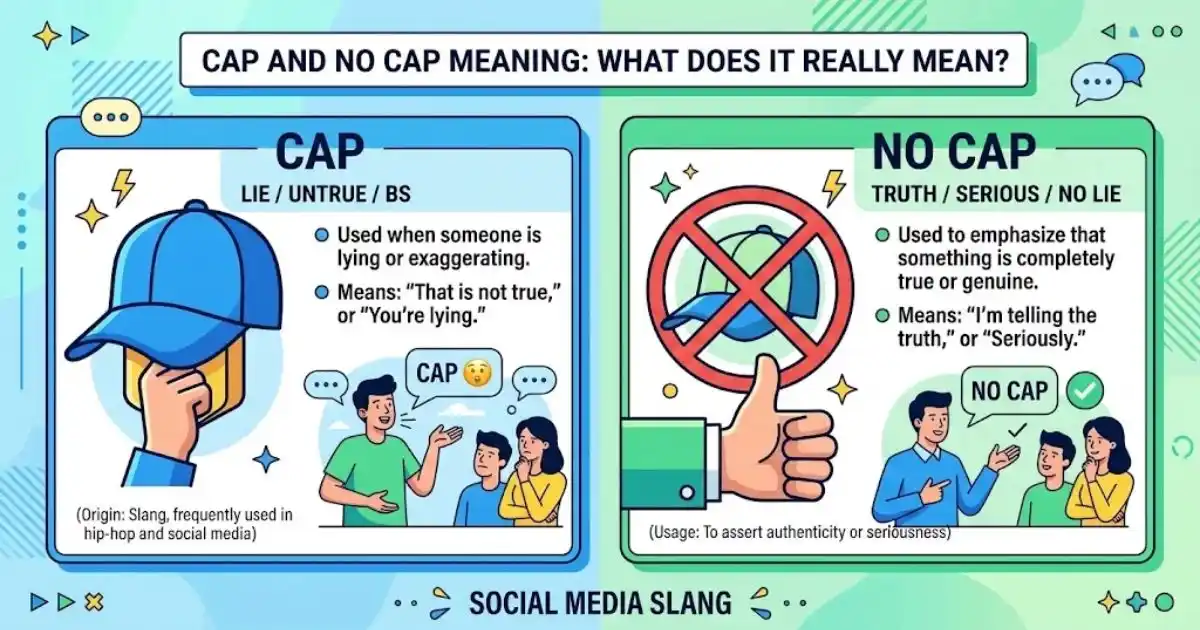
In modern internet slang, “cap” usually means lying, exaggerating, or saying something untrue, while “no cap” means being honest, serious, or telling the truth. For example, if your friend says, “I finished the whole project in 10 minutes,” you might respond, “That’s cap!” But if they say, “No cap, I really finished it,” they are emphasizing that they are being honest.
These expressions are common on social media, in text messages, on TikTok and Instagram, in gaming chats, memes, dating conversations, and online communities. However, their meaning can change slightly depending on the context, tone, and relationship between the people using them.
So, does “cap” always mean “lying”? Is no cap simply the opposite? And where did these popular slang terms come from?
In this guide, you’ll learn the meanings of “cap” and “no cap,” their origins, real-life examples, cultural interpretations, similar slang terms, and how to use them naturally without sounding out of place.
Read Also : Janky Meaning: Definition, Origin, Slang & Examples
Meaning & Definition
“Cap” and “no cap” are popular slang expressions used to talk about truth, honesty, exaggeration, and lying. In modern internet language, “cap” usually means a lie, false statement, exaggeration, or something that is not true, while “no cap” means “I’m telling the truth,” “seriously,” or “no lie.”
For example:
- “You got the new iPhone already? Stop capping.” → You are probably lying or exaggerating.
- “No cap, this is the best pizza I’ve ever had.” → I’m being completely serious.
- “That story is cap.” → That story is not believable or true.
- “No cap, she’s really good at singing.” → Honestly, she is genuinely talented.
The meaning depends heavily on context and tone. Someone saying “cap” may accuse another person of lying, while “no cap” is often used to emphasize sincerity.
Old and New Slang Meaning with Comparison
| Expression | Older/Common Meaning | Modern Slang Meaning | Example |
| Cap | A hat or covering | A lie, exaggeration, or false claim | “That’s cap.” |
| Capping | Putting a cap on something | Lying or exaggerating | “You’re capping.” |
| No cap | Literally, no cap/cover | Honestly, seriously, no lie. | “No cap, I love this song.” |
| Capper | Someone who puts on a cap | Someone who lies or exaggerates | “He’s a capper.” |
| Stop the cap. | Not a traditional fixed phrase | Stop lying or exaggerating. | “Stop the cap, bro.” |
The biggest modern meaning to remember is simple: cap = not true, while no cap = true or honest.
Pronunciation of “Cap” and “No Cap”
- Cap: /kæp/ /kæp/—sounds like “kap.”
- No cap: /noʊ kæp/—sounds like “noh kap.”
The pronunciation is straightforward. The confusing part is usually not how you say it but what the speaker means by it.
Breakdown
The slang pair works almost like an informal truth meter:
- Cap → lie / exaggeration / false claim
- Capping → lying / exaggerating
- No cap → truth / honesty / seriously
- Stop the cap → stop lying
- That’s cap → that isn’t true
- For real, no cap—I genuinely mean this
You can think of “no cap” as an informal way to add emphasis to a statement.
“No cap, that movie was amazing.”
This does not necessarily mean the speaker is proving a fact. It simply signals that they want you to understand that they are being sincere.
Other Meanings and Descriptions
Outside slang, “cap” has several completely different meanings.
| Meaning | Description | Example |
| Cap | A type of hat | “He wore a baseball cap.” |
| Cap | A cover or lid | “Put the cap back on the bottle.” |
| Cap | A limit or maximum | “There is a spending cap.” |
| Cap | A sports appearance | “He earned his first international cap.” |
| Cap | A capitalization abbreviation in some contexts | “Use caps carefully.” |
| Cap | Slang for a lie | “That’s a cap.” |
| No cap | Slang for honesty | “No cap, I’m serious.” |
This is why you should always look at the sentence and surrounding conversation before deciding what “cap” means.
Meanings Across Platforms
On modern digital platforms, “cap” and “no cap” are especially common in informal conversations, memes, comments, and short-form videos.
| Platform | Typical Use | Example |
| TikTok | Reactions, opinions, jokes, comments | “No cap, this trend is everywhere.” |
| Captions and comments | “No cap, best outfit today.” | |
| X | Opinions, debates, reactions | “That take is cap.” |
| Calling out questionable claims | “Sounds like cap to me.” | |
| Discord | Casual conversations and gaming | “Bro, that’s cap.” |
| Gaming chats | Calling out exaggeration or disbelief | “You said you got 30 kills? Cap.” |
| Group chats | Teasing friends or emphasizing honesty | “No cap, I forgot.” |
You may also see variations such as “capping,” “stop the cap,” “no cap fr,” and “that’s cap.”
One common misunderstanding is assuming cap always means “hat.” Online, especially in younger informal conversations, the slang meaning is often the intended one. Context tells you which meaning applies.
Read More: BTW Meaning in Text: What It Really Means & Examples
Psychological / Emotional Meaning
Cap and no cap can communicate more than simple truth or falsehood. They often reveal the speaker’s emotional attitude, confidence, skepticism, or desire to emphasize sincerity.
Positive
“No cap” can create a sense of honesty, authenticity, and trust.
For example:
“No cap, you did an amazing job.”
The phrase makes the compliment feel more direct and sincere.
People may use it when they want to show:
- Genuine appreciation
- Honesty
- Excitement
- Authenticity
- Strong agreement
- Confidence in an opinion
Neutral
Sometimes “cap” and “no cap” simply function as conversational slang without strong emotion.
For example:
“No cap, I think the second option is better.”
Here, the speaker is simply emphasizing that the opinion is genuine.
Similarly:
“Is that a cap?”
can simply mean:
“Is that true?”
Negative
Cap can become confrontational when someone uses it to accuse another person of lying.
For example:
“Bro, that’s cap. You weren’t even there.”
Depending on the relationship and tone, this could be playful teasing or a serious challenge.
The emotional effect therefore depends on who says it, who hears it, and how it is delivered. In a friendly group chat, “cap” may be harmless banter. In a serious conversation, accusing someone of “capping” can sound disrespectful.
Read More: IG Meaning: Definition, Origin, Slang & Social Media
Grammar and Linguistic Notes
In modern slang, “cap” can function as both a noun and a verb, while “no cap” commonly works as an informal phrase or discourse marker.
Common Forms
- Cap—”That’s cap.”
- Capping—”You’re capping.”
- Capped—”He capped about his score.”
- No cap—”No cap, I’m serious.”
- Stop the cap—”Stop the cap, you know that’s not true.”
How to Use “Cap”
As a noun:
“That story is cap.”
Here, “cap” means a lie or false claim.
As a verb:
“Why are you capping?”
Here, capping means lying or exaggerating.
As an emphasis phrase:
“No cap, this is incredible.”
Here, “no cap” means seriously or honestly.
Common Mistake
Don’t automatically replace every use of “cap” with “lie.” In some situations, “cap” means exaggeration rather than a deliberate lie.
For example:
“That was the greatest burger ever, no cap.”
This is usually an opinion, not a factual claim that can be objectively proven.
The safest approach is to interpret “cap” according to the speaker’s intent and the surrounding conversation.
Similar Terms & Alternatives
Several slang expressions overlap with “cap” and “no cap,” although they aren’t always perfect substitutes.
| Term | Meaning | Example |
| No lie | Honestly | “No lie, that was amazing.” |
| For real | Seriously / genuinely | “For real, you did great.” |
| FR | For real | “FR, that was funny.” |
| Honestly | Speaking sincerely | “Honestly, I agree.” |
| Seriously | Used for emphasis | “Seriously, that was impressive.” |
| Facts | Strong agreement or truth | “Facts. You’re right.” |
| Deadass | Very seriously / genuinely | “Deadass, I’m tired.” |
| BS | Nonsense or falsehood | “That sounds like BS.” |
| Lying | Deliberately saying something untrue | “You’re lying.” |
| Exaggerating | Making something seem bigger or better than it is | “You’re exaggerating.” |
“No cap” is closest to expressions such as “no lie,” “for real,” “honestly,” and “seriously.”
Meanwhile, “cap” can overlap with “lie,” “BS,” “fake,” or “exaggeration,” depending on context.
Origin and History of “Cap” and “No Cap”
The modern slang use of “cap” has strong roots in African American English (AAE/AAVE) and Black American cultural language. It later spread widely through hip-hop, music, social media, memes, and internet culture.
The exact historical development of the slang expression is debated, but the modern meanings became especially visible in mainstream online culture during the 2010s.
Importantly, “cap” has older meanings unrelated to this slang. The word has long referred to a hat, cover, limit, or other type of covering. The slang sense developed separately through cultural and linguistic usage.
Timeline
| Period | Development |
| Earlier English usage | Cap commonly referred to a hat, covering, or limit. |
| 20th century | Related slang expressions developed in different communities, including expressions involving “capping.” |
| 1990s–2000s | The slang sense became increasingly associated with claims, boasting, and dishonesty in Black American speech and hip-hop culture. |
| 2010s | Cap and No Cap gained wider visibility through music and internet culture. |
| Late 2010s | Social media helped push no cap into mainstream youth slang. |
| 2020s | The expressions became common across TikTok, Instagram, Discord, gaming, memes, and everyday online communication. |
| Today | “Cap” = false/exaggerated and “no cap” = honest/serious remain widely recognized informal expressions. |
The important takeaway is that the slang meaning did not simply come from the ordinary word “cap,” meaning a hat. Its development has a broader linguistic and cultural history.
Usage in Different Contexts
Casual Chats
In everyday conversations, “cap” is usually used to challenge a claim or call out exaggeration.
Examples:
- “You finished the whole project in one hour? Cap.”
- “You got tickets for the concert? No cap?”
- “Bro, you’re capping.”
- “No cap, I was actually scared.”
Among friends, these phrases can be playful rather than aggressive.
If someone says, “That’s cap,” they may simply mean, “I don’t believe you.”
Social Media
Social media has made “cap” and “no cap” highly recognizable slang.
You might see:
“No cap, this is the best restaurant in town.”
or:
“Bro really said he could beat everyone. That’s a cap.”
The phrases work especially well in comments, captions, memes, short videos, and reaction posts because they communicate skepticism or sincerity with very few words.
You may also encounter combinations such as:
- No cap fr
- Cap 😂
- Stop the cap
- That’s straight cap
- No cap whatsoever
Remember that these expressions are highly informal and often carry a playful internet tone.
Professional Use
You should generally avoid “cap” and “no cap” in formal professional communication unless you’re intentionally using casual language in a relaxed workplace.
Instead of:
“No cap, this report is really good.”
Use:
“Honestly, this report is very strong.”
Instead of:
“That’s a cap.”
Use:
“I don’t think that information is accurate.”
In professional settings, clearer terms such as “accurate,” “inaccurate,” “truthful,” “misleading,” “exaggerated,” or “unverified” communicate your meaning more precisely.
Gaming & Group Chats
Gaming communities and group chats frequently use caps to challenge unbelievable claims.
For example:
Player 1: “I just defeated the entire team by myself.”
Player 2: “Cap 💀”
Or:
Player 1: “No cap, that was the hardest boss fight.”
In gaming, the expression can be especially playful because friends often exaggerate scores, kills, achievements, rankings, or gameplay skills.
You might also see:
- “Cap detected.”
- “Bro is capping.”
- “No cap, that clutch was impulsive.”
- “Stop the cap 😂.”
The meaning remains consistent: “cap” challenges truth, while “no cap” emphasizes it.
The key is to match the slang to your audience. It works naturally in casual chats, gaming, memes, and social media, but formal writing usually calls for more precise language.
Read More: MHM Meaning in Text: What It Really Means in Chat!
Advantages and Disadvantages of “Cap” and “No Cap”
“Cap” and “no cap” make online communication faster, more expressive, and easier to understand once you know the context. “Cap” means a lie, exaggeration, or something untrue, while “no cap” means I’m telling the truth, seriously, or honestly.
| Term | Advantages | Disadvantages |
| Cap | Quickly calls out a lie or exaggeration; adds humor; works well in casual conversations | Can sound confrontational; may accuse someone unfairly |
| No cap | Emphasizes honesty; shows sincerity; adds emphasis to a statement | Can sound overly dramatic; may feel unnatural in formal conversations |
| Cap/No cap together | Makes online slang more expressive and playful | Can confuse people unfamiliar with internet slang |
For example, saying “That’s cap” is a quick way to challenge someone’s claim, while “No cap, that was the best concert ever” emphasizes genuine excitement.
The key takeaway is simple: “cap” questions the truth, while “no cap” reinforces it. That distinction becomes even clearer when you see how people use these expressions in real conversations.
Real-Life Examples & Memes
You will often see “cap” and “no cap” in texts, TikTok comments, Instagram captions, gaming chats, memes, and casual conversations. Their short, punchy style makes them especially useful for humorous reactions.
Real-Life Examples
Example 1 — Calling out exaggeration
Friend: “I ran 10 miles before breakfast.”
You: “Bro, that’s cap.”
Here, cap means “I don’t believe you.”
Example 2 — Emphasizing honesty
“No cap, this is the best pizza I’ve ever had.”
The speaker is stressing that they genuinely mean it.
Example 3 — Gaming
“He said he got 30 kills? Cap.”
The speaker thinks the player’s claim is probably false or exaggerated.
Example 4 — Social media
“No cap, this outfit is fire.”
This means the person genuinely likes the outfit.
Meme Culture
Memes often exaggerate situations to make “cap” funnier:
- “You said you were going to sleep early. Cap.”
- “No cap, I could eat this whole pizza.”
- “Bro said he wasn’t scared. 💀 Cap.”
- “No cap, that comeback was legendary.”
The humor usually comes from exposing an obvious exaggeration. As a result, cap slang has become closely connected with internet humor and reaction culture.
Cultural or Regional Interpretations
The basic meaning of “cap” and “no cap” remains similar across English-speaking communities, but the frequency and tone can vary by region.
| Region | Common Interpretation | Typical Context |
| United States | “Cap” = lie/exaggeration; “no cap” = truth/honesty | Social media, texting, gaming, everyday slang |
| UK | Generally understood through US-influenced internet culture | TikTok, memes, gaming, youth conversations |
| India | Commonly understood by younger internet users | Instagram, YouTube, gaming, texting |
| Pakistan | Increasingly familiar among younger social media users | TikTok, Instagram, gaming, casual chats |
| Philippines | Used mainly through online and global internet culture | Social media, gaming, memes |
| Australia | Understood, especially among younger users. | Online conversations, gaming, social media |
United States & UK
In the United States, “cap” and “no cap” are widely recognized forms of casual slang. You may hear phrases such as “Stop capping,” meaning “Stop lying or exaggerating.”
In the UK, the expressions are also recognizable because American internet slang spreads quickly through TikTok, YouTube, gaming communities, and social media.
However, neither expression is appropriate for every situation. You would normally avoid them in formal emails, academic writing, or professional presentations.
Australia
Australian users generally understand cap and no cap, particularly in online spaces influenced by American social media and gaming culture.
You may see:
“That’s cap, mate.”
or:
“No cap, that was hilarious.”
The meaning remains essentially the same, although the surrounding vocabulary may reflect Australian conversational style.
These regional differences show that slang travels quickly online, but local culture still influences how naturally people use it.
Read More: Cuffing Season Meaning: Definition, Origin & Slang!
Common Mistakes & Misconceptions
One of the biggest mistakes is assuming that “cap” literally refers to a hat whenever you see it online. In slang, the word usually has a completely different meaning.
Common misunderstandings
1. Thinking “cap” always means a hat
In ordinary English, a cap can mean a type of hat. In internet slang, however, “cap” usually means a lie or exaggeration.
2. Thinking “no cap” means “no hat”
In slang, “no cap” means “no lie,” “for real,” or “honestly.”
3. Assuming “cap” always means intentional lying
Sometimes someone says “cap” when they think another person is exaggerating, joking, or making an unbelievable claim. It does not always mean the person is deliberately deceiving someone.
4. Using “no cap” in every sentence
Because the expression is popular, some users overuse it. Adding “no cap” to every statement can make your writing sound forced.
5. Using it in formal communication
“That’s cap” may work in a group chat but would sound inappropriate in a formal report or business email.
The easiest way to avoid confusion is to look at the surrounding conversation and ask whether the speaker is discussing truth, exaggeration, or honesty.
The Vibe Behind “Cap” and “No Cap”
The emotional tone depends heavily on the situation.
Positive Vibe
“No cap” can create a feeling of honesty, enthusiasm, confidence, or strong approval.
“No cap, you absolutely nailed that presentation.”
The speaker is emphasizing genuine praise.
Neutral Vibe
Sometimes these expressions simply communicate information without strong emotion.
“That’s a cap.”
This can simply mean:
“I don’t think that’s true.”
Negative Vibe
“Cap” can sound dismissive, skeptical, or confrontational.
“You’re capping right now.”
This suggests the speaker believes someone is lying or exaggerating.
So, the vibe comes from tone, relationship, and context, not just the words themselves. That matters when deciding whether your response should be playful, serious, or cautious.
Read More: Pick-Me Meaning, Definition, Origin, and Slang Use!
Is It Offensive or Friendly?
“Cap” and “no cap” are generally casual and not inherently offensive. However, “cap” can feel rude if you use it to accuse someone of lying.
Compare:
“Bro, that’s cap 😂”
with:
“You’re lying.”
The first sounds more playful in many friend groups, while the second sounds much more direct.
Among friends, “cap” can be teasing or humorous. With strangers, coworkers, teachers, clients, or older people who may not know the slang, it could create confusion or come across as disrespectful.
“No cap” is usually less confrontational because it emphasizes your own honesty rather than challenging someone else.
When in doubt, consider your relationship with the person before using slang.
How to Respond?
Your response depends on whether you agree, disagree, or want to play along.
If Someone Says, “That’s Cap”
You can respond:
- “I’m serious!”
- “No cap, I swear.”
- “Believe me, it’s true.”
- “Okay, okay, you got me.” — if you were exaggerating
- “”Proof?”—playful challenge
If Someone Says “No Cap”
You can respond:
- “For real?”
- “I believe you.”
- “Same!”
- “No way 😂”
- “Facts.”
Example
Friend: “No cap, I finished the whole assignment in one hour.”
You: “For real?”
Friend: “No cap!”
The best response usually matches the casual, playful energy of the conversation.
Read More: Salty Meaning, What It Means in Slang and Social Media!
Differences Between Cap and No Cap
The two expressions are closely related but communicate opposite ideas.
| Expression | Meaning | Example | Simple Translation |
| Cap | A lie, exaggeration, or unbelievable claim | “That story is cap.” | “That’s not true.” |
| No cap | Truth, honesty, or sincerity | “No cap, I love this song.” | “I’m being honest.” |
Quick Memory Trick
Think of it this way:
Cap = 🚫 Truth
No cap = ✅ Truth
Another useful phrase is “stop capping,” which means “stop lying or exaggerating.”
Once you remember this opposite relationship, the slang becomes much easier to interpret.
Differences from Similar Words
Several slang expressions overlap with cap, but they are not always interchangeable.
| Term | Meaning | Example | Difference |
| Cap | Lie or exaggeration | “That’s a cap.” | Specifically calls something untrue or exaggerated |
| No cap | Honestly / truthfully | “No cap, I’m tired.” | Emphasizes sincerity |
| Lie | False statement | “That’s a lie.” | Standard English and more direct |
| Fronting | Pretending or acting differently | “He’s fronting.” | Often involves pretending or hiding feelings |
| BS | Nonsense or dishonesty | “That’s BS.” | Stronger and potentially more offensive |
| Fake | Not genuine or authentic | “That’s fake.” | Can describe objects, behavior, or claims |
| Facts | Strong agreement with a statement | “Facts!” | Shows agreement rather than accusing someone |
| For real | Genuine or serious | “For real?” | Questions or emphasizes authenticity |
The important distinction is that cap/no cap focuses strongly on truthfulness and credibility, while related slang can describe agreement, pretense, nonsense, or authenticity.
Read more: RN Meaning, Definition, Origin, Slang & Examples!
Relevance in Dating & Online Culture
Cap and no cap are especially common in modern online dating and social media conversations because they quickly communicate trust, skepticism, and sincerity.
For example:
“No cap, your profile picture is really good.”
This emphasizes genuine attraction or appreciation.
Someone might also say:
“He said he’s 6’5″, but that’s cap.”
Here, cap expresses doubt about someone’s dating-profile claim.
In dating conversations, the phrase can also be playful:
“No cap, I actually like talking to you.”
Because online communication lacks facial expressions and body language, slang can add tone, humor, emphasis, and emotional context to short messages.
However, accusing someone of “capping” can create tension if the relationship is new. If you genuinely question something important, a direct but respectful question may work better.
Common Examples of “Cap” and “No Cap”
Here are some natural examples you may encounter online:
Texting
- “That’s a cap.”
- “No cap, I’m exhausted.”
- “Stop capping.”
- “You know that’s a cap.”
Social Media
- “No cap, this is the best trend yet.”
- “Bro is capping in the comments.”
- “That’s a straight cap 😂.”
Gaming
- “He said he got a 50-kill game. Cap.”
- “No cap, that was the best match I’ve played.”
Friends
- “No cap, you look great.”
- “You’re capping right now.”
Memes
- “Me: I’ll only watch one episode. Also me at 3 a.m.: No cap, one more.”
These examples show how flexible the expressions can be across texting, gaming, memes, social media, and everyday conversations.
Read More: Deadass Meaning, Definition, Origin & Slang Uses!
Popularity & Trends
“Cap” and “no cap” became major internet slang terms through social media, music, memes, and youth culture. Their popularity grew especially through platforms such as TikTok, Instagram, YouTube, X, Reddit, and gaming communities.
The expression became widely recognizable because it is:
- Short
- Easy to type
- Easy to understand from context
- Funny in reaction-based conversations
- Useful for emphasizing honesty
- Effective in memes and captions
The phrase “no cap” also became especially recognizable through popular music and online culture, helping move it from specific communities into mainstream internet vocabulary.
Today, you may see the expressions used seriously, sarcastically, ironically, or simply as part of a meme. Like many slang terms, their popularity can change over time, but their basic meanings remain recognizable.
When Not to Use “Cap” or “No Cap”?
Although these expressions are harmless in most casual situations, you should avoid them when clarity, professionalism, or formality matters.
Avoid using them in:
- Formal business emails
- Academic essays
- Professional reports
- Job applications
- Legal documents
- Formal presentations
- Official customer communication
- Situations where the listener may not understand internet slang
Instead of:
“No cap, our sales increased.”
Use:
“Our sales genuinely increased.”
Instead of:
“That’s a cap.”
Use:
“I don’t believe that claim is accurate.”
The goal is not to avoid slang completely. It is to match your language to the audience and situation.
FAQs About Cap and No Cap Meaning
1. What does “cap” mean in slang?
“Cap” means a lie, false statement, or exaggeration.
2. What does “no cap” mean?
“No cap” means honestly, seriously, or without lying.
3. Does “cap” mean lie?
Yes. In modern slang, “cap” commonly means a lie or exaggeration.
4. What does “stop capping” mean?
“Stop capping” means “stop lying or exaggerating.”
5. Is “no cap” positive?
Usually, yes. It often emphasizes honesty, sincerity, excitement, or strong agreement.
6. Is “cap” rude?
Not necessarily. Among friends, it can be playful, but calling someone a “capper” can sound accusatory depending on the context.
7. Can “cap” mean a hat?
Yes. Cap still has its traditional meaning of a type of hat. Context tells you which meaning applies.
8. Where is “no cap” commonly used?
You can find it in text messages, TikTok, Instagram, gaming chats, memes, YouTube comments, and casual conversations.
9. What is the opposite of “cap”?
“No cap” is the common slang opposite because it means truth or honesty.
10. Is “cap” appropriate in formal writing?
Generally, no. Use standard expressions such as “lie,” “false,” “inaccurate,” “honestly,” or “truthfully” in formal writing.
Final Thoughts
“Cap” means a lie or exaggeration, while “no cap” means honesty, truth, or genuine feeling. These popular internet slang terms appear frequently in texting, TikTok, gaming, memes, dating, and social media, making them useful for adding emphasis and personality to casual conversations.
If someone says, “That’s cap,” they are questioning the truth of your statement; if they say, “No cap,” they are telling you they are being serious.
Just remember to consider your audience, slang works best when the conversation is casual and the meaning is clear.

Hi, I am Isabel, the Author of Skypunz.com, where I share witty puns, jokes, and fun content to brighten your day.