
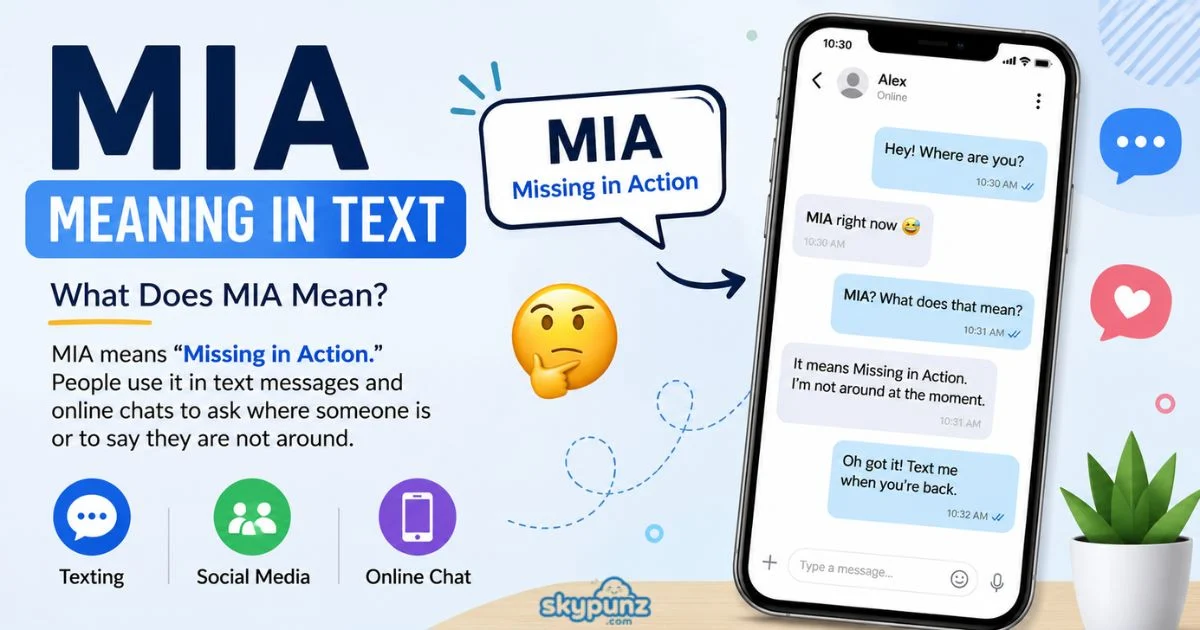
In text messages and casual online chat, MIA stands for “Missing in Action.” It means that someone has temporarily disappeared, stopped replying to texts, or gone quiet on social media.
A friend stops replying to your messages, and someone says they’re MIA. If you’re not sure what MIA Meaning in Text is, you’re not alone. In texting, chats, and social media, MIA usually means “Missing in Action.” People use it to describe someone who has been absent, inactive, or out of touch for a while. The meaning often depends on the conversation, so knowing the context is important.
This common internet slang appears on platforms like WhatsApp, Instagram, TikTok, Snapchat, and Discord. It can describe a friend who disappeared from a group chat, a coworker who has not replied, or someone taking a break from social media.
In this article, you’ll learn what MIA means in text, where it came from, how people use it in different situations, and real examples that make the meaning easy to understand.
Read Also : ETC Meaning in Text: What It Really Means in Chats
What Does MIA Mean?
MIA most commonly means “Missing in Action.” In text messages, online chats, and social media, people use it to describe someone who has suddenly disappeared, stopped replying, or has not been active for a while.
The phrase does not always mean someone is physically missing. Most of the time, it simply means a person has gone quiet. For example, if a friend has not answered messages for several days, someone might say, “You’ve been MIA all week.”
Although the term came from the military, its modern use is much broader. Today, it appears in everyday conversations, gaming chats, work messages, and social media posts. Understanding the context helps you know whether it is being used seriously or casually.
Quick Definition Table
| Term | Meaning |
| MIA | Missing in Action |
| Common Meaning in Text | Someone has disappeared, gone quiet, or stopped responding |
| Tone | Usually casual, sometimes serious |
| Used On | WhatsApp, Snapchat, TikTok, Instagram, Facebook, YouTube, LinkedIn, Discord, SMS |
| Original Source | Military terminology |
| Modern Usage | Texting, social media, gaming, workplace chats |
| Example | “Where have you been? You went MIA for three days!” |
Background & Origin
The phrase Missing in Action (MIA) originally came from the military. It described soldiers whose whereabouts were unknown during or after combat. Governments and armed forces still use the term in official reports when a service member cannot be located.
Over time, people adopted MIA in everyday language. Instead of referring to war, it became a simple way to describe someone who has disappeared from conversations, social media, or daily life for a short period.
Today, the meaning is usually lighthearted. Friends, coworkers, classmates, and online communities often use it when someone has been inactive or difficult to reach.
MIA Full Form Explained
The full form of MIA is Missing in Action.
In military use, it means a person cannot be accounted for during military operations, and their status remains unknown until more information becomes available.
In texting and online communication, the meaning has shifted. It now describes someone who is absent from conversations or social activities.
Here are a few examples:
- “You were MIA during the weekend.”
- “Our group admin has been MIA lately.”
- “She went MIA after finishing her exams.”
Even though the words stay the same, the intended meaning depends on the situation. Most online conversations use the casual version rather than the military one.
How to Use MIA Real Examples
People use MIA when talking about someone’s absence or lack of communication. It works in personal conversations, workplace chats, gaming groups, and social media.
Here are some natural examples:
- “You disappeared after lunch. Totally MIA.”
- “Our teammate has been MIA since Monday.”
- “Sorry, I’ve been MIA. Work has been really busy.”
- “He went MIA from social media for a month.”
- “Where have you been? Everyone thought you were MIA.”
- “I was MIA because my phone stopped working.”
- “She came back online after being MIA all week.”
In most cases, the phrase sounds friendly and informal. However, avoid using it in situations involving real emergencies or sensitive events unless the context clearly fits.
MIA on Different Platforms (2026)
The meaning of MIA stays mostly the same across popular platforms in 2026. It generally refers to someone who has not posted, replied, or been active for a period of time.
What changes is the context. On one platform, it may refer to unanswered messages. On another, it may describe a creator who has stopped uploading content. Looking at the conversation makes the meaning clear.
1. On WhatsApp
On WhatsApp, MIA usually means someone has stopped replying or has not opened messages for a while.
Example:
“You’ve been MIA since Friday. Everything okay?”
Friends often use it jokingly after delayed replies. It can also show genuine concern if someone suddenly becomes inactive.
2. On Snapchat
On Snapchat, MIA often refers to someone who has stopped sending Snaps, lost their streak, or disappeared from chats.
Example:
“Why did you go MIA? We almost lost our Snap streak.”
Because Snapchat focuses on daily interaction, even a short absence can lead people to use the term.
3. On TikTok
On TikTok, people use MIA when a creator stops posting videos or disappears from the platform for some time.
Example:
“This creator went MIA for two months before posting again.”
Fans also use it in comments when asking why someone has not uploaded new content.
4. On Instagram
On Instagram, MIA often describes someone who has stopped posting Stories, Reels, or photos.
Example:
“I’ve been MIA because I needed a social media break.”
Many users include the term in captions when returning after taking time away from the app.
5. On YouTube
On YouTube, MIA usually refers to creators who have paused uploads or disappeared from their channel.
Example:
“The channel has been MIA for six months.”
Viewers commonly use the term while wondering when new videos will return.
6. On Facebook
On Facebook, MIA generally means someone has not posted updates, commented, or replied to friends for a while.
Example:
“Sorry I’ve been MIA. Life has been busy lately.”
The phrase often appears in status updates when users return after a long break.
7. On LinkedIn
On LinkedIn, MIA is less common but still used professionally to describe someone who has been inactive or unavailable.
Example:
“I’ve been MIA while finishing a major project.”
In professional settings, it is best to use the term carefully and provide a brief explanation if your absence affected colleagues or clients.
MIA Medical and Other Fields
The abbreviation MIA does not always mean Missing in Action. In medicine, technology, business, education, and government, it can have completely different meanings. The correct definition depends on the field, which is why context is so important when reading abbreviations.
1. MIA Meaning in Medical Terms
In medical terminology, MIA commonly stands for Minimally Invasive Approach or Minimally Invasive Surgery, depending on the procedure and healthcare setting.
Doctors use this term when describing treatments that require smaller incisions and cause less damage to surrounding tissue compared to traditional surgery. These procedures often lead to faster recovery times and shorter hospital stays.
Example:
“The surgeon recommended an MIA technique to reduce recovery time after the operation.”
Because medical abbreviations can vary between hospitals and specialties, patients should always confirm the meaning with a healthcare professional.
2. MIA Meaning in Technology
In technology, MIA can stand for Mobile Internet Access. It refers to using the internet through smartphones, tablets, mobile networks, or wireless connections while away from a fixed location.
The term appears in discussions about telecommunications, connectivity, remote work, and digital services.
Example:
“The company improved MIA so employees could securely access online tools while traveling.”
Technology acronyms often have multiple meanings, so reading the surrounding context is essential.
3. MIA Meaning in Business
In business and workplace communication, MIA often keeps its informal meaning of Missing in Action. It describes an employee, teammate, client, or project member who has become unexpectedly unavailable or unresponsive.
People usually use it casually rather than as an official business term.
Example:
“Our project manager was MIA during the morning meeting, so we delayed the decision.”
In professional settings, it is best to use the phrase respectfully and avoid it in sensitive situations.
4. MIA Meaning in Education
In education, MIA can refer to a student who is absent, inactive, or missing from classes in informal conversations. Some schools and universities may also use MIA as an abbreviation for specific programs or departments.
The meaning can differ between institutions, so checking the school’s official usage is important.
Example:
“The teacher noticed that one student had been MIA for several classes.”
When used casually, it simply means someone has not been participating or attending.
5. MIA Meaning in Government
In government and military records, MIA officially stands for Missing in Action. It is used when military personnel cannot be located during or after combat operations and their status remains unknown.
This is the original and most formal meaning of the abbreviation.
Example:
“The report listed several service members as MIA until further information became available.”
Because this use involves real military personnel and official records, it carries a much more serious meaning than the casual texting version.
Common Mistakes About MIA
Many people understand MIA correctly, but a few common mistakes can lead to confusion.
- Thinking it always means someone is physically missing. In texting, it usually means a person has been inactive or has not replied.
- Using it without context. The meaning changes depending on the conversation or industry.
- Confusing it with another abbreviation. Similar acronyms may have different meanings in medicine, technology, or business.
- Using it during serious emergencies. In real-life emergency situations, saying someone is “MIA” can sound insensitive unless you are referring to its official military meaning.
- Assuming it is negative. Most of the time, it is simply a casual way to say someone has been away or quiet.
Using MIA appropriately helps your message sound natural and avoids misunderstandings.
Read More: OOTD Meaning in Text: Social Media Slang Explained
Is MIA Rude or Offensive?
No, MIA is generally not rude or offensive. Most people use it casually when talking about someone who has not replied to messages or has been inactive online.
The tone depends on how you say it. Among friends, it often sounds playful.
Example:
“You’ve been MIA all weekend!”
In professional or formal conversations, use it carefully. If someone is dealing with a personal issue, illness, or family emergency, calling them “MIA” may sound insensitive. When in doubt, ask politely if everything is okay instead of making assumptions.
How to Reply to MIA
If someone says you’ve been MIA, your reply should match the situation and your relationship with that person. You can keep it casual, funny, caring, or even a little playful.
1. Casual Responses
Simple replies work well with friends, coworkers, or classmates.
- “Yeah, I’ve been really busy lately.”
- “Sorry! I finally have some free time.”
- “I’m back now.”
- “Life got a little hectic.”
- “Thanks for checking in.”
2. Funny Responses
A little humor can make the conversation more relaxed.
- “I was hiding from my alarm clock.”
- “Mission complete. I’m back.”
- “I survived the mountain of work.”
- “I got lost in real life for a while.”
- “My phone and I needed a vacation.”
3. Flirty Responses
If you’re chatting with someone you like, a playful answer can keep the conversation going.
- “I was waiting for you to text first.”
- “I’m here now. Did you miss me?”
- “Guess who finally came back?”
- “Maybe I was seeing if you’d notice.”
- “I’m making up for lost time.”
4. Supportive Responses
When someone says you’ve been MIA because they were worried, respond with appreciation and reassurance.
- “Thanks for checking on me. I’m doing okay.”
- “I appreciate your concern.”
- “Things have been difficult, but I’m getting better.”
- “I’m glad you reached out.”
- “Sorry for worrying you.”
5. Sarcastic Responses
Use these only with people who understand your sense of humor.
- “Breaking news: I have officially returned.”
- “The legend lives again.”
- “Sorry, my fan club had to wait.”
- “Turns out I still exist.”
- “I escaped the witness protection program.”
6. Responses in a Relationship
A warm and honest reply usually works best with your partner.
- “Sorry for disappearing. I missed you.”
- “I should have replied sooner.”
- “Thanks for being patient with me.”
- “I’ve had a busy week, but you’re on my mind.”
- “Let’s catch up tonight.”
Open communication is usually better than making excuses.
7. Responses in Group Chats
Group chats move quickly, so a short reply is often enough.
- “Sorry, everyone. I’ve been MIA.”
- “I’m finally catching up on the messages.”
- “What did I miss?”
- “I’m back. Fill me in.”
- “Thanks for keeping the chat alive while I was gone.”
A friendly response helps you rejoin the conversation without making it awkward.
Read More: IONK Meaning in Text: What It Really Means Online
MIA Alternatives and Similar Slang
If you want to avoid repeating MIA, several other slang terms and phrases can express a similar idea. Each one has a slightly different tone, so choose the one that best fits the conversation.
| Term | Meaning | Common Use |
| MIA | Missing in Action | Someone has been absent or unresponsive |
| AFK | Away From Keyboard | Temporarily away from a device, common in gaming |
| Ghosting | Suddenly cutting off communication | Dating, friendships, and online conversations |
| Off the Grid | Staying away from phones or the internet | Social media breaks or travel |
| Inactive | Not active online | Social media and messaging apps |
| Silent | Not replying or posting | Texting and group chats |
| Taking a Break | Stepping away temporarily | Work, school, or social media |
| Offline | Not connected to the internet | Online games and messaging platforms |
While these terms are related, MIA usually suggests an unexpected absence rather than a planned break.
When MIA Can Sound Rude
Although MIA is usually harmless, it can sound rude in certain situations.
Avoid using it when:
- Someone is dealing with a family emergency.
- A person is recovering from illness or injury.
- You do not know why someone has been absent.
- You are speaking with a client, manager, or senior professional in a formal setting.
- The conversation involves a serious or sensitive topic.
Instead of saying, “You’ve been MIA,” you could say, “I hope everything is okay. We haven’t heard from you in a while.” That sounds more thoughtful and respectful.
When to Use MIA
MIA works best in casual conversations where everyone understands the context.
Good situations include:
- Chatting with friends.
- Text messages and group chats.
- Social media captions and comments.
- Gaming communities.
- Informal workplace conversations.
- Talking about someone who has not been active online.
In these situations, MIA is short, familiar, and easy to understand.
When NOT to Use MIA
There are times when another phrase is a better choice.
Avoid using MIA when:
- Writing formal emails or business reports.
- Speaking with customers or clients.
- Discussing emergencies or missing persons.
- Referring to someone who recently experienced a personal loss.
- The audience may not understand internet slang.
In professional writing, words like absent, unavailable, or inactive are often clearer.
Read More: ROFL Meaning in Text: What It Really Means in Chats
MIA vs Similar Slang
Many internet abbreviations describe someone who is unavailable, but they are not interchangeable.
| Slang | Meaning | Key Difference |
| MIA | Missing in Action | Someone unexpectedly disappears or stops replying |
| AFK | Away From Keyboard | Usually a short, temporary absence |
| Ghosting | Ending communication without explanation | Often intentional and long-term |
| BRB | Be Right Back | Returning very soon |
| Offline | Not connected to the internet | Describes connection status, not behavior |
| Inactive | Not participating | More formal and neutral than MIA |
Knowing these differences helps you choose the right expression for each conversation.
Why Do People Still Use MIA in Text Messages?
People continue to use MIA because it is short, familiar, and easy to understand. Instead of typing a long explanation, a single abbreviation quickly tells others that someone has been absent or unresponsive.
The term has also become part of everyday internet slang, making it common on messaging apps, gaming platforms, and social networks. It works across different age groups and remains widely recognized.
Another reason is its flexibility. You can use MIA to describe missing messages, inactive social media accounts, skipped group chats, or friends who suddenly disappear for a while.
What Do Dictionaries Say?
Major English dictionaries recognize MIA as the abbreviation for Missing in Action, its original military meaning. Many dictionaries also note that the phrase is commonly used in everyday English to describe someone who is absent or cannot be found.
Modern language references acknowledge this informal meaning because it has become widely accepted in conversation, media, and digital communication.
Although dictionaries explain the official definition, real-life usage often depends on context, especially in text messages and social media.
Regional And Cultural Usage Of MIA
The abbreviation MIA is widely understood in English-speaking countries such as the United States, Canada, the United Kingdom, and Australia. Thanks to social media, movies, and online gaming, it has also become familiar in many other parts of the world.
In countries where English is a second language, people often use MIA in chats even if the rest of the conversation is in another language. Younger users are generally more familiar with the term than older generations.
Because slang varies by culture, it is always helpful to consider your audience before using abbreviations.
Usage in Online Communities & Dating Apps
Online communities use MIA to describe members who suddenly stop participating. You might see it in gaming groups, Discord servers, Reddit discussions, or hobby forums when someone has been inactive for days or weeks.
On dating apps, MIA usually refers to a match who stopped replying or disappeared after a few conversations. It is different from ghosting, which often suggests a more permanent end to communication. Someone can be MIA for a few days and return later, while ghosting usually means the conversation ends without explanation.
Whether you’re chatting with friends, gaming teammates, or new matches, MIA remains a quick and widely understood way to describe someone who has temporarily gone quiet.
Key Insight
What does MIA mean in text?
In text messages, MIA usually means “Missing in Action.” It describes someone who has stopped replying, disappeared from a conversation, or has been inactive for a while. It is commonly used in casual chats and on social media.
Is MIA a military term?
Yes. MIA originally comes from the military, where it stands for Missing in Action. It refers to service members whose whereabouts are unknown during or after combat. Today, people also use it informally to describe someone who has gone quiet or is absent.
Is MIA the same as ghosting?
No. MIA and ghosting are different. MIA often suggests a temporary absence, while ghosting means someone intentionally stops communicating without explanation and may never respond again.
What does “I’ve been MIA” mean?
When someone says, “I’ve been MIA,” they mean they have been unavailable, inactive, or not responding to messages for some time. It is often followed by a reason, such as being busy with work, school, travel, or personal matters.
Is MIA appropriate for work?
MIA can be appropriate in casual workplace conversations, but it is best avoided in formal emails, reports, or communication with clients. In professional settings, words like unavailable, absent, or away are usually more suitable.
Is MIA a slang term?
Yes. While MIA began as a military abbreviation, it is now widely used as internet slang in texting, messaging apps, gaming communities, and social media to describe someone who has been absent or inactive.
Is MIA different from AFK?
Yes. AFK means Away From Keyboard and usually refers to a short, temporary break from a computer or game. MIA suggests a longer or unexpected absence and is not limited to online activities.
What should I reply if someone says I’m MIA?
A simple and honest reply works best. You could say:
- “Sorry, I’ve been really busy.”
- “I’m back now.”
- “Thanks for checking in.”
- “Life has been hectic lately.”
Choose a response that matches the tone of the conversation.
Does MIA always mean Missing In Action?
No. Although Missing in Action is the original and most common meaning, MIA can have different meanings in fields such as medicine, technology, education, and business. The correct meaning depends on the context.
Is MIA still commonly used?
Yes. MIA remains a popular abbreviation in 2026. People regularly use it on WhatsApp, Instagram, TikTok, Snapchat, Facebook, Discord, and other messaging platforms to describe someone who has been inactive or difficult to reach.
Conclusion
MIA Meaning in Text is simple once you understand the context. In most text messages and social media conversations, it means “Missing in Action” and describes someone who has been absent, inactive, or slow to reply.
Throughout this article, you’ve learned its meaning, origin, real-life examples, platform-specific usage, alternative slang, common replies, and how it compares with similar terms. Knowing when and where to use MIA helps you avoid confusion and communicate more naturally in chats, online communities, and everyday conversations.
The next time you see or use MIA, you’ll be able to understand its meaning instantly and use it with confidence in the right situation.
Related Post :

Hi, I am James Whitman, the author of Skypunz.com. I create funny puns and jokes to make your day brighter and bring a smile to every reader.