
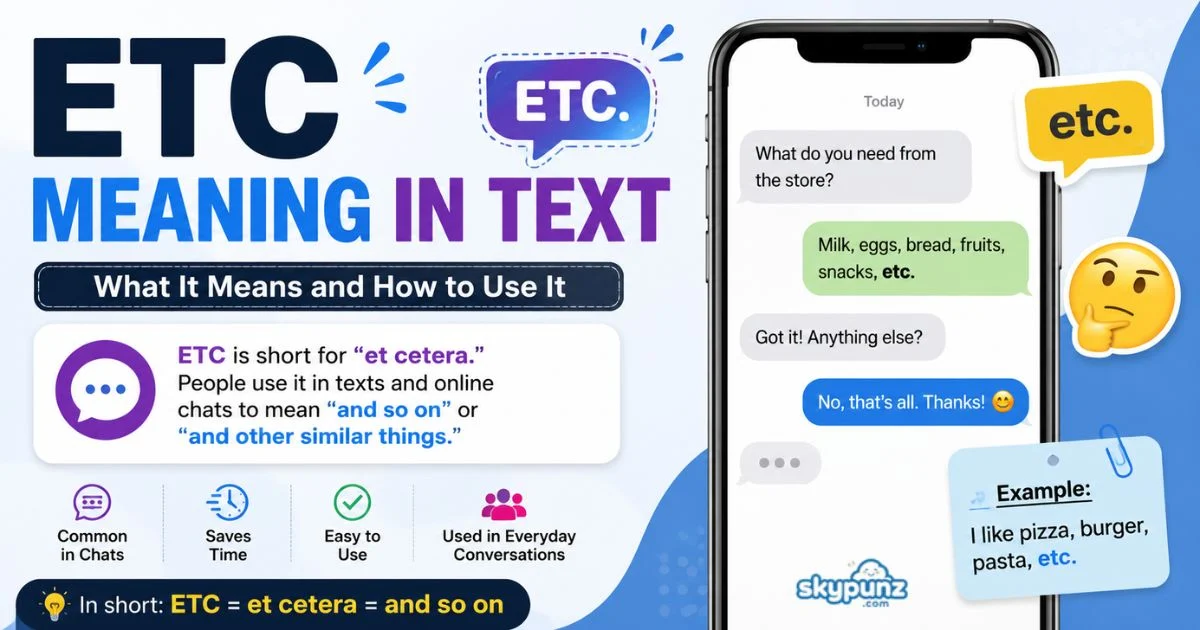
In text, etc. stands for et cetera, a Latin phrase meaning “and other things,” “and so forth,” or “and the rest.” It is used at the end of a list to show that there are more similar items you did not bother to name.
You receive a quick message from a friend, and they end it with “ETC.” You may understand the sentence, but you might still wonder what the short form means in a text conversation. ETC Meaning in Text is the same as “etcetera,” which means “and other similar things” or “and so on.”
People often use ETC in chats, social media posts, emails, and online conversations to save time when listing examples, items, ideas, or related details. Understanding its meaning helps you follow digital communication clearly and use this abbreviation correctly in everyday messages.
In this article, you will learn what ETC means in texting, how people use it, common text examples, and mistakes to avoid. Keep reading to understand this simple but useful internet abbreviation.
Read Also : DTTM Meaning in Text: What It Really Means Today
What Does ETC Mean?
ETC means “et cetera,” a Latin phrase that means “and other similar things” or “and so on.” People use ETC in text messages, writing, and online conversations when they want to mention more examples without listing everything.
The abbreviation helps make messages shorter and easier to read. For example, instead of writing “I bought pens, notebooks, folders, and other school supplies,” someone may write “I bought pens, notebooks, folders, etc.”
ETC usually shows that a list continues with similar items. It does not mean “everything” or “anything,” so the missing items should belong to the same category as the examples already mentioned.
Quick Definition Table
| Term | Meaning |
| ETC | Et cetera |
| Full meaning | And other similar things; and so on |
| Language origin | Latin |
| Common use | Text messages, writing, emails, social media, and conversations |
| Purpose | To shorten a list of examples |
| Example | “Bring your books, notes, pens, etc.” |
Background & Origin
The term ETC comes from the Latin phrase “et cetera,” where “et” means “and” and “cetera” means “the rest” or “other things.” English speakers adopted this phrase many years ago, and it became common in formal and casual writing.
Over time, people shortened “et cetera” to etc. because it saves space and makes communication faster. Today, you can see ETC in digital conversations, articles, reports, and everyday messages.
Although ETC has an old history, people still use it because the need to shorten lists remains common. It works across many types of communication, from quick chats to professional documents.
ETC Full Form Explained
The full form of ETC is “Et cetera.” It tells the reader that more items could be added to the list, but the writer does not want to mention every example.
For instance:
- “The store sells fruits like apples, bananas, oranges, etc.”
- “You need basic tools such as a ruler, pencil, eraser, etc.”
In both examples, ETC replaces extra items that follow the same pattern. It keeps the sentence clear without making the list too long.
People sometimes write etc, ETC, or etc. The most common and grammatically correct form is etc. because it is an abbreviation.
How to Use ETC Real Examples
You can use ETC when you provide a few examples and want to show that more similar examples exist. It works best when the reader can easily understand what type of items continue the list.
Examples:
- “I enjoy outdoor activities like hiking, camping, cycling, etc.”
- “Please bring your ID card, documents, photos, etc.”
- “The app supports features like messaging, video calls, file sharing, etc.”
Avoid using ETC when the missing information is important or unclear. If the reader needs the complete list, write every item instead of shortening it.
A common mistake is writing “and etc.” because ETC already includes the idea of “and.” The correct form is simply “etc.” After understanding its meaning and usage, it becomes easier to recognize ETC in daily conversations.
How ETC Is Used Today
Today, ETC is widely used in digital communication, online writing, and professional settings. People use it to save time when sharing examples, especially when the full list is not necessary.
The meaning stays the same across different platforms, but the way people use ETC can change depending on the situation. A casual text message may use ETC freely, while a school assignment or business email may require more careful use.
Understanding how ETC works in different places helps you communicate more clearly and avoid confusion.
1. Text Messaging
In text messages, people often use ETC to keep conversations short and quick. Mobile users may add ETC when they mention several examples but do not want to type a long list.
Examples:
- “I need to buy milk, bread, eggs, etc.”
- “We talked about movies, music, games, etc.”
ETC works well in casual chats because friends usually understand the context. However, if the message involves important details, such as instructions or plans, it is better to provide complete information.
2. Social Media
On social media platforms, users often use ETC in captions, comments, and posts. It helps them share ideas without making the text too long.
Examples:
- “My favorite hobbies include reading, drawing, traveling, etc.”
- “Follow us for tips about fitness, food, lifestyle, etc.”
Because social media content needs to be easy to scan, ETC can make posts cleaner. Still, creators should avoid using it too often because specific examples usually create more engaging content.
3. Emails
ETC appears in both personal and professional emails when writers list several related items. It helps keep messages organized and prevents unnecessary details.
Examples:
- “Please review the attached files, reports, images, etc.”
- “The meeting will cover sales, marketing, customer feedback, etc.”
In formal emails, writers should use ETC carefully. If the recipient needs exact information, a complete list is usually better than a shortened one.
4. School and Work
Students and professionals use ETC in assignments, notes, presentations, and reports. It allows them to mention examples while keeping their writing concise.
Examples:
- “Common renewable energy sources include solar, wind, hydro, etc.”
- “The project requires planning, research, testing, etc.”
In academic and workplace writing, correct punctuation matters. Writers should place a period after ETC because it is an abbreviation. They should also make sure the examples before ETC clearly show what other items might follow.
Read More: OOTD Meaning in Text: Social Media Slang Explained
ETC on Different Platforms (2026)
In 2026, ETC will still be commonly used across digital platforms because people want faster and shorter ways to communicate. The meaning usually stays the same: “et cetera” or “and other similar things.” However, the way people use it can change depending on the platform and audience.
On WhatsApp
On WhatsApp, people often use ETC in personal chats, group conversations, and status updates. It helps users shorten lists when they mention multiple examples.
Examples:
- “Bring snacks, drinks, plates, etc.”
- “We discussed travel plans, hotels, tickets, etc.”
WhatsApp conversations are usually casual, so ETC fits naturally when everyone understands the context.
On Snapchat
On Snapchat, users may add ETC in captions, messages, or story text. Since Snapchat content is often short and quick, abbreviations help save space.
Example:
- “Weekend plans: movies, food, shopping, etc.”
Users should avoid using ETC when the audience may not understand what other items the list includes.
On TikTok
On TikTok, ETC appears in video captions, comments, and descriptions. Creators may use it when listing trends, ideas, or examples.
Examples:
- “Things I love: coffee, books, music, etc.”
- “Easy tips for students: planning, notes, focus, etc.”
Specific examples usually create better engagement, but ETC can keep captions simple.
On Instagram
On Instagram, ETC is used in captions, comments, and profile descriptions. It helps users avoid writing long lists while keeping posts clean.
Examples:
- “My favorite places include beaches, mountains, cities, etc.”
- “Beauty tips: skincare, makeup, routines, etc.”
For marketing posts, creators often prefer detailed examples because they make content more interesting and easier to understand.
On YouTube
On YouTube, creators may use ETC in video descriptions, community posts, and comments. It is useful when describing topics covered in a video.
Example:
- “This video covers editing tips, camera settings, lighting, etc.”
However, YouTube descriptions often benefit from clear details, especially when viewers need specific information.
On Facebook
On Facebook, ETC appears in posts, comments, and group discussions. People use it to quickly mention related examples without making a post too long.
Examples:
- “We talked about family events, celebrations, holidays, etc.”
- “Join us for games, activities, food, etc.”
The abbreviation works best when the missing examples are easy to guess.
On LinkedIn
On LinkedIn, professionals may use ETC in posts, articles, and messages. It can help shorten lists of skills, industries, or business topics.
Examples:
- “Our services include consulting, training, strategy, etc.”
- “Professionals need communication, leadership, teamwork, etc.”
Since LinkedIn focuses on professional communication, users should avoid overusing ETC and provide specific details when accuracy matters.
Read More: IONK Meaning in Text: What It Really Means Online
ETC Medical and Other Fields
The meaning of ETC can change depending on the field where it appears. While most people know ETC as “et cetera,” some industries use ETC as a separate abbreviation with a specific meaning.
Understanding the context helps you identify whether ETC means “and so on” or refers to a technical term.
1. ETC Meaning in Medical Terms
In medical contexts, ETC can have different meanings depending on the specialty and organization. One possible meaning is electroconvulsive therapy (ECT), but the standard abbreviation is usually ECT, not ETC.
In some medical notes or systems, ETC may represent specific terms used by a hospital, department, or healthcare provider. Because medical abbreviations can vary, readers should check the surrounding information.
For general writing, ETC usually still means “et cetera.”
2. ETC Meaning in Technology
In technology, ETC most commonly means “et cetera” when developers, writers, or users list examples. It appears in documentation, guides, and online discussions.
Examples:
- “Supported devices include phones, tablets, laptops, etc.”
- “Programming languages like Python, Java, C++, etc.”
In some technical areas, ETC may also represent specific project names, systems, or terms. The exact meaning depends on the technology being discussed.
3. ETC Meaning in Business
In business communication, ETC usually means “and other similar items.” Companies use it in reports, emails, proposals, and presentations.
Examples:
- “The budget includes marketing, advertising, training, etc.”
- “Our clients come from healthcare, finance, retail, etc.”
Business writers should use ETC carefully because clear communication is important. A detailed list may work better when readers need exact information.
4. ETC Meaning in Education
In education, students and teachers often use ETC in notes, assignments, and presentations. It helps shorten lists of examples or related topics.
Examples:
- “Subjects include math, science, history, etc.”
- “Learning methods include reading, practice, discussion, etc.”
Students should avoid using ETC when a teacher asks for complete details or specific examples. Clear explanations usually create stronger academic work.
5. ETC Meaning in Government
In government documents, ETC often means “et cetera” when officials refer to additional items without listing every example. It may appear in forms, reports, and public information documents.
Examples:
- “Required documents include identification, applications, certificates, etc.”
- “The program supports communities, organizations, agencies, etc.”
Government writing often requires accuracy, so ETC should only appear when the remaining items are obvious. Important legal or official information usually needs a complete list.
Is ETC Rude or Offensive?
ETC is not rude or offensive in normal conversations. It is a common abbreviation for “et cetera,” which means “and other similar things.” People use it to shorten lists and make messages easier to read.
The meaning of ETC depends on the situation and the way someone uses it. A message like “Bring your books, notes, pens, etc.” sounds normal and helpful. However, using ETC when someone asks for specific details may seem unclear or unhelpful.
In casual texting, ETC is usually accepted and does not carry any negative meaning. It is simply a writing shortcut that helps people communicate faster.
Read More: ROFL Meaning in Text: What It Really Means in Chats
How to Reply to ETC
The best way to reply to ETC depends on the conversation, relationship, and context. Since ETC usually continues a list or idea, you can respond by asking for more details, adding your own examples, or simply acknowledging the message.
Here are some common ways to reply:
1. Casual Responses
For everyday chats with friends or family, simple replies work well.
Examples:
- “Got it, thanks!”
- “Okay, I understand.”
- “Sounds good.”
- “That makes sense.”
- “Anything else I should know?”
These replies keep the conversation natural without making it too formal.
2. Funny Responses
If the conversation is playful, you can use humor when replying to ETC.
Examples:
- “ETC? That mysterious list strikes again!”
- “So many things, so little time!”
- “The famous ‘and more’ section!”
- “I need the full list someday!”
Funny replies work best when you already have a friendly connection with the person.
3. Flirty Responses
In a romantic conversation, ETC can become part of a playful reply. The response should match the existing tone between both people.
Examples:
- “ETC includes spending time with me, right?”
- “I hope I’m on that list too.”
- “And etc. means more reasons to talk to you?”
Flirty replies should feel natural and respectful rather than forced.
4. Supportive Responses
When someone uses ETC while explaining plans, goals, or problems, a supportive reply can show interest.
Examples:
- “That sounds like a good plan. Let me know if you need help.”
- “I understand. I’m here if you want to talk more.”
- “Those are great ideas. Keep going.”
Supportive responses help continue meaningful conversations.
5. Sarcastic Responses
Sarcastic replies can be funny among close friends, but they may sound negative with people you do not know well.
Examples:
- “Ah yes, the endless ETC list!”
- “Very detailed… thanks for the mystery.”
- “ETC saves the day again!”
Use sarcasm carefully because written messages can sometimes be misunderstood.
6. Responses in a Relationship
In relationships, the right reply depends on the topic. If your partner uses ETC in a casual message, you can respond warmly or ask questions.
Examples:
- “Tell me more, I want to hear the details.”
- “Okay, I’m listening.”
- “Sounds interesting. What else?”
Open replies help create better conversations and show attention.
7. Responses in Group Chats
In group chats, ETC often appears when someone shares plans, ideas, or reminders. A short and clear reply usually works best.
Examples:
- “Thanks for sharing!”
- “I’ll bring my part.”
- “Got it, everyone.”
- “Anything else needed?”
Group conversations move quickly, so simple responses keep things organized.
Read More: Ml Mean In Text: Is It Love, Gaming, or Something Else?
ETC vs Similar Abbreviations
ETC, E.G., and I.E. are often confused because they appear in lists and explanations. However, each abbreviation has a different purpose.
ETC means “and other similar things,” while E.G. and I.E. explain information in different ways. Understanding the difference helps you use each term correctly.
ETC vs E.G.
ETC means “and other similar things,” while E.G. means “for example.”
Use ETC when you already gave examples and want to show that more similar items exist.
Example:
- “I like fruits such as apples, bananas, oranges, etc.”
Use E.G. when you want to introduce examples.
Example:
- “I enjoy outdoor activities, e.g., hiking and camping.”
The key difference is that E.G. introduces examples, while ETC shows that the list continues.
ETC vs I.E.
ETC means “and other similar things,” while I.E. means “that is” or “in other words.”
Use ETC to avoid listing every item in a group.
Example:
- “Bring supplies like paper, pens, folders, etc.”
Use I.E. when you want to explain something more clearly or restate it with exact meaning.
Example:
- “The meeting is for new employees, i.e., people who joined this year.”
A simple way to remember the difference:
| Abbreviation | Meaning | Purpose | Example |
| ETC | And other similar things | Continues a list | Books, pens, bags, etc. |
| E.G. | For example | Gives examples | Hobbies, e.g., reading and painting |
| I.E. | That is / in other words | Gives a clearer explanation | A weekday, i.e., Monday to Friday |
Using ETC, E.G., and I.E. correctly makes your writing clearer and helps readers understand your message faster.
Common Mistakes When Using ETC
Using ETC correctly makes your writing clearer and more professional. Although the abbreviation looks simple, many people make small mistakes when adding it to sentences.
Understanding these common errors helps you avoid confusion and use ETC naturally in texts, emails, and other forms of communication.
Using “And Etc.”
One of the most common mistakes is writing “and etc.” This is incorrect because ETC already includes the meaning of “and other things.”
Incorrect:
- “Bring your books, pens, and etc.”
Correct:
- “Bring your books, pens, etc.”
Adding “and” before ETC repeats the same idea twice. The correct form is to place ETC directly after the last example in the list.
Using ETC Without a List
ETC works best after a group of examples. Using it without showing what kind of items continue the list can confuse readers.
Unclear:
- “I like many things, etc.”
Clear:
- “I like hobbies such as reading, painting, cooking, etc.”
The reader should understand what other items ETC represents. If the missing information is not obvious, it is better to provide more details.
Overusing ETC
Using ETC too often can make your writing feel incomplete. Readers may feel that you are leaving out important information instead of simply shortening a list.
For example, a sentence filled with ETC may not explain enough:
- “The project needs planning, research, testing, reports, etc.”
If the details matter, write a complete list or explain the main points. ETC works best when used occasionally and with clear examples.
ETC Alternatives and Similar Slang
Several words and abbreviations can replace ETC depending on the situation. Each option has a slightly different meaning and style.
| Term | Meaning | Best Use | Example |
| ETC | And other similar things | General lists | “Bring food, drinks, plates, etc.” |
| And so on | More items of the same type | Casual writing | “We talked about work, family, hobbies, and so on.” |
| And more | Additional items or options | Marketing and casual content | “Available in many colors and more.” |
| Etcetera | Full form of ETC | Formal or careful writing | “The list includes books, papers, and etcetera.” |
| Plus | Adds another related item | Casual conversations | “We need chairs, tables, plus decorations.” |
| E.G. | For example | Giving examples | “Try activities, e.g., walking and cycling.” |
Choosing the right alternative depends on your audience and the type of message you are writing.
When ETC Can Sound Rude
ETC is not naturally rude, but it can sound dismissive in certain situations. The tone depends on the conversation and the importance of the missing information.
For example, replying only with “ETC” when someone asks for a detailed explanation may seem like you are avoiding the question.
Situations where ETC may sound less helpful:
- When someone needs exact instructions.
- When the topic is serious or important.
- When the reader does not know what the missing items are.
- When it replaces too much information.
Using ETC in a normal list is usually fine. The problem comes from using it when someone expects a complete answer.
When to Use ETC
You can use ETC when you mention a few examples and the remaining items are easy to understand. It helps make writing shorter while keeping the main idea clear.
Good situations for using ETC include:
- Text messages with friends.
- Casual social media posts.
- Notes and reminders.
- General explanations.
- Lists where extra examples are not important.
Examples:
- “My favorite apps include WhatsApp, Instagram, TikTok, etc.”
- “Pack clothes, shoes, toiletries, etc.”
ETC works best when the reader can easily guess what comes next.
When NOT to Use ETC
Avoid using ETC when the reader needs complete or exact information. In these cases, a full explanation is clearer and more useful.
Do not use ETC for:
- Legal documents.
- Official instructions.
- Important workplace reports.
- Academic answers requiring details.
- Safety information.
For example, a school assignment asking for five examples needs the actual examples, not “plants, animals, etc.”
Clear communication matters more than saving a few words.
ETC vs Similar Slang
ETC is an abbreviation, but it is different from modern internet slang. Slang terms often show emotions, reactions, or casual expressions, while ETC simply shortens a list.
| Term | Meaning | Main Purpose |
| ETC | And other similar things | Continues a list |
| IDK | I don’t know | Shows uncertainty |
| BTW | By the way | Adds extra information |
| FYI | For your information | Shares information |
| IMO | In my opinion | Gives a personal view |
| LOL | Laughing out loud | Shows humor |
Unlike slang such as LOL or IDK, ETC can appear in both casual and formal writing. It focuses on saving space rather than expressing a feeling.
Why Do People Still Use ETC in Text Messages?
People still use ETC in text messages because it makes communication faster and easier. When a list contains many similar items, writing every example can make a message longer than necessary.
ETC helps people:
- Save time while typing.
- Keep messages short.
- Avoid repeating obvious information.
- Make conversations easier to read.
For example, instead of typing “I need to buy soap, shampoo, toothpaste, towels, and other bathroom items,” someone can write “I need to buy soap, shampoo, toothpaste, towels, etc.”
Even with modern messaging apps, ETC remains useful because people still want simple ways to communicate ideas quickly. Its meaning is easy to understand, which keeps it popular in everyday conversations.
Conclusion
ETC Meaning in Text is simple to understand: it means “et cetera” and shows that a list continues with other similar items. Knowing this abbreviation helps you understand and write text messages, online conversations, and digital communication more clearly.
This article explained ETC’s full form, meaning, common usage, real examples, social media use, email communication, replies, similar abbreviations, and common mistakes. Using ETC correctly helps you create clear messages while keeping your writing short and easy to follow.
Whenever you see ETC in a chat, social media post, or written message, you can now recognize its meaning and use this texting abbreviation confidently in the right context.
Frequently Asked Questions About ETC Meaning in Text
1. What does ETC mean in text messages?
ETC means “et cetera,” which means “and other similar things” or “and so on.” People use it in text messages when they want to mention examples without writing a complete list.
2. Is ETC a slang word?
No, ETC is not slang. It is a common abbreviation from the Latin phrase et cetera. People use it in casual chats, social media, emails, and formal writing.
3. How do you use ETC correctly in a sentence?
Use ETC after listing a few examples that belong to the same category. For example: “I packed clothes, shoes, books, etc.” It shows that more similar items are included.
4. Is writing “and ETC” correct?
No, writing “and ETC” is incorrect because ETC already means “and other things.” The correct form is to write the list followed by etc.
5. Does ETC have a different meaning on social media?
Usually, ETC has the same meaning on social media platforms like WhatsApp, Instagram, TikTok, and Facebook. It means “and other similar things” and helps users shorten messages.
6. Is ETC rude when someone uses it in a message?
No, ETC is not rude by itself. However, it may sound unhelpful if someone uses it instead of giving important details that another person needs.
7. What is the difference between ETC and E.G.?
ETC means “and other similar things,” while E.G. means “for example.” E.G. introduces examples, while ETC shows that more examples could be added to a list.
8. What is the difference between ETC and I.E.?
ETC continues a list, while I.E. explains or clarifies something. For example, ETC means “and more,” while I.E. means “in other words” or “that is.”
9. Can ETC be used in professional emails?
Yes, ETC can be used in professional emails when the remaining items are obvious. However, in important reports or official messages, a complete list may be clearer.
10. Why do people use ETC in texting?
People use ETC in texting because it saves time and keeps messages shorter. This texting abbreviation makes communication faster when listing several related examples.

Hi, I am James Whitman, the author of Skypunz.com. I create funny puns and jokes to make your day brighter and bring a smile to every reader.