
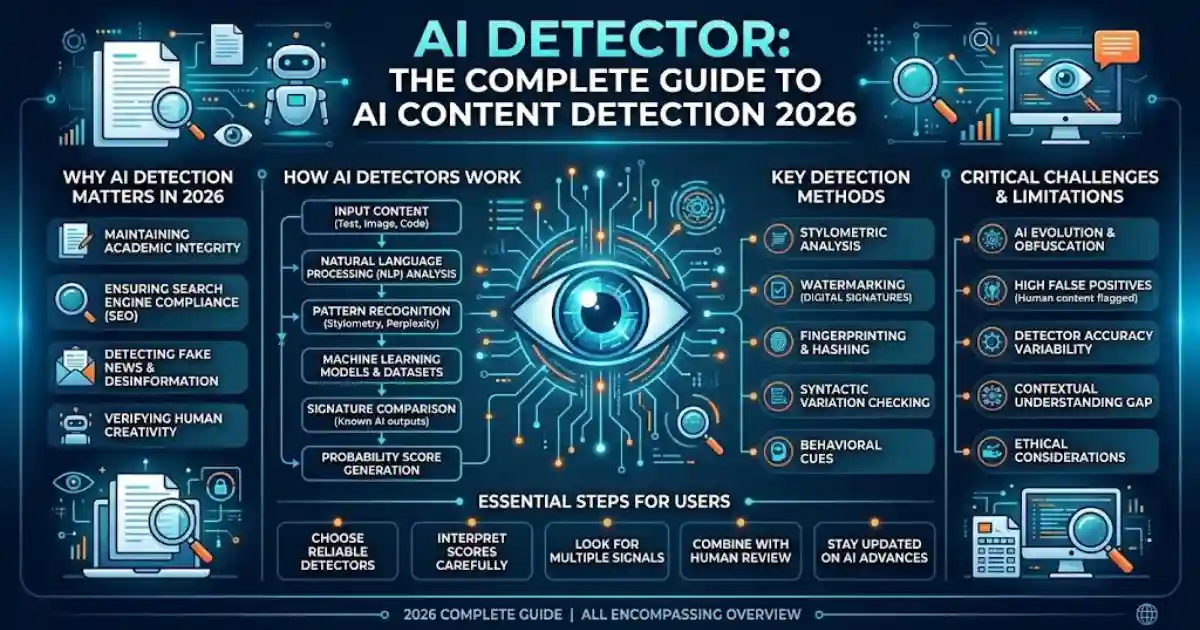
Wondering whether a passage was written by a person or created by AI? An AI detector, also called an AI content detector, AI checker, or AI writing checker, uses AI detection technology to examine AI-generated text and identify patterns associated with generative AI.
This type of AI detection can involve text analysis, content analysis, AI content analysis, and the study of text patterns, writing patterns, and AI-generated patterns to distinguish human-written text from machine-generated text.
Today, an AI detector tool, AI checker tool, or AI detection software may be used for AI content detection, AI text detection, AI content checking, and AI content verification. Students, writers, educators, editors, content creators, SEO professionals, and businesses often check AI-written content, AI-written text, and other forms of AI-generated content.
Popular AI platforms such as ChatGPT, Claude, and models including GPT-4 and GPT-5 have made these checks increasingly relevant.
However, detection accuracy can vary, and an AI detection score should not automatically be treated as proof of authorship. Different tools analyze language differently, which makes understanding AI writing detection, AI content detection, and human vs AI writing important before making conclusions.
In this guide, we’ll explore how AI detectors work, what their results mean, and the practical limits of modern AI detection tools.
What is an AI detector?
An AI detector is a tool that analyzes written text and estimates whether it was produced by a human, an AI system, or a combination of both. It is also called an AI content detector, AI checker, AI detection tool, or AI text detector.
These tools examine patterns in wording, sentence structure, predictability, and other characteristics that can appear more frequently in AI-generated writing.
In simple terms, an AI detector does not usually “see” who wrote a piece of content. Instead, it studies the text itself and calculates how strongly its characteristics resemble patterns found in AI-generated content.
Modern detectors may be designed to identify writing associated with systems such as ChatGPT, GPT-based models, Claude, Gemini, and other large language models (LLMs).
People use AI detection software for different reasons. Teachers may check assignments, editors may review submitted articles, businesses may evaluate content, and writers may use an AI checker to understand how their writing is being classified.
The same technology can also be useful for publishers who want to review large amounts of text before publication.
However, an AI detector should be treated as an indicator rather than absolute proof. Human writing can sometimes receive an AI-like score, while edited or heavily paraphrased AI-generated text may be difficult for a detector to identify.
Factors such as writing style, text length, language, editing, and the detector’s underlying model can influence the result. Therefore, a responsible review should consider the detector’s explanation alongside the actual writing and its context.
What is an AI content detector?
An AI content detector is a software tool that analyzes written text and estimates whether it was likely produced by an AI writing system or by a human. It looks for patterns associated with AI-generated writing, such as predictability, sentence variation, repetitive phrasing, and other linguistic characteristics. QuillBot says its detector provides a percentage-based likelihood score and sentence-level explanations rather than treating the result as a simple yes-or-no judgment.
AI detection is useful for screening content, but it does not provide absolute proof of authorship. Human-written text can sometimes be flagged, while edited or paraphrased AI content can be harder to identify. QuillBot itself advises users not to rely on an AI detection score alone for decisions that could affect academic or professional standing.
How do AI detectors work Step by Step?
AI detectors use statistical and machine-learning techniques to estimate whether text resembles AI-generated writing.
Modern systems can analyze the submitted content at sentence or phrase level rather than simply making one judgment about an entire document. QuillBot says its detector uses multiple validation layers, sentence-level analysis, and confidence scoring.
A simplified process looks like this:
- Text input: The user pastes or uploads the content for analysis.
- Text processing: The system divides or processes the material into suitable sections.
- Pattern analysis: The detector examines vocabulary, sentence structure, predictability, repetition, and other characteristics.
- Model comparison: The analyzed patterns are compared with characteristics learned from human and AI-generated examples.
- Classification: The system estimates whether the content resembles human writing, AI writing, or potentially mixed writing.
- Scoring: The detector produces a probability, confidence score, or classification.
- Explanation: Some tools identify specific sentences or passages that contributed to the result.
NIST describes AI detection as a classification problem in which detectors estimate the likelihood that text was generated by an LLM. Its evaluations also show that detection performance varies between systems and generators, which is why an AI score should not be interpreted as absolute proof.
How accurate is Quillbot’s AI detector?
QuillBot’s AI detector is designed to estimate whether submitted text is likely to have been generated by AI. Its result should be understood as a probability-based assessment rather than a definitive statement about authorship. In practical use, accuracy can vary depending on the type of text, the language, the amount of text submitted, and whether the content has been edited or rewritten.
One important point when evaluating any AI checker is that “accuracy” is not a single number that applies equally to every situation. A detector may perform differently on a formal essay, a short social media caption, technical documentation, or text that has been translated between languages. Human writers also have different styles, and highly polished or predictable writing can sometimes resemble patterns associated with AI-generated text.
For users testing QuillBot’s detector, the most useful approach is to look beyond the headline result. Consider whether the detected sections make sense, whether the explanation is consistent with the actual writing, and whether another form of evidence supports the result. This is particularly important in academic or professional situations where a false positive could have consequences.
Trained on the latest LLMs
An AI detection system needs to account for changing language models because AI-generated writing does not remain stylistically identical over time. Newer LLMs can produce more varied sentence structures, more natural transitions, and writing that may be harder for older detection methods to distinguish from human text.
For that reason, a detector’s usefulness depends partly on how its underlying detection technology is maintained and evaluated as generative AI develops. A tool that was effective against one generation of AI writing should not automatically be assumed to perform equally well against every newer model.
Users should therefore pay attention to what a detector actually claims about the AI systems or model families it can identify. Being described as an AI detector does not automatically mean that it can reliably identify every current LLM or every piece of AI-assisted writing.
Accuracy and reliability
Accuracy is one of the most important considerations when choosing an AI detection tool, but it should be interpreted carefully. A result such as “likely AI” does not establish who wrote the content. It represents the detector’s assessment based on the characteristics it has analyzed.
False positives are an important concern. A person who writes in a formal, highly structured, or repetitive style may produce text that a detector considers AI-like. Likewise, text written by a non-native English speaker, translated content, heavily edited material, or very short passages can present additional challenges for automated detection.
Reliability also depends on how the tool is used. For casual content checks, an AI checker can provide a useful signal. For high-stakes decisions, however, its output should be considered alongside drafts, revision history, source material, writing samples, or other relevant evidence rather than being treated as the only basis for a decision.
Multilingual support
Multilingual capability matters because AI-generated text can appear in many languages, and detection performance is not necessarily identical across them. A detector may have stronger coverage for some languages than others because its training, testing, and evaluation data can differ by language.
If you plan to check content outside English, verify which languages the tool officially supports and understand whether the same level of detection is available for each one. Translation can also change sentence structure and vocabulary, which may affect how an AI detection system interprets the resulting text.
For users working with multilingual websites, academic material, or international content, this distinction is important. A result from an AI text detector should be interpreted within the language and writing context rather than assuming that one detection standard works equally well everywhere.
Instant detection
Fast results are useful when someone needs to check an article, essay, paragraph, or other text without waiting for a lengthy analysis. An AI detector tool can process submitted text and return an assessment quickly, making it convenient for writers, editors, students, and content teams.
Speed, however, should not be confused with accuracy. A result that appears instantly is still only an analysis of the submitted text. The most useful experience comes from a tool that combines quick processing with understandable results rather than simply displaying a percentage without context.
For routine checks, instant detection can save time. For an important piece of writing, users may still want to review the flagged passages manually and compare the result with the circumstances in which the content was created.
Privacy-first design
Privacy is an important consideration whenever text is pasted into an online AI checker. Users may submit essays, unpublished articles, business documents, personal messages, or other material that they do not want unnecessarily exposed or retained.
Before using any AI detection service, check its privacy policy and terms to understand how submitted text is handled. Look for clear information about data retention, processing, storage, account requirements, and whether submitted content may be used for improving the service.
A privacy-conscious workflow also means avoiding sensitive information when it is not necessary for the detection task. If you are reviewing confidential material, consider whether an online service is appropriate before uploading the complete document.
Insights and explanations
A useful AI detection report should provide more than a simple label. Explanations can help users understand why certain writing was classified as potentially AI-generated and whether particular sections contributed strongly to the overall result.
This is especially helpful when reviewing longer documents. Instead of treating the entire article as one undifferentiated score, users can examine individual passages and look for patterns such as unusually predictable phrasing, repetitive structures, or consistently uniform sentence construction.
These insights should still be interpreted cautiously. An explanation from an AI detection system describes patterns identified by the software; it does not prove the writer’s identity or establish exactly how the content was produced.
Downloadable reports
Downloadable reports can be useful when an AI detection result needs to be saved for later review. Teachers, editors, content managers, and organizations may want a record of what was analyzed, when it was checked, and what result the system returned.
A report can also make it easier to discuss questionable passages with another reviewer. Instead of relying on a screenshot or manually copying a score, users may be able to preserve the detector’s findings in a more organized format, depending on the features available in the service.
The practical value of downloadable results depends on what the report contains. A detailed report with highlighted passages and explanations is generally more informative than a document containing only a single percentage. Users should also remember that a saved AI detection result remains an automated assessment, not independent proof of authorship.
Transparent results
Transparent results help users understand what an AI detector actually found instead of leaving them with an unexplained number. Clear reporting should distinguish between the text that was analyzed, the system’s assessment, and the limitations of that assessment.
For example, a transparent AI checker should make it reasonably clear whether its result represents an estimated probability, a classification, or another type of measurement. Users should also be able to understand that AI detection is inherently imperfect and that writing can be modified, translated, or produced in styles that affect automated classification.
This transparency is particularly important when the result may influence an academic, editorial, or workplace decision. The most responsible way to use AI detection is to treat the result as one piece of evidence, review the underlying text, and consider the broader context before reaching a conclusion.
Why is Quillbot’s AI detector different from other AI detection tools?
QuillBot says its AI Detector is designed to distinguish between fully AI-generated writing, human-written content, and mixed or AI-refined writing. Its system analyzes text at the sentence level and can provide explanations for sections identified as likely AI-generated.
Another stated difference is its training approach. QuillBot says its detector is designed for current AI systems including GPT-5, Gemini, Claude, Llama, and other LLMs, and is regularly updated as these models evolve. It also says its training includes AI-generated, paraphrased, academic, openly licensed, and publicly available text.
| Feature | QuillBot’s stated approach |
| Detection method | Linguistic and statistical pattern analysis |
| Result | Percentage-based AI likelihood |
| Detailed analysis | Sentence-level and phrase-level insights |
| Mixed writing | Designed to identify human-AI mixed content |
| AI model coverage | GPT, Claude, Gemini, Llama, and others |
| Paraphrased AI text | Specifically included in its training approach |
| Languages | 20+ languages according to QuillBot |
| Interpretation | Results are signals, not definitive verdicts |
The practical difference, therefore, is less about simply producing an AI percentage and more about providing additional context around where and why text may be classified as AI-like.
What is Quillbot’s AI Detector false positive rate?
QuillBot does not currently publish a single fixed false-positive percentage for all content and situations on its AI Detector page. Instead, it states that false positives can occur and that certain types of writing, including highly formulaic academic or legal content, may be more likely to receive an unexpected AI classification.
QuillBot’s current page cites a 99% detection rate according to independent RAID evaluations, but a detection rate should not be interpreted as a universal false-positive rate. Detection performance and false-positive performance are different measurements, and results can vary according to the dataset, AI model, writing style, language, and testing conditions.
QuillBot also acknowledges that no AI detector is 100% accurate. Its guidance notes that longer text generally produces more reliable results, while heavily paraphrased content and formulaic human writing can make classification more difficult.
For that reason, if a human-written article receives a high AI score, the result should be reviewed rather than automatically treated as proof of AI use. QuillBot specifically recommends using detection as one input in a wider review process.
Does Quillbot’s AI detector verify human originality?
No. QuillBot explicitly states that its AI Detector cannot verify whether writing was created by a human or whether the content is original. AI detection and originality checking are separate processes.
An AI detector focuses on whether text contains patterns associated with AI-generated writing. A plagiarism checker, by comparison, looks for similarities between submitted content and existing sources. A document can therefore appear human-written to an AI detector while still containing copied material.
QuillBot offers a separate Content Certification feature for published pages. According to QuillBot, content receiving an AI likelihood score of 20% or lower can qualify for its Human Content Badge, with certification intended to provide a public verification signal. However, this certification should not be confused with a universal guarantee that the content is original in the plagiarism sense.
For a stronger originality review, users should consider both AI detection and plagiarism checking when appropriate:
| Check | What it tells you |
| AI detector | Whether text resembles AI-generated writing |
| Plagiarism checker | Whether text matches or closely resembles existing sources |
| Draft history | Evidence of how the writing developed |
| Source review | Whether claims and borrowed ideas are properly supported |
| Human review | Context that automated tools may miss |
Using these checks together provides a more complete picture than treating an AI detector as proof of human authorship or originality.
How to use Quillbot’s free AI checker
Using QuillBot’s free AI checker is a straightforward way to analyze written content for signs commonly associated with AI-generated text. The basic process involves entering your text, running the scan, and then reviewing the result rather than relying on the score alone.
The tool can be useful when you want a quick AI content check before submitting an assignment, publishing an article, or reviewing AI-assisted writing. For the most meaningful result, use enough text to give the detector sufficient context and avoid treating a single percentage as definitive proof of how the content was created.
Input text
Start by entering or pasting the text you want to analyze into QuillBot’s AI checker. Depending on your purpose, this could be an essay, article section, paragraph, or other piece of written content.
Before running the scan, make sure the text is complete enough to provide useful context. Very short passages can be more difficult for an AI detector to classify reliably because there may not be enough writing patterns for the system to examine.
If the content contains confidential information, remove unnecessary personal or sensitive details before submitting it. It is also worth checking the service’s current privacy terms if the material is unpublished, private, or commercially sensitive.
Run scan and review
After adding the text, run the AI detection scan and wait for the tool to analyze it. The checker will assess the writing and present its result according to the detection system it uses.
Take time to review the result instead of focusing only on the headline percentage. Look at any highlighted sections, explanations, or other indicators provided by the AI checker tool. These details can help you understand which parts of the writing contributed to the classification.
Keep the result in context. AI detection systems can produce false positives, particularly when writing is highly formal, predictable, edited, translated, or unusually consistent in style. A detection score therefore should be viewed as an automated signal rather than conclusive evidence.
Review and act
Once the scan is complete, compare the result with the way the content was actually created. If you wrote the material yourself, review any sections that appear unusually formulaic and check whether the detector’s comments correspond to the wording on the page.
If the text was created with AI assistance, use the report as an opportunity to review the content for accuracy, originality, clarity, and appropriate disclosure rather than simply trying to change words until the detector produces a different result.
For academic, editorial, or professional use, keep supporting evidence such as drafts, notes, sources, and revision history when appropriate. This creates a more reliable record than an AI detection score alone and helps put the AI detection result into its proper context.
What makes Quillbot different from other AI detection tools?
QuillBot’s AI detector stands out mainly because it fits into a wider writing and editing environment. Instead of using an AI checker as an isolated service, users can work with other writing-focused features in the same platform. This can be convenient for students, writers, editors, and content creators who already use QuillBot during the writing process.
When comparing QuillBot with another AI detection tool, it is useful to look beyond the detection percentage. Different tools can analyze the same paragraph and produce different results because they use different detection methods, datasets, thresholds, and scoring systems.
| Feature | What to consider |
| AI detection | Estimates whether text shows patterns associated with AI writing |
| Writing workflow | Convenient when detection is part of a broader writing process |
| Results | Look for clear scores, explanations, and highlighted areas |
| Speed | Useful when checking articles, assignments, or multiple passages |
| Language support | Important for multilingual writers and international content |
| Privacy | Review how submitted text is processed and retained |
| Usability | A simple interface makes repeated checking easier |
For a fair comparison, users should ask what to expect from the tool, how understandable its results are, and whether its limitations are clearly communicated. No detector should be treated as an unquestionable authority because AI detection remains an estimation rather than a guaranteed method of proving authorship.
How do AI detectors differentiate between human and AI-generated text?
AI detectors examine patterns within written language and compare those patterns with characteristics associated with human and AI-generated text. Depending on the technology, an AI content detector may examine predictability, sentence structure, vocabulary, repetition, and other statistical features.
A simplified detection process can look like this:
- Text is submitted: The system receives the passage for analysis.
- Writing patterns are examined: The detector evaluates features within the text.
- Patterns are compared: The system compares those characteristics with patterns learned from human and AI-generated examples.
- A classification is produced: The tool estimates how likely the passage is to resemble AI-generated writing.
- The result is displayed: The user receives a score, classification, highlights, or other available insights.
The important distinction is that an AI detector generally does not know who physically wrote the text. It analyzes the characteristics of the submitted writing. A person can therefore produce text that receives an AI-like result, while AI-generated content that has been substantially edited may receive a different classification.
Several factors can influence detection:
- Length and amount of text available for analysis
- Writing style and sentence structure
- Use of predictable or repetitive wording
- Human editing after AI generation
- Translation or paraphrasing
- Language being analyzed
- The particular AI model involved
- The detection system’s training and methodology
Because of these variables, an AI detection score should be treated as supporting information rather than definitive proof of authorship.
AI Detector: Explore free vs. Premium features
Free and premium AI detection options can serve different needs. A free AI detector is often suitable for occasional checks, while premium access may provide additional capacity, reporting, or related writing features depending on the service and plan.
| Feature | Free AI checker | Premium option |
| Basic AI detection | Usually available | Available |
| Occasional text checks | Suitable | Suitable |
| Higher usage limits | May be limited | May offer expanded access |
| Additional writing tools | May be limited | Often broader |
| Detailed workflow | Basic | May include additional features |
| Best suited for | Casual or occasional users | Frequent writers and professionals |
Before paying for a premium plan, consider how often you actually need an AI checker tool. Someone checking a few paragraphs occasionally may not need the same level of access as an editor, content team, educator, or professional writer working with large amounts of text.
Users should also check the current pricing, limits, supported features, and terms directly before subscribing because software plans can change. The most useful premium feature is not necessarily the largest feature list; it is the one that solves a real problem in your workflow.
Certify yourhuman-written content
Certifying human-written content is intended to provide additional context that a piece of writing was created by a person rather than generated entirely by an AI system. This type of feature can be useful when writers want to communicate how their content was produced.
However, a certification should not be confused with an absolute technical guarantee. An AI detector evaluates the submitted text, while the actual writing process can involve drafts, editing tools, grammar assistance, research, and other forms of human input.
A sensible approach is to maintain evidence of your writing process when authorship matters. Useful records may include:
- Original drafts
- Research notes
- Source documents
- Revision history
- Outlines and planning notes
- Document timestamps
- Previous versions of the article
These records can provide useful context if a detection result is questioned. For professional or academic work, always follow the relevant institution’s rules regarding AI-assisted writing and disclosure.
Go beyond text: Detect AI in images
AI-generated media is no longer limited to written content. Images can also be created or significantly modified using generative AI systems, which creates a separate need for tools that analyze visual material.
An AI image detector generally examines visual characteristics that may be associated with synthetic or AI-generated images. Depending on the technology, this may involve analyzing image patterns, metadata, artifacts, or other signals that distinguish generated content from conventional photographs or artwork.
When evaluating an AI image detection feature, consider:
| Consideration | Why it matters |
| Detection method | Different systems look for different signals |
| Image quality | Compression and editing can affect analysis |
| Editing history | AI and human modifications can make classification harder |
| File format | Some information may be lost when an image is converted |
| Result transparency | Users should understand what the result means |
| False positives | Genuine images can sometimes be classified incorrectly |
Image detection also has limitations. A photograph that has been resized, compressed, filtered, or edited may not contain the same signals as the original file. Likewise, improvements in image-generation technology can make synthetic images increasingly difficult to distinguish automatically.
For that reason, an AI image result should be considered alongside the image’s source, metadata when available, publication history, and surrounding context rather than used as the only evidence of authenticity.
What’s the difference between an AI detector and a plagiarism checker?
An AI detector and a plagiarism checker answer two different questions. An AI detector estimates whether writing contains characteristics associated with AI-generated text, while a plagiarism checker primarily looks for matching or closely similar material in available sources.
For example, imagine a writer submits an original paragraph created with an AI writing assistant. A plagiarism checker may find no meaningful matching source because the wording is newly generated. An AI detector, however, may still classify the writing as potentially AI-generated.
The reverse can also happen. A person may copy a paragraph from an existing website and receive a plagiarism match even though the copied text was written by a human. An AI detector is not designed to replace a plagiarism search for this purpose.
| AI Detector | Plagiarism Checker |
| Estimates whether text resembles AI-generated writing | Searches for matching or similar existing content |
| Focuses on writing patterns | Focuses on textual similarity |
| Does not prove authorship | Does not prove whether AI was used |
| Can produce false positives | Can miss sources outside its searchable databases |
| Useful for AI-content screening | Useful for originality and source checking |
| Result is an AI-likelihood assessment | Result is generally based on detected similarities |
The two tools can therefore complement each other. If you are reviewing an article for publication, for example, an AI detector can provide information about possible AI-generated characteristics, while a plagiarism checker can help identify potentially copied material.
Neither result should automatically be treated as proof of wrongdoing. For important academic, editorial, or professional decisions, the findings should be reviewed together with the actual content, source material, drafts, and other available evidence.
Who can use Quillbot’sAI detector?
QuillBot’s AI detector can be useful for anyone who needs to review written content for signs commonly associated with AI-generated text. Its potential users range from educators and students to SEO professionals, marketers, publishers, writers, editors, and researchers.
The reason for using an AI detector can vary by profession. An educator may want to review an assignment, while an SEO professional may check an article before publication. A publisher may use it as one part of an editorial workflow, whereas a writer may simply want to understand how an AI checker classifies their own work.
The result should always be interpreted in context. An AI detection score is an automated assessment of writing patterns, not definitive proof of who wrote the content. For important decisions, users should combine the result with drafts, sources, revision history, or other relevant evidence.
Educators
Educators can use an AI content detector as one tool when reviewing essays, assignments, reports, and other student submissions. It can help identify passages that may deserve closer examination when the writing style appears inconsistent with a student’s previous work.
An AI checker should not be the sole basis for accusing a student of using AI. Human writing can sometimes be classified as AI-generated, particularly when the language is highly formal, predictable, or heavily edited.
Educators can make the review process more reliable by considering:
- Previous writing samples
- Drafts and revision history
- Notes and research materials
- Sources cited in the assignment
- The student’s explanation of their writing process
- The AI detector’s result and highlighted sections
This approach gives the automated result useful context instead of treating a percentage as conclusive evidence.
SEO and digital professionals
SEO and digital professionals can use an AI detector tool when reviewing articles, landing pages, blog posts, product descriptions, and other online content. AI writing is now commonly incorporated into content workflows, so teams may want an additional review step before publishing.
For SEO teams, detection is only one part of content quality. A strong article also needs accurate information, useful answers, original analysis, clear structure, appropriate sources, and a good experience for readers.
An AI checker can therefore be used alongside normal editorial checks. For example, a content manager might review an article for factual accuracy and search intent first, then use AI detection as an additional signal about how the writing was produced.
Marketers
Marketers can use QuillBot’s AI detector when reviewing campaign copy, website content, email drafts, social media text, and other customer-facing material.
Marketing content often passes through several people and tools before publication. An AI detection check can provide another point of review, especially when a business has internal guidelines about AI-assisted content.
However, marketers should not focus only on whether text appears human-written. Accuracy, brand voice, clarity, originality, and customer relevance usually matter more to the quality of the final copy.
A practical marketing workflow might include:
- Create or draft the content.
- Check factual claims and brand requirements.
- Review the language and tone.
- Run an AI detection check when appropriate.
- Manually review any areas that receive unusual results.
- Complete the final editorial approval.
Publishers and content teams
Publishers and larger content teams can use an AI checker as part of a broader editorial process. When multiple writers, freelancers, and contributors submit material, teams may want a consistent way to review content before it goes live.
For publishers, an AI detection result can be particularly useful when combined with plagiarism checks, fact-checking, source verification, and editorial review. These checks address different risks and should not be treated as interchangeable.
Content teams can also establish internal guidelines for interpreting detection results. For example, a team might use an AI detector to identify material that needs additional review rather than automatically rejecting content based on a particular score.
This creates a more balanced workflow where technology supports editors instead of replacing editorial judgment.
Writers and editors
Writers can use an AI detection tool to understand how their own work may be classified before submitting or publishing it. This can be particularly useful for writers who use AI tools during brainstorming, outlining, editing, or drafting and need to understand how their final text is being assessed.
Editors can use detection results as another layer of review when evaluating contributed articles or revisions. If a section receives an unexpected result, the editor can examine the actual wording and ask whether there is a reasonable explanation for the classification.
Writers should also remember that trying to achieve a particular AI detector score should not become the main goal. Good writing should prioritize:
- Clear communication
- Accurate information
- Original ideas
- Natural language
- Strong organization
- Appropriate sourcing
- A consistent voice
Researchers and technical writers
Researchers and technical writers can use AI detection tools when reviewing papers, reports, documentation, and other specialized material. Technical writing often uses standardized terminology and predictable sentence structures, which makes careful interpretation especially important.
A highly structured research or technical document may naturally contain repeated terminology and formal phrasing. These characteristics can influence automated detection, so a result should not automatically be interpreted as evidence that the material was generated by AI.
For researchers, maintaining drafts, references, notes, datasets, and revision records can provide valuable evidence of the writing process. Technical teams can similarly preserve document history and source materials when authorship or content provenance matters.
Used appropriately, an AI detector can be a useful supporting tool across education, publishing, marketing, SEO, research, and professional writing. Its greatest value comes from helping people identify content that deserves closer review rather than replacing human evaluation altogether.
Do it all with Quillbot
QuillBot brings several writing-focused tools together, allowing users to move from drafting and editing to checking content within the same broader workflow. For someone working regularly with written content, this can be more convenient than switching between separate websites for every task.
An AI detector can be one step in that process. After creating or editing an article, essay, email, or other text, users can check how the content is classified and then review the result alongside grammar, clarity, and originality considerations.
A practical workflow can include:
- Draft: Create the initial content and organize the main ideas.
- Rewrite: Improve unclear or repetitive sentences where necessary.
- Check: Review grammar, spelling, and readability.
- Detect: Use the AI checker to analyze AI-like writing patterns.
- Review: Examine unusual or unexpected results manually.
- Finalize: Make factual, editorial, and formatting checks before publishing or submitting.
The advantage of this approach is convenience, but no single tool should replace careful human review. The final quality of an article depends on accuracy, usefulness, originality, and whether it genuinely answers the reader’s needs.
Featured in
Being featured in publications, websites, or other media can provide visibility and help establish awareness of a software product. However, users should distinguish between being mentioned by a publication and independent evidence about how well an AI detector performs.
When evaluating claims about QuillBot or any other AI detection service, it is useful to look at the context of the mention. Consider whether the source is reporting news, publishing an independent review, discussing a specific feature, or simply referencing the company.
A useful trust-checking process includes:
| What to check | Why it matters |
| Source identity | Shows who published the mention |
| Publication date | Helps determine whether information is current |
| Context | Explains why the product was mentioned |
| Independent testing | May provide additional evidence about performance |
| Feature claims | Can be compared with the tool’s current documentation |
| User feedback | Shows how people experience the product in practice |
This approach helps readers separate promotional visibility from independently verified information.
AI detector vs AI content detector
AI detector and AI content detector generally refer to the same type of technology. Both terms describe software that analyzes text and estimates whether it was generated or substantially produced with an AI writing system.
The terminology can vary between platforms. Some services use AI checker, AI text detector, or AI content detection tool, but the underlying purpose is similar: examine writing patterns and provide an estimate of how likely the text is to be AI-generated. QuillBot, for example, describes its tool as an AI content detector that analyzes writing patterns and provides an AI-likelihood score.
| Term | Typical meaning |
| AI detector | General term for software that detects possible AI-generated content |
| AI content detector | Usually refers specifically to detecting AI-generated written content |
| AI checker | Informal term for an AI detection tool |
| AI text detector | Focuses specifically on written text |
| AI detection | The overall process of analyzing content for AI-generated characteristics |
The important distinction is not usually the name of the tool but what it actually analyzes, how it produces its score, and what limitations it acknowledges.
What signals AI detectors analyze
An AI content detector can examine multiple characteristics of writing rather than searching for a hidden label that says “AI-generated.” Common signals include word probability, sentence structure, repetition, predictability, and variation in language.
Some detectors also use trained classification models that have learned differences between human-written and machine-generated examples. QuillBot says its system analyzes word patterns, sentence variety, probability, and several categories of AI-writing patterns.
| Signal | What it can indicate |
| Word predictability | How expected particular word choices are within context |
| Sentence structure | Whether sentences follow unusually consistent patterns |
| Vocabulary | Repeated, generic, or highly predictable word choices |
| Sentence variation | Differences in sentence length and construction |
| Repetition | Repeated wording, structures, or ideas |
| Language probability | Statistical patterns associated with likely word sequences |
| Overall consistency | Whether the writing has unusually uniform characteristics |
| Mixed content | Whether different sections appear to have different writing patterns |
No individual signal proves that text was generated by AI. A formal human-written article can contain predictable language, while an AI-generated passage can be edited to introduce greater variation.
How reliable AI detection scores are
AI detection scores are useful signals but not definitive proof of authorship. Reliability depends on the detector, the AI model that produced the text, the amount and type of text being analyzed, the language, and whether the content has been edited or paraphrased.
NIST’s evaluations demonstrate why this matters: detector performance varies across different generation systems, and some generated text can successfully evade particular detectors. NIST also identifies the lack of standardized testing approaches and datasets as an ongoing challenge in evaluating detection performance.
When interpreting an AI score, consider:
- Text length: Very short passages provide less material for analysis.
- Writing style: Formal or highly structured writing may resemble AI-generated text.
- Editing: Human revisions can change the patterns a detector sees.
- Paraphrasing: Rewording can make detection more difficult.
- AI model: Different models can produce different linguistic patterns.
- Language: Detection performance may vary across languages.
- Detector methodology: Different systems can reach different conclusions.
For important academic or professional decisions, an AI detection score should therefore be considered alongside drafts, revision history, source material, and human review.
Can AI detectors detect edited or paraphrased AI text?
They can sometimes detect edited or paraphrased AI text, but detection becomes more difficult when the original AI output has been substantially changed. Paraphrasing can alter vocabulary, sentence structure, and statistical patterns that a detector would otherwise use as evidence.
NIST research identifies paraphrasing as an important challenge for AI detection and notes that it can substantially reduce the performance of some non-watermark-based detection methods.
Some newer detectors are specifically trained on transformed or paraphrased AI text. QuillBot says its AI detector is trained to recognize paraphrased and rewritten AI content and uses specialized training for text transformations.
Even with these improvements, users should not expect perfect detection. Light editing may leave many AI-associated patterns intact, while extensive rewriting can produce text that is much harder for an automated detector to classify accurately.
Can AI detectors detect AI-assisted writing?
AI-assisted writing is more difficult to classify than completely AI-generated writing because the final document may contain both human and AI contributions. A writer might create the ideas and first draft themselves, then use AI for grammar correction, sentence rewriting, brainstorming, or editing.
Some modern detectors attempt to account for this mixed workflow. QuillBot says its detector can classify content into different categories, including human-written, AI-generated, and mixed human-AI writing.
However, detection cannot reliably reconstruct the complete history of how a document was created. A detector sees the final text, not every action taken by the writer.
For this reason, users evaluating AI-assisted writing should also consider:
- The writer’s drafts
- Document revision history
- Notes and outlines
- AI-use disclosures
- Editing records
- The specific rules governing the work
This is especially important when AI assistance is permitted but must be disclosed.
Can AI detectors detect text from different AI models?
Many modern AI detectors are designed to analyze content from multiple large language models rather than being limited to one generator. QuillBot says its current detector is designed for content from GPT-5, GPT-4, Claude, Gemini, ChatGPT, Llama, and other LLMs.
However, detecting multiple models does not mean that every model will be detected with identical reliability. Different generators have different architectures, training methods, prompting behavior, and output characteristics. Newer models can also change the patterns that detectors previously learned.
NIST’s research supports this broader limitation: detection performance can vary substantially depending on the generator and detector combination.
| AI source | Can detectors analyze it? | Important consideration |
| ChatGPT / GPT models | Yes, many detectors are designed to analyze them | Model version and editing can affect results |
| Google Gemini | Yes, some detectors explicitly support it | Output patterns can change as models evolve |
| Claude | Yes, some detectors explicitly support it | Detection performance can vary by version and prompt |
| Llama-based models | Some detectors support them | Open and customized models can produce varied outputs |
| Mixed AI content | Some detectors attempt classification | Human editing can make attribution harder |
Can AI detectors detect ChatGPT-generated text?
Yes, AI detectors can analyze text generated by ChatGPT, but they cannot guarantee that every ChatGPT passage will be identified correctly. QuillBot specifically lists ChatGPT and GPT models among the AI systems its detector is designed to analyze.
The result can depend on how the text was generated and what happened afterward. A straightforward ChatGPT response may contain patterns that a detector recognizes, while extensive human editing, paraphrasing, or changes in the prompting process can alter those patterns.
ChatGPT also evolves over time. As language models become better at producing natural and varied prose, detectors need to be updated and evaluated against newer outputs. NIST’s ongoing GenAI evaluations reflect this continuing competition between text generators and detection systems.
Therefore, a ChatGPT detection result is best treated as an AI-likelihood assessment, not definitive evidence that ChatGPT was used.
Can AI detectors detect Google Gemini content?
Yes, some AI detectors are specifically designed to analyze text generated by Google Gemini. QuillBot currently lists Gemini among the LLMs its AI Detector is designed to detect.
As with other AI systems, detection depends on the characteristics of the particular output. The model version, prompt, length of the response, human editing, and paraphrasing can all affect the final text and therefore the detector’s result.
This means that “Gemini detected” should not be interpreted as a guarantee that every Gemini-generated passage will receive an AI classification. AI detection is an evolving technical problem, and detector performance can change as both generation and detection systems improve.
Can AI detectors detect Claude-generated content?
Yes, some AI detectors can analyze Claude-generated text. QuillBot lists Claude among the AI systems supported by its current AI detection technology.
The same limitations apply to Claude as to other LLMs. A detector analyzes the characteristics of the final text rather than accessing Claude’s internal generation history. If the output is edited, paraphrased, combined with human writing, or generated using unusual prompting, classification can become more difficult.
For that reason, users should avoid treating a Claude detection score as a definitive record of tool usage. The most responsible interpretation is that the detector has identified patterns that resemble AI-generated writing. Supporting evidence such as drafts, revision history, and disclosure can provide additional context when authorship matters.
AI detector-related guides and resources
AI detector guides can help users understand what detection scores mean, how AI detection works, and where automated systems can have limitations. This information is particularly useful because a detection percentage can easily be misunderstood when viewed without context.
Helpful resources should explain the difference between AI detection, plagiarism checking, originality review, and human editorial assessment. These processes examine different aspects of written content and should not be treated as interchangeable.
When researching AI detection, users can focus on resources covering:
- How AI detectors analyze text
- How AI-generated writing differs from copied content
- Why false positives can occur
- How editing can affect detection results
- How multilingual content is handled
- Privacy and data-handling considerations
- Appropriate use in education and publishing
- How to interpret AI detection scores responsibly
The best resource is not necessarily the one promising a perfect detection rate. Look for clear methodology, transparent limitations, current information, and explanations that help you understand what the result actually means.
Why people love ourAI detector
People may appreciate an AI detector when it fits naturally into an existing writing workflow and provides results that are quick and easy to understand. Convenience can be especially valuable for users who regularly review articles, assignments, reports, or other large amounts of text.
Common reasons users may find an AI checker useful include:
- Simple workflow: Text can be checked without a complicated process.
- Fast feedback: Results can help users review content without lengthy waiting.
- Accessible analysis: Detection results can provide another perspective on writing.
- Writing workflow integration: Detection can be used alongside other content-related tasks.
- Practical review: Highlighted or explained results can help users identify sections that deserve closer attention.
- Broad use cases: Students, educators, writers, editors, marketers, and publishers can have different reasons to use detection technology.
At the same time, responsible users should understand that positive experiences do not eliminate the limitations of automated detection. An AI detector can misclassify human writing, and AI-assisted writing can sometimes be difficult to identify. That is why the most useful customer experience comes from treating the result as a review signal, not an unquestionable verdict.
Real-time AI Content detection where you already work
Real-time AI content detection can make the checking process more convenient when it is available within the tools or platforms where users already create and edit documents. Instead of copying text into a separate AI checker, users can potentially review content during their normal writing workflow.
This can be particularly useful for professional teams. An editor working on an article, for example, may want to review a passage while making revisions rather than waiting until the entire document is finished. Similarly, a writer can use detection as one checkpoint during the editing process.
A practical workflow looks like this:
| Stage | AI detection role |
| Drafting | Identify content that may need additional review |
| Editing | Check revised passages when appropriate |
| Collaboration | Give teams another content-review signal |
| Final review | Examine unexpected classifications before publication |
| Publication | Combine detection with fact-checking and editorial review |
The key benefit of real-time detection is workflow efficiency, not guaranteed accuracy. Detection technology still analyzes writing patterns and can produce uncertain results.
Keeping the check close to where the writing happens simply makes it easier to notice and investigate those results as part of a broader content-review process.
FAQs About AI detector
1. What is an AI detector?
An AI detector is a tool that analyzes written content and estimates whether it was generated by an artificial intelligence system. It looks at patterns such as word choice, sentence structure, predictability, and writing consistency to produce an AI-likelihood result.
2. How does an AI detector work?
An AI detector processes the submitted text and analyzes its linguistic and statistical patterns. It then compares those characteristics with patterns commonly found in human-written and AI-generated content before providing a classification or probability score.
3. Can an AI detector detect ChatGPT content?
Many AI detection tools are designed to analyze text produced by ChatGPT and other GPT-based models. However, detection is not guaranteed, particularly when the content has been substantially edited, paraphrased, or combined with human-written material.
4. Can an AI detector detect Google Gemini content?
Some modern AI detectors are designed to identify writing produced by Google Gemini. Their ability to do so can vary depending on the Gemini model, the generated text, the amount of editing, and the detection technology being used.
5. Can an AI detector detect Claude-generated content?
Yes, some AI detection systems can analyze text generated by Claude. However, the result is an estimate based on writing characteristics rather than direct access to Claude’s generation history, so it should not be treated as conclusive proof.
6. Can AI detectors detect paraphrased AI content?
AI detectors can sometimes identify paraphrased AI content, but extensive rewriting can make detection more difficult. Changes to vocabulary, sentence structure, and organization may alter the patterns that the detector relies on.
7. Are AI detector scores always accurate?
No. AI detection scores are not guaranteed to be accurate in every situation. Human-written content can sometimes be incorrectly flagged, while AI-generated content may avoid detection. Text length, language, writing style, editing, and the AI model used can all influence the result.
8. Can AI detectors detect AI-assisted writing?
Some AI detectors attempt to identify mixed human-AI writing, but detecting exactly how much AI assistance was used is difficult. A detector analyzes the final text and generally cannot reconstruct the complete writing process.
9. What is the difference between an AI detector and a plagiarism checker?
An AI detector estimates whether text resembles AI-generated writing, while a plagiarism checker looks for matching or similar content in existing sources. They measure different things, so one cannot completely replace the other.
10. Should an AI detector result be used as proof of AI use?
An AI detector result should generally be treated as a signal for further review, not standalone proof. For important academic, professional, or publishing decisions, it is better to consider the score alongside drafts, revision history, sources, and other evidence about how the content was produced.
Conclusion
An AI detector can be a useful way to examine written content for patterns commonly associated with AI-generated text. Tools such as QuillBot’s AI checker can help writers, educators, editors, marketers, and publishers review content and identify passages that may require closer attention. They can also analyze writing associated with different AI models, although detection performance can vary.
The most important thing to remember is that AI detection is not the same as proving authorship. Human writing can sometimes be flagged, while edited, paraphrased, or AI-assisted content can be more difficult to classify. Results can also vary between different detection tools, so a single percentage should not be treated as an unquestionable fact.
For the most responsible approach, use an AI content detector as part of a wider review process. Combine automated results with the actual writing, source checks, drafts, revision history, and relevant context. This gives users a clearer understanding of what the detector found while avoiding conclusions that the technology cannot reliably support.

Hi, I am the Admin of Skypunz.com. I handle all the fun, creative, and clever puns to make your day full of laughter and smiles!