
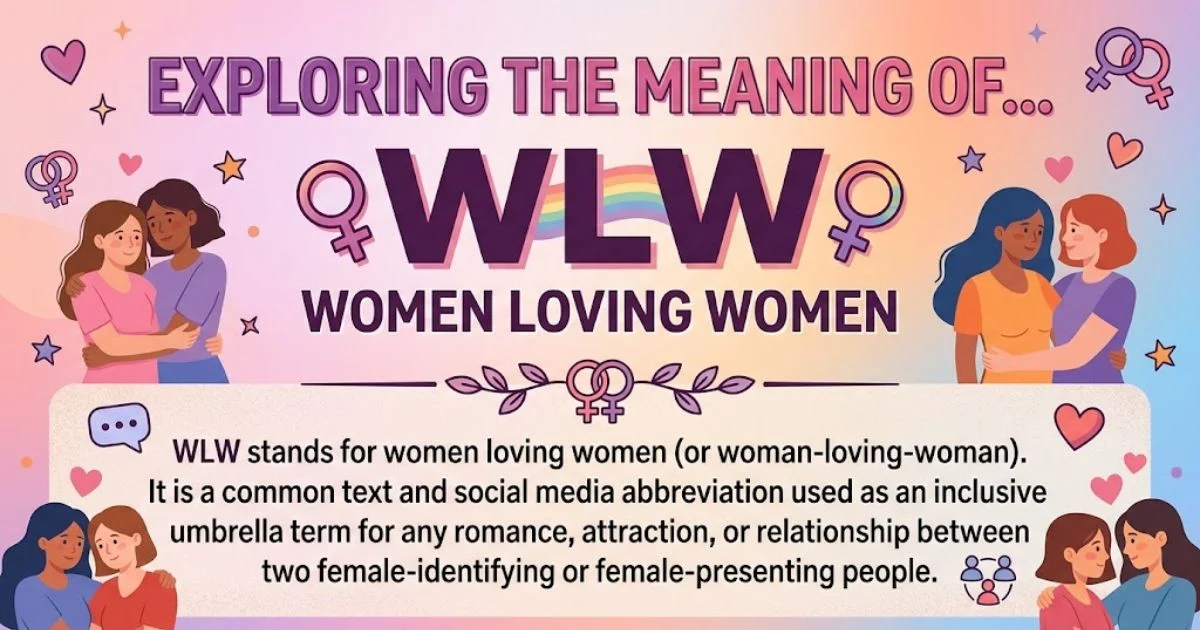
WLW stands for women loving women (or woman-loving-woman). It is a common text and social media abbreviation used as an inclusive umbrella term for any romance, attraction, or relationship between two female-identifying or female-presenting people.
You’re texting someone when they suddenly reply with “WLW,” leaving you unsure what those three letters mean. WLW means in text usually refers to “women loving women,” a term describing women who are romantically or emotionally attracted to other women. It is commonly used in texts, social media posts, dating conversations, and online communities.
If you were confused by the abbreviation, that’s completely understandable. Short forms can have different meanings depending on the conversation, so context matters.
In this article, you’ll learn what WLW means, how people use it in messages, what the abbreviation refers to, and how it differs from related terms such as lesbian and sapphic.
You’ll also see simple examples that make the meaning clear. Let’s look at the common uses of WLW and when you may see it online.
Read Also : SS Meaning In Text: What Does SS Really Mean?
What Does WLW Mean?
WLW means “women loving women.” It is a broad term used for women who feel romantic or sexual attraction toward other women. You may see it in texts, social media bios, dating profiles, hashtags, and online conversations.
WLW is an umbrella term, so it does not describe only one identity. It can include lesbians, bisexual women, pansexual women, and other women who are attracted to women.
For example:
- “I’m looking for more WLW movies to watch.”
- “She joined a WLW community online.”
- “This dating app has a great WLW section.”
The meaning is usually clear from the surrounding conversation. Now that the basic meaning is clear, let’s look at the full form and why people use this abbreviation.
WLW Full Form Explained
The full form of WLW is “Women Loving Women.” It describes attraction between women without requiring someone to use a specific sexual orientation label.
The phrase is useful because people have different identities and may not want to describe themselves only as lesbian, bisexual, or another label. WLW can therefore be a wider and more flexible term.
| Term | General meaning |
| WLW | Women who are attracted to women |
| Lesbian | A woman who is primarily attracted to women |
| Sapphic | A broader term connected with women’s attraction to women |
| Bisexual | A person attracted to more than one gender |
These terms can overlap, but they are not interchangeable in every situation. A person may choose the label that best fits their own identity and experience.
How To Use Wlw Real Examples
People commonly use WLW when talking about relationships, dating, entertainment, friendships, or online communities involving women who are attracted to women. It is often used as a quick and inclusive abbreviation.
Here are some natural examples:
- “Do you know any good WLW shows?”
The person is asking for shows featuring women-loving-women relationships or characters. - “I found a cool WLW community on Reddit.”
This refers to an online community centered around women attracted to women. - “That movie has strong WLW themes.”
The movie includes important romantic or emotional relationships between women. - “I’m looking for WLW dating advice.”
The person wants relationship advice relevant to women dating women.
WLW can appear as a noun, adjective, or descriptive term depending on the sentence. The exact meaning still depends on context, especially when it appears in a short message.
Wlw On Different Platforms (2026)
In 2026, WLW is commonly seen across social media and messaging platforms. The basic meaning stays the same, but people may use it differently depending on the platform.
You might find WLW hashtags, captions, bios, videos, communities, or private messages. On some platforms, it may describe content, while on others it may identify a community or shared interest.
| Platform | Common WLW usage |
| Text conversations and group chats | |
| Snapchat | Stories, messages, and profiles |
| TikTok | Videos, hashtags, and community content |
| Bios, captions, Reels, and hashtags |
The abbreviation itself does not change from one platform to another. The surrounding post or conversation tells you how it is being used.
On WhatsApp
On WhatsApp, WLW is usually used in private chats, group conversations, or status updates. Someone might use it while discussing dating, relationships, movies, or communities focused on women-loving-women experiences.
For example:
“Do you know any good WLW movies?”
Here, WLW describes movies featuring romantic or emotional relationships between women.
Another example is:
“My friend recommended a WLW group.”
In this case, the abbreviation describes the focus of the group. If someone sends only “WLW,” however, you may need to ask for context before assuming exactly what they mean.
On Snapchat
On Snapchat, WLW may appear in chats, usernames, profiles, or Stories. Users can also use it when sharing content about relationships, dating, or LGBTQ+ topics.
For example:
“That Snap was so WLW-coded.”
The phrase “WLW-coded” is informal. It usually means the content strongly suggests or relates to women-loving-women themes.
Because Snapchat messages can be short and casual, context is especially important. If the meaning is unclear, a simple question can prevent a misunderstanding.
On TikTok
On TikTok, WLW is often connected with videos, captions, hashtags, creators, and online communities. You may see phrases such as WLW TikTok, WLW dating, or WLW relationships.
For example:
“I keep getting WLW videos on my For You page.”
This means the person’s feed contains videos related to women-loving-women topics.
TikTok users may also use WLW when discussing fictional couples, dating experiences, LGBTQ+ culture, or relationship advice. The term can describe either the people involved or the type of content being shared.
On Instagram
On Instagram, WLW can appear in bios, captions, comments, Reels, and hashtags. Someone might use it to describe their interests, community, relationships, or the type of content they create.
For example:
“Her page has lots of WLW book recommendations.”
Here, WLW tells you that the recommendations focus on stories involving women-loving-women relationships or characters.
You may also see related terms such as sapphic, lesbian, and LGBTQ+. These words have related meanings but should not automatically be treated as exact synonyms.
Is Wlw Rude Or Offensive?
WLW is generally not considered rude or offensive. It is a widely used, neutral abbreviation for women loving women and is often used in LGBTQ+ communities and broader online discussions.
Still, the way you use the term matters. Avoid using WLW to label a person if you do not know whether they are comfortable with that description.
It is also important to remember that WLW is not automatically someone’s personal identity label. A woman may identify as lesbian, bisexual, pansexual, queer, or use no label at all.
If you’re unsure, respectful language and context are the safest approach. That also makes it easier to respond naturally when someone uses WLW in a message.
How To Reply To Wlw
How you reply to WLW depends on what the other person means. If they use it in a clear sentence, respond to the topic rather than focusing only on the abbreviation.
For example:
- If they ask about WLW movies: “Sure! I can recommend a few.”
- If they mention a WLW community: “That sounds interesting. What is it about?”
- If they say they enjoy WLW stories: “Nice! What’s your favorite one?”
- If they simply send “WLW”: “Do you mean women loving women?”
If the conversation is personal, be respectful and avoid making assumptions about someone’s identity or relationships. A short, friendly question is often the best response when the meaning is unclear.
Once you understand that WLW means “women loving women,” most uses become easy to understand from context.
Wlw Alternatives And Similar Slang
WLW is one of several terms used to describe attraction between women. Some alternatives overlap in meaning, while others have a slightly different focus.
- Sapphic: A broad term connected with attraction between women.
- Lesbian: A sexual orientation describing women who are attracted to women.
- Queer: A broader identity term that some people use for themselves.
- WLW: The same abbreviation as WLW, sometimes written with different capitalization.
- Women-loving-women: The full phrase behind WLW.
These terms are not perfect substitutes in every situation. A person may prefer one label over another, so it is best not to assume someone’s identity based only on the language they use.
Why Is Wlw Used Instead Of Lesbian?
People use WLW instead of lesbian because it is broader and does not require a specific sexual-orientation label. The term can include women with different identities who experience attraction toward women.
For example, a bisexual woman may describe herself as WLW when discussing her attraction to women. Someone else may prefer the term sapphic or lesbian instead.
WLW can also be useful when discussing media, dating, books, or communities without focusing on one particular identity. That flexibility is one reason the abbreviation appears so often online.
The History of WLW
The idea behind women loving women is much older than the abbreviation itself. Women have formed romantic and emotional relationships with other women throughout history, while language for describing those relationships has changed over time.
The modern abbreviation WLW became especially common in online LGBTQ+ spaces, social media, fandom communities, and dating discussions. Short terms like WLW are convenient because they communicate a broad idea quickly.
Today, the term can describe people, relationships, fictional characters, entertainment, or online communities. Its meaning has stayed fairly consistent even as its use has expanded across digital platforms.
How Wlw Is Used In Text Messages
In text messages, WLW usually means women loving women. People may use it when talking about dating, relationships, celebrities, fictional characters, or LGBTQ+ content.
For example:
“Do you know any good WLW shows?”
This means the person wants recommendations for shows involving women-loving-women relationships or themes.
Another example is:
“She sent me a WLW book recommendation.”
Here, WLW describes the type of book being recommended. If someone sends only “WLW” without any context, it is reasonable to ask what they mean.
Wlw Meaning In Dating Apps
On dating apps, WLW usually refers to women who are attracted to women or to dating and relationship spaces focused on women. It may appear in profiles, filters, community descriptions, or conversations.
Someone might write:
“Looking for WLW connections.”
This generally signals interest in meeting or connecting with women who are attracted to women.
The term can be useful because it is broader than a single identity label. However, profiles should still be read carefully because people may describe their identity and dating preferences in different ways.
Common Contexts Where WLW Appears
WLW appears in many online and everyday conversations. Its meaning usually stays the same, but the subject around it can change.
You may see WLW when people discuss:
- Relationships and dating
- Books and novels
- Movies and films
- Television shows
- Online communities
- Social media posts and hashtags
- Fictional characters and couples
- LGBTQ+ representation
Looking at the words around WLW is often enough to understand what the person is talking about.
Relationships
In relationship discussions, WLW often refers to romantic or emotional relationships between women. People may use it when talking about dating experiences, communication, attraction, or relationship advice.
For example:
“I’m looking for WLW relationship advice.”
The person is asking for advice that relates to relationships between women.
WLW can describe many different relationship experiences. It does not automatically tell you how someone identifies, so personal labels should not be assumed from the abbreviation alone.
Books
In the book community, WLW often describes novels, short stories, or characters featuring romantic or emotional relationships between women.
You might see:
“Can anyone recommend a good WLW romance?”
This means the reader wants a romance story centered on women loving women.
The term can also appear in book reviews, reading lists, social media posts, and recommendation groups. It helps readers quickly identify the type of relationship or representation featured in a story.
Movies
For movies, WLW commonly refers to films that include women-loving-women relationships, characters, or storylines.
For example:
“I need some good WLW movies for the weekend.”
The person is asking for films with relevant romantic or LGBTQ+ themes.
The term does not necessarily mean that the entire movie focuses on romance. It can also describe a movie where a WLW relationship is one important part of the story.
Television
On television and streaming platforms, WLW is often used when discussing characters, couples, or storylines involving women attracted to women.
A viewer might say:
“This show has one of my favorite WLW couples.”
That means the person is referring to a romantic couple made up of women.
Fans may also use WLW when sharing recommendations, discussing character relationships, or talking about LGBTQ+ representation in a series. Context usually makes the intended meaning clear.
Online Communities
Online communities use WLW as a simple way to identify discussions, content, and spaces centered on women-loving-women experiences.
You may encounter the term on social media, forums, messaging groups, fandom spaces, and community pages. It can appear in hashtags, group descriptions, usernames, posts, and comments.
For example:
“I found a supportive WLW community online.”
Here, WLW describes the community’s main focus.
Because online communities can have different rules and meanings, it is still wise to check the specific context before making assumptions.
Related Terms Similar to WLW
Several terms are closely related to WLW, but they do not all mean exactly the same thing. Understanding the difference can help you use each term correctly and avoid making assumptions about someone’s identity.
MLM
MLM commonly means “men loving men.” It is a broad term for men who are romantically or sexually attracted to other men.
Like WLW, MLM can include people with different sexual identities. It is often used in discussions about relationships, dating, books, movies, and LGBTQ+ representation.
LGBTQ+
LGBTQ+ is a broad umbrella term covering different sexual orientations and gender identities. The letters commonly refer to lesbian, gay, bisexual, transgender, and queer or questioning, while the “+” includes additional identities.
WLW is more specific because it focuses on women who are attracted to women.
Sapphic
Sapphic is a broad term connected with women who experience attraction toward women. It is often used when discussing romance, literature, art, or relationships.
Some people use sapphic as an identity term, while others use it simply to describe content or attraction. It can overlap with WLW but is not necessarily identical in every context.
Queer
Queer is a broad identity term that some LGBTQ+ people use to describe their sexuality, gender, or both. It does not specifically mean attraction between women.
Because queer is a personal identity label, it is best used for someone who uses the term for themselves rather than assuming it applies to them.
Lesbian
Lesbian generally describes a woman who is attracted to women. It is a specific sexual-orientation label rather than a broad category covering every woman who may experience attraction to women.
A lesbian can also describe herself as WLW, but someone who uses WLW does not necessarily identify as lesbian.
Bisexual
Bisexual generally refers to attraction to more than one gender. A bisexual woman may experience attraction to women and therefore may also be described within the broader WLW category.
However, WLW and bisexual are not synonyms. One describes attraction in a broad way, while the other is a specific sexual-orientation identity.
Is WLW Offensive?
WLW is generally not considered offensive. It is a neutral abbreviation commonly used to discuss women who are attracted to women, relationships, media, and online communities.
The important point is context. Using WLW to describe a movie, book, or community is different from assigning the term to a person who may not use it for themselves.
For respectful communication:
- Use someone’s preferred identity terms when you know them.
- Do not assume a person’s sexual orientation from their appearance or relationships.
- Use WLW as a broad description when it fits the context.
- Avoid treating WLW, lesbian, bisexual, and sapphic as exact synonyms.
When used thoughtfully, WLW is simply a convenient and inclusive term.
When Should You Use WLW?
You can use WLW when you need a broad term for women who are attracted to women or for content related to those experiences.
Common situations include:
- Dating: “I’m looking for WLW dating advice.”
- Books: “Do you have any WLW romance recommendations?”
- Movies: “That’s a great WLW movie.”
- Television: “The series has a popular WLW couple.”
- Online communities: “I joined a WLW discussion group.”
- Social media: “I found this through a WLW hashtag.”
The abbreviation works especially well when the exact identity of the people involved is not important. It keeps the conversation short while still giving readers useful context.
When Should You Avoid Using WLW?
You should avoid using WLW when it could wrongly label someone or when a more specific term is clearly preferred. Personal identity is not something to guess from an abbreviation, relationship, or social media post.
For example, if someone says they identify as lesbian, there is usually no reason to replace that label with WLW. Likewise, avoid calling someone’s relationship WLW if doing so could reveal or assume something personal about them.
You should also avoid using the term when the context is unclear. If someone simply writes “WLW” in a message and you are unsure what they mean, asking “What do you mean by WLW?” is better than guessing.
Used with context and respect, WLW is a simple way to discuss women-loving-women relationships and related topics.
Differences Between WLW and Lesbian
WLW and lesbian are related, but they are not the same term. WLW means “women loving women” and works as a broad description of attraction or relationships. Lesbian is a specific sexual orientation used by women who identify as being attracted to women.
A woman may identify as lesbian and also be described as WLW, but not every woman who fits the WLW description identifies as lesbian. For example, a bisexual woman who is attracted to women may use WLW when discussing her relationships or interests.
| Term | Meaning | How broad is it? |
| WLW | Women loving women | Broad |
| Lesbian | A woman attracted to women | More specific |
The key difference is that WLW describes a type of attraction or relationship, while lesbian is commonly used as an identity label. Understanding this distinction helps you use both terms respectfully.
Lesbian
Lesbian is a specific sexual-orientation term generally used by women who experience romantic or sexual attraction toward women. It is also a personal identity that someone may choose to use for themselves.
For example, someone might say:
“I’m a lesbian.”
That statement directly describes their identity. In contrast, saying a movie has a WLW storyline focuses on the content rather than assigning an identity to every person involved.
The terms can overlap, but they should not be treated as interchangeable. A person’s preferred label always matters more than an outside assumption.
WLW
WLW stands for “women loving women.” It is commonly used as an umbrella term for discussions involving women who are attracted to women, including relationships, dating, entertainment, literature, and online communities.
For example:
“I’m looking for more WLW romance books.”
Here, WLW describes the type of romantic content the reader wants. It does not tell you that every person represented in those books uses the same identity label.
This flexibility makes WLW useful in casual conversations and online searches where a broad description is more appropriate than a specific identity.
Why Wlw Matters In Modern Communication
WLW matters because it gives people a short, flexible way to discuss women-loving-women experiences without forcing a specific identity label. It is especially useful in online communication, where people often use abbreviations to express ideas quickly.
You may see WLW in social media captions, dating profiles, book recommendations, movie discussions, community names, and text messages. It also makes it easier to describe a topic without assuming how every individual involved identifies.
The term can be helpful when discussing LGBTQ+ representation, relationships, dating, media, and online communities. At the same time, respectful communication means recognizing that people have different identities and may prefer different labels.
Popular Phrases Using WLW
WLW appears in many everyday online phrases. These expressions usually describe content, relationships, communities, or interests connected with women loving women.
Some common examples include:
- WLW dating — dating or relationships involving women attracted to women.
- WLW relationship — a romantic relationship between women.
- WLW romance — romantic stories or content featuring women-loving-women relationships.
- WLW books — books featuring relevant characters, relationships, or themes.
- WLW movies — films featuring women-loving-women storylines or characters.
- WLW shows — television or streaming content with relevant representation.
- WLW community — an online or offline community focused on women-loving-women experiences.
- WLW couple — a phrase commonly used for a romantic couple consisting of women.
- WLW content — general media or online material related to women-loving-women experiences.
- WLW recommendations — suggestions for books, movies, shows, or other relevant content.
The exact meaning can change slightly depending on the sentence. When in doubt, look at the surrounding words rather than assuming WLW refers to a person’s specific identity.
Conclusion
WLW mean in text refers to “women loving women,” a broad term used for attraction, relationships, and related content involving women. Knowing this meaning makes texts, social media posts, dating profiles, and online discussions much easier to understand.
We covered its meaning, full form, real examples, platform-specific usage, replies, related terms, and the difference between WLW and lesbian. The key point is that WLW is a broad description, while labels such as lesbian or bisexual can describe a person’s specific identity.
With this context, you can recognize WLW more confidently and understand how it fits into everyday online conversations. You’ll now be better prepared to use or interpret the term respectfully whenever you come across it.
FAQs About WLW Mean In Text
1. What Does WLW Mean In Text Slang?
WLW in text slang usually means “Women Loving Women.” It is commonly used to describe women who are romantically or sexually attracted to other women.
For example, someone might text, “I love WLW romance movies.” Here, WLW describes the type of relationship or content being discussed.
2. What Does WLW Mean On Instagram?
On Instagram, WLW usually means “Women Loving Women.” You may see it in bios, captions, comments, hashtags, Reels, and posts about relationships or LGBTQ+ representation.
For example, “WLW couple goals” refers to a romantic relationship between women. The meaning remains the same, although the context can vary.
3. What Is A WLW Relationship?
A WLW relationship is a romantic or sexual relationship involving women who are attracted to women. The term is broad and does not automatically mean that both people identify as lesbian.
For instance, a relationship between two women who identify as lesbian may be described as WLW. A relationship involving a bisexual woman can also fall under the broader WLW category.
4. What Is The Meaning Of WLW In Chat?
In chat, WLW generally means “Women Loving Women.” People may use it while talking about dating, attraction, relationships, books, movies, TV shows, or online communities.
If someone sends only “WLW” without context, asking what they mean is better than making an assumption.
5. Is WLW The Same As Lesbian?
No, WLW and lesbian are not exactly the same. WLW is a broader description of women attracted to women, while lesbian is a specific sexual-orientation identity.
A lesbian may be described as WLW, but someone who uses WLW does not necessarily identify as lesbian.
6. What Does WLW Stand For In Dating?
In dating conversations, WLW usually refers to women who are interested in or attracted to women. On dating apps, phrases such as “WLW dating” or “WLW only” can indicate interest in women-loving-women connections.
Hi, I am James Whitman, the author of Skypunz.com. I create funny puns and jokes to make your day brighter and bring a smile to every reader.